
We live in a time of gross lies in our public sphere. Many of the lies we tell these days involve phantom ills: racism or sexism or various “phobias” that must be exaggerated. Might these false and exaggerated fears be stand-ins for the real ills that we have suffered, but which we have not been able to mourn?
 It’s a good thing the kids weren’t with me. For one thing, they can’t take it when I spend too much time talking to friends after Mass or after any other party. They would never have made it for this one. The shopkeeper is closing up business after several decades and I wanted to take advantage of the going-out-of-business sale being offered. I knew that what should take fifteen minutes would probably end up being an hour. But I didn’t care, for I like the shopkeeper.
She knows her wares and she explains why one should get this rather than that, whether this frill or that bauble is worth the extra money, and why product x is aesthetically pleasing while product y will just not work. She is, in short, the consummate professional.
And yet she is always personal. This is the other reason it’s a good thing the kids weren’t there. All the professional stuff could be, as I already said, taken care of in a quarter of the time. The other part of the time is spent in quizzing me about what I’ve been doing since the last time I did business with her. My kids would have rolled their eyes and then later huffily asked me why she was “butting in” to my life. They would also have asked why she was “oversharing.” After all, it wasn’t an interrogation; she was also telling me about her recent doings as well as reminiscing about many older ones. Given the shop’s closure coming up, there was even more reminiscing than usual.
A vacation to Seattle in 1972, time spent living in the Black Hills, trips to sunnier locales further south. Great times she had with her now-adult son on these trips. Figuring out where to send him to school when he was young. Great times she had with him in ordinary life. Private jokes they still engage in when they talk or text. I love hearing it all.
It’s not just that I’m always on the qui vive for material to write about (though here we are), but I’ve always loved this kind of connection. We were wearing the masks required by the controlling owner of the shop, but they got pulled down a bit to see each other’s faces. After 18 months of Covid insanity and the near-destruction of this kind of ordinary social discourse, I might have sat there gossiping forever, so delightful it was to experience something so close to times BC (Before Covid).
But as the minutes went by and the reminiscing continued, a note of sadness crept in. It was talking about that son of hers and his father. I don’t remember exactly what she was talking about at the time. It had to do with negotiations with that father of her son, but all of a sudden she pointed to her ears and her neck. “That’s why I’ve got these,” she said, making me look more closely at the skull earrings and the skeleton hanging as if in a noose around his neck on a chain around hers.
I had glanced at the macabre jewelry before and merely thought she was one of those people for whom Halloween is very important. Now, however, I was a bit confused. She noticed and explained: today, she observed, was her 46th wedding anniversary. Or, rather, it would have been. “We’ve been divorced for 25 years now—we were married nearly 21 years.”
Now the macabre note made a sort of sense. The death’s heads and the hanging skeleton represented either her husband or the marriage itself. I’m guessing it was a bit of both. I said what I thought and think was the appropriate thing: “I’m so sorry.”
She brushed it off, “Oh, don’t be. It should have ended ten years before that!”
To which I responded that I was still sorry. She brushed it off again, a bit more hesitantly this time. But she kept talking a bit longer about that husband of hers, the father of her son. We passed on to other things before I left, but that conversation stuck in my head and heart.
We live in a time of gross lies in our public sphere. Public officials and corporate masters demand that we accept that a man who says he is a woman must be believed and affirmed, despite the fact that there is no shared definition of “woman” that applies to this man and the woman to whom I am married and with whom I have seven children. Similarly, we are told that there are no problems at our southern border even though footage taken by journalists and testimony taken by those who have worked at it all corroborates a true catastrophe. We are told that ours is a thoroughly racist society in which black people are at constant risk of being attacked, yet case after case of “hate crimes” yields the result that many such “crimes” (quite often scrawled racist messages or notes left on cars or doors) are done by other black people, eager to seize the mantle of victim of racism and yet incapable due to the supply not being able to keep up with the demand. We are told that healthcare is a human right that is inalienable, but that those who have not received one of the vaccinations purported to protect one from COVID-19 should be denied organ transplants or hospital beds. The list goes on and on.
How have we gotten to the point that so many in our country are willing to tell such lies and so many others believe them? Especially when the evidence is in front of people’s eyes. I think the key is found in my conversation with the shopkeeper.
We have for many years in our country been forcing people to repeat lies about their own experiences in order to help them “move on” and shuck off guilt and shame. The shopkeeper is not the first to tell me that I should not be sorry that a divorce has taken place. I expected the demurral at my condolence even as I offered it. People are not allowed, it would seem, to express sorrow at the ending of a functioning marriage. “It’s ok! It’s a good thing! We’re all better off! It should have happened years before! I’m so much happier!”
And yet, I sat before a woman wearing the symbols of death to mark the anniversary of a marriage that had ended a quarter century before. Forgive me, honest shopkeeper, if I do not now believe you.
There are other aspects of this lying. Children of divorce are expected to repeat these chipper untruths about their supposedly new and better state wherein dad or mom is no longer part of their households. Children of single mothers are expected to say that the lack of a dad means nothing to them. Parents and society are expected never to say words like “disability” about children who have mental, physical, or emotional problems lest such negativity burden the child.
Americans are an optimistic people. We like to look on the bright side of things. And yet, this optimism, when misapplied, forces us to smile when we might better cry or be angry. It forces us not just to put the best face on situations that are objectively bad but to deny that they are objectively bad. We pass the graveyards in which our hopes for our marriages and those of our parents, the dreams for our children’s futures, seem buried. And we are forced to say that nothing is wrong.
I do not mean to say that a broken marriage or a missing father or a child with deficits is a thing that should bring on a never-ending Lent in this life. We need not spend the rest of our lives in an Eeyore-like mood. But can we allow people to express their sorrow over things that are truly sad? Can we say that the husband or wife who has left us has hurt us? Can we say that our own parents’ divorce has left us at a disadvantage? Can we say that it is difficult to raise a child who has needs that go beyond those of most children?
Many, though not all, of the lies we tell these days involve phantom ills: racism or sexism or various “phobias” that must be exaggerated; the dangers of COVID-19 to children, even though the old-fashioned flu was much more dangerous to them; the end of the earth because of carbon emissions. Might these false and exaggerated fears be stand-ins for the real ills that we have suffered, but which we have not been able to mourn? The lies we have told ourselves in order to free us from real pain seem to have put us in a bind. We must express our pain, but we are not allowed to do so. We go on our merry way, forced to cry out, at specters if we must, and wear skeletons to mark our days.
The Imaginative Conservative applies the principle of appreciation to the discussion of culture and politics—we approach dialogue with magnanimity rather than with mere civility. Will you help us remain a refreshing oasis in the increasingly contentious arena of modern discourse? Please consider donating now.
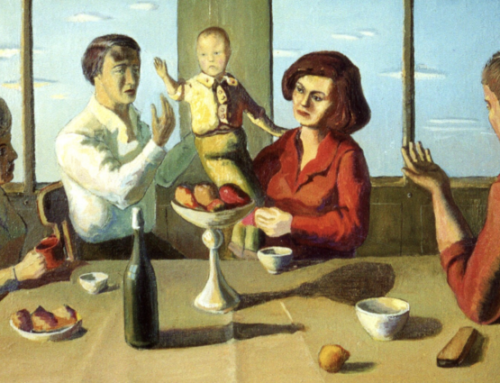
The featured image, uploaded by Vladimir Menkov, is licensed under the Creative Commons Attribution-Share Alike 2.5 Generic, 2.0 Generic and 1.0 Generic license, courtesy of of Wikimedia Commons.




In my country Croatia in Europe only 50 years ago we did not understand at all what the word DIVORCE means why women and men do it, and then it started and under our pretext it is better if people do not agree. Of course we learned everything through American movies, and began to consider it normal and inevitable in Catholic families as well, and today the horrible statistics in my extended family are 60% divorced, 20% those who will never get married, and only 20% percent of those who will stay together until death do so. The ideologues of the Frankfurt School of Philosophy were in no hurry, but their philosophy, the REVOLUTION, will never succeed unless we destroy the FAMILY is slowly coming true unfortunately.
Well said! In grief recovery work, one of the myths we bring out is “grieve alone”, because others are uncomfortable with our sadness, anger, etc. So we lie and say “I’m fine.”
This article is very beautifully written. Its tone is sincere and poetic while remaining un-pedantic (if indeed that’s an actual word). Thank you, David.
Dr. Deavel,
In this list of lies we tell ourselves, the following start to a key paragraph of the essay jumped out at me. “Americans are an optimistic people.”
This was certainly the case in our past, perhaps even just a few short years ago. But the culture has changed. That optimism is a part of the same facade you so eloquently described.
Alas, the national narcissism we have adopted dissuades true optimism, just as an individual narcissist is incapable of being truly optimistic. Optimism requires hope. And hope is dependent upon wanting something greater than who we are in the present. The selfish person, as well as the selfish nation, does not hope for better. Their pessimism Is driven by a conniving, manipulative mindset based upon the belief that there is an absence of possibility. Only through their own deception and manipulation are the able to get what they want.
Removing the veil of deception requires patience, wisdom, perseverance and faith. When we strive to build those marks of character within ourselves and with those around us, particularly our children, we will begin our journey back to what made our country optimistic and great.