
It is undoubtedly true that our first and primary loyalty is the love due to family rather than the state. Even if it brings death, the choice of love rather than power is the most heroic thing a human can choose.
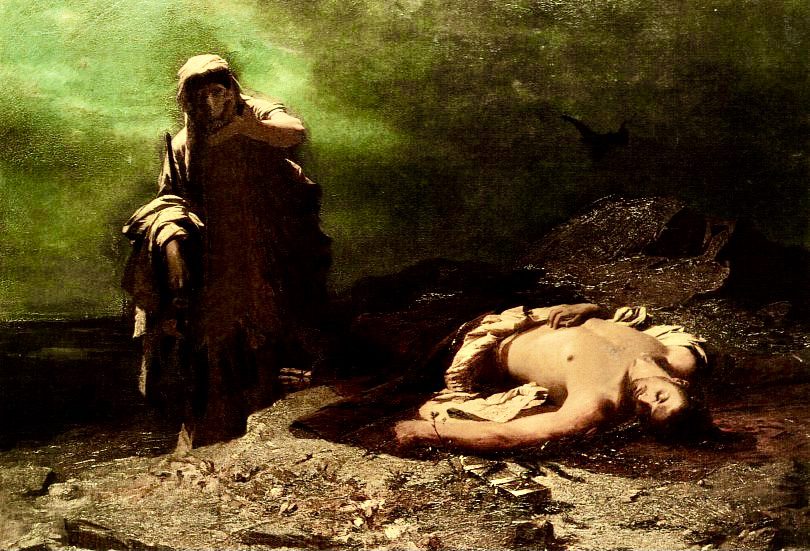 Aristotle in the Poetics defined the heart of tragedy as the imitation of admirable action. And among the Greek tragedians, Sophocles reigns supreme as the tragedian par excellence of Athens. As Matthew Santirocco wrote, “More than any other dramatist except perhaps Shakespeare, Sophocles is regarded as the quintessential tragedian.” If so, and if Aristotle is right that the essence of tragedy is a teaching in admirable action, what is the admirable action that Antigone undertakes in her eponymous tragedy which ends in her death?
Antigone, as we know, follows its titular protagonist as she struggles against divided loyalties. Antigone’s brothers, Eteocles and Polyneices, have both recently been killed in civil war. Creon, honoring Etocles’s patriotism, decides to honor his death at the exclusion of the treacherous Polyneices. Filial love is tested in Etocles’s and Polyneices’s death. The state, led by Creon, honors one brother while shunning the other; Antigone is caught between the love due to family members and the loyalty demanded by the state.
Sophocles, though a dramatist, was also a political theorist—or at least he certainly had much to say about politics.
The greatest of the tragedians, Sophocles sang in a chorus celebrating the Greek victory at Salamis over the Persians in 480 B.C. By the time of his death, Greece was at war with itself as the final campaigns of the Peloponnesian War were undertaken in 406 B.C. Sophocles’s life spanned the golden age of Athens, its rise and fall, the sudden and spectacular emergence of Greece and its slip into decadence and downfall which would lead to the Hellenic city-states being overrun by Macedon in the next century.
Antigone, as far as we know, was written a decade before the outbreak of the Peloponnesian War. It was, therefore, written in a time of great political energy and transformation. The rise of the polis was now capturing the hearts and minds of the Greeks, especially the Athenians, who were moving away from the filial loyalties of the past toward the new collective citizenry offered in the emergent city-state democracies of the fifth century B.C. When one reads Plato and Aristotle, one might be struck by the limited discussion placed on clan, family, and tribe; unlike Near Eastern political theologies and cosmogonies which stressed such lineages, the great political philosophers of Greece emphasize the state and collective citizenship as the highest goods in political life (Aristotle, though, leaves more room for the family and property than does Plato but nevertheless exalts the importance of the state and citizenship above filial piety and devotion).
In this context of political and filial transformation, Sophocles wrote his many plays (of which only seven have survived to posterity). In Antigone, we see this tension between the old ways and the new and all-powerful state take center stage. Where will Antigone’s heart be devoted?
The essence of Antigone is the struggle of the heart, of love; the battle between remaining loyal to the decrees of Creon (the state) and the demands of filial piety and burial (Polyneices). Antigone initially tries to find solace and comfort in the presence of her sister, Ismene, which hints at Antigone’s predisposed disposition. She is an intimately filial individual seen through her want of affection from her sister. As Antigone says to Ismene when seeking her support in burying Polyneices against Creon’s decree, “He is my brother still, and yours; though you would have it otherwise, but I shall not abandon him.”
In declaring that Antigone will not abandoning Polyneices, Sophocles reveals to us in the opening moments of the play what the admirable action will be: Antigone’s devoted heart to her brother. Against Antigone’s devotion to her brother, Creon vocally declares the new political order at hand in Greece and the world: “I find intolerable the man who puts his country second to his friends. For instance, if I saw ruin and danger heading for the state, I would speak out. Never could I make my country’s enemy my private friend, knowing as I do, she is the good ship that bears us safe.”
Creon’s role in the play is to serve as the mouthpiece of the new political zeitgeist. The state demands all loyalty; devotion to friends and family, as Creon says, cannot coexist with the demand of loyalty to the state which “bears us safe.” It is even implied in Creon’s statement that intense love for friends and family threatens the state. It is imperative, then, for the state to break those bonds and that is precisely what Creon sets out to achieve in his combative confrontation with Antigone.
Antigone defies Creon’s order and ventures out the bury the body of Polyneices. She is discovered and accused by sentries as defying the laws of the state. Creon confronts her, “Come, girl, you with downcast eyes, did you or did you not, do this deed?” Antigone admits her actions, “I did. I deny not a thing.”
Antigone and Creon argue over the morality/immorality of the state’s decree. In the preceding chorus, the chorus had extoled the “rule of law” through Creon’s dictatorial fiat. Fiat declaration is seemingly implied as the rule of law, even if it is arbitrarily enacted. In contrast to Creon’s statism, Antigone defends the tradition of filial piety and the due reverence of burial rites (something very sacred to the Greeks). The agon, the conflict, is now fully brewing; the storm has been unleashed and is crashing down upon us as we witness this struggle of supremacy between the state (Creon) and filial devotion (Antigone). Antigone is condemned to die.
The conflict between state loyalty and filial loyalty is exacerbated with the entry of Haemon into the play. Haemon is the son of Creon and betrothed to Antigone whom he deeply loves. Initially it seems as if Haemon will cut Antigone loose, abandon her to her fate, and abide in loyalty to his father’s—the state’s—decision in condemning Antigone. However, Haemon begins to gently prod his father’s hardened heart. He attempts to get Creon to spare Antigone. Father and son now erupt in vitriolic conflict toward each other.
Creon’s outlook is fully revealed to us when he speaks to his son, “But as for anarchy, there is no greater curse than anarchy. It topples cities down, it crumbles homes, it shatters allied ranks in broken flight that disciple kept whole: For discipline preserves and orders well. Let us then defend authority and not be ousted by a girl.” Here is the fullest maturation of Creon’s disposition. He considers it his duty as king to defend the authority and order placed upon him by virtue of his rule. Furthermore, as Friedrich Hölderlin brought out in his translation, there also seems to be intergender tensions between Creon and Antigone; by law Haemon’s marriage to Antigone will deprive Creon of an heir for the continuation of his bloodline’s rule as Oedipus’s bloodline is restored through the marriage of Haemon and Antigone. Yet Haemon says something wise in rebuke of the growing tyranny of his father. When Creon asserts that he, and he alone (not the mob) rules the state, Haemon rebuts by saying that singular rule is a cruel parody of the polis, “A one man state is no state at all.” Creon snaps back, “The state is he who rules it.”
Thus we see that Creon’s motives are rooted in power. Antigone’s motives are rooted in love. Sophocles plays this tension between power and love magnificently and poignantly. Like many greater thinkers after him, Sophocles seems to assert that power and love cannot coexist; that either power eviscerates love or love forsakes power. And power eviscerating the bonds of love is patently clear in Creon’s case. Love forsaking power is also where the arc of Antigone’s and Haemon’s destinies move us to.
Creon against Antigone and Creon against Haemon reveals the corrosive and acidic power that statism brings into relationships. Creon, as Antigone’s uncle, loses his relationship with his niece because of the quarrel. Creon, as Haemon’s father, also loses his relationship with his son because of their infighting. Creon’s headstrong rule destroys the very fabric which had given his life meaning.
Let us return, briefly, to the question as to why Antigone is a heroine. Although a descendant of noble blood, Antigone as a woman of royal lineage in the confines of royal expectations is very much at the mercy of the political powers that be. If her father were still alive, she would likely be utilized as political capital for Oedipus’s political designs. Though Oedipus is gone, she is still, in some sense, a pawn to Creon’s political machinations. Power, once again, deprives one of love.
Antigone’s heroism is found in her agency, an agency moved by love which compels her to defy her uncle, the King of Thebes, and draws her closer to her dead brother to bury his body with the funeral rites he deserves as a Greek and as sanctioned by the moral law of the gods. Antigone’s freedom is found in her choice to honor the natural law of filial devotion rather than the arbitrary decrees of the state embodied in the person of Creon. In defying the state, Antigone reveals the totality of freedom: freedom found only in love. Love breaks the power of the state which is why it is dangerous; Creon’s fear of “anarchy” masks what he truly fears: lack of devotion to the state. He would rather the people be subjects than citizens, slaves than lovers. Antigone’s heroic action is found in the supremacy of the heart refusing to be curtailed by the force of the state.
So too is Haemon’s freedom found in love instead of power. He breaks free of his father and chases after Antigone to declare his undying love for her. In Haemon’s love for Antigone, he too escapes the clutches of his father’s desires. Love, and love alone, Sophocles begins to reveal to us, sets us free.
But Antigone is a tragedy. Sophocles, as a Greek, did not have the mature revelation of love as a salvific force that was inherited by the West through the adoption of Christianity. The notion that “love wins” is thoroughly Christian, though we might say that love frees us is something undeniably found in Greek literature albeit with a tragic caveat.
Sophoclean love draws us to death, but it is a death that we face with dignity and liberty rather than degradation and enslavement. We are not slaves to death. We can stare death in the face with a dignity of soul unrivaled by other mortal creatures. Antigone’s lament crystalizes this reality for us:
Come tomb, my wedding chamber, come!
You sealed off habitations of the grave!
My many family dead, finished fetched
in final muster to Persephone.
I am last to come, and lost the most of all,
my life still in my hands.
And yet I come (I hope I come) toward a father’s love,
beloved by my mother,
And by you, my darling brother, loved.
Yes, all of you,
Whom these hands have washed, prepared and sped.
Antigone’s lament reveals the warmth and spirit of her heart. She is a woman free to make the choice of death by love. She accepts Creon’s criminalization of love and doesn’t flinch; she doesn’t forsake love for the false life offered in the body politic. She gives up her power as a noble princess to die having honored her brother and her familial bonds. In her love, Antigone is led away with dignity as Creon and his guards arrest her for her crime of love and take her a cavern cell as punishment.
Now let us return to Creon. Having just hauled away Antigone to die, Creon begins to suffer from guilt over his actions. Two of his nephews have been slain in civil war. He has just condemned his niece to death. And his son has deserted him over his strongarm tyrannical politics. Creon, a man who was once surrounded by friends and family, is isolated and alone despite the sublime power he wields.
The encounter with the blind prophet Tiresias is the return to Creon’s moral sensibilities, a return to the moral law of the gods whom Tiresias says are unhappy with Creon’s actions. The displeasure of the gods, the awakening of the moral law inside Creon, causea an abrupt change of heart in the tyrant’s disposition. When Creon exclaims, “My mind’s made up. I’ll not be slow to let her loose myself who locked her in the tomb. In the end it is the ancient codes—oh, my regrets!—that one must keep: To value life then one must value law.” The “ancients codes” and “life” and “law” that Creon speaks of is the love of family which he had scorned in his tyrannical pronouncements.
Alas, it is too late for Creon. He has learned the truth about the order of the world, the truth that had always been known to Antigone and chosen by Haemon in his rebuke of the tyranny of his father in favor of his love for Antigone. Creon rushes to free Antigone only to learn that she has committed suicide. Inside the cave, Creon sees Haemon lamenting over Antigone’s dead body.
The two come to blows as Haemon blames Creon for this sorrowful lot in life and attempts to stab him (the final dissolution of their relationship which moved from verbal sparring to physical violence); Creon manages to escape. Haemon, then, turns the blade on himself to die with Antigone than live alone. In a touching scene revealing the power of love and how it binds souls together, Sophocles writes of this unity in death: “And conscious still but failing, limply folded Antigone close into his arms—Choking blood in crimson jets upon her waxen face. Corpse wrapped in love with corpse he lies, married not in life but Hades: Lesson to the world that inhumane designs Wreak a havoc immeasurably inhumane.”
Moreover, Eurydice, Creon’s wife, also commits suicide upon hearing the news of Haemon’s death. Creon’s world has come crashing down over him. He may still be King of Thebes, but he has lost everything that is so precious, so dear, truly meaningful, in life. The lust for power which Creon had embodied only led to misery, death, and loneliness. The King of Thebes is now isolated, alienated, alone in the world.
Sophocles has shown us two alternative visions of life. The life of power leads to misery, death, and loneliness. The life of love, impetuous as it may be, leads to unity and relationships. Antigone retained a communion with Polyneices despite his death; Haemon retained a communion with Antigone despite her death. Antigone took Polyneices in her arms to bury him. Haemon took Antigone in his arms to die with her in love. Creon, meanwhile, loses everything.
While the choral ode concludes by asserting wisdom can be found in suffering, the suffering that Creon now embodies having lost his family, the play ends with a moment of moral instruction to the audience about what matters in life and what ancient codes and laws of life we are to follow. This returns us to Aristotle and his assertion that the heart of tragedy is the imitation of admirable action. If Aristotle is right that tragedy attempts to inspire admirable action from among its audience, what is the admirable action that Sophocles wanted to leave us with in Antigone, one of the grandest and most poignant tragedies of the Athenian literary tradition?
It is undoubtedly true that our first and primary loyalty is the love due to family rather than the state. Even if it brings death, the choice of love rather than power is the most heroic thing a human can choose. In choosing love over power we are truly free and can meet death with dignity and a spirit of inspiration that will live on forever.
The Imaginative Conservative applies the principle of appreciation to the discussion of culture and politics—we approach dialogue with magnanimity rather than with mere civility. Will you help us remain a refreshing oasis in the increasingly contentious arena of modern discourse? Please consider donating now.
The featured image is “Antigone in front of the dead Polynices” (1865) by Nikiforos Lytras, and is in the public domain, courtesy of Wikimedia Commons. It has been brightened for clarity.


The author, in my humble esitmation, misses the point of greater import in his comments here about Antigone. The conflict is not between loyalty to the family v. the State, but rather loyalty to the higher law of the gods v. loyalty to the State. Could Mr. Krause’s interpretaion be more related to a political agenda?
Antigone’s struggle is exactly what ours is today, that is, do we give our total allegiance to the fickle, finite and fashionable dictates of the State, or ideology, or do we give it to the only One worthy of such allegiance, our God. And, of course, the consequences for doing so are just as harrowing and difficult and life endangering as Antigone’s.
Mr. Krause is not wrong in his assessment as it is. I just think he has not seen and dealt with this more transcendent interpretation of Sophocles’s great Tragedy, Antigone. Antigone, for me, is a great metaphor for our own times. The “world” (politics/social media/secularism) has taken on more importance than the One who is its Creator, Source and Goal. Like Antigone, our struggle is to confront the realities of our own submission to worldly things, rather than paying attention to and honoring the higher Law that is the only source of happiness that we all desire.