
A radical polarization is going on in our own day. Knowing better, people interpret others as short-sighted and selfish, demonize their affiliations, and tar them with imputed evil. The hard question facing us is a political one: how long will we be able to sustain our constitutional forms? The still harder question, though, is what it means to follow Christ’s law of love.
 Another election is coming up, which means that accusations, distortions, and misunderstandings, often deliberate ones, dominate the public discourse. It’s easy to get sour when you see your own reasonable opinion distorted and misrepresented. But it helps to put our polarized situation into context. A book I have recently been reading about Atlanta in the Civil War unexpectedly sheds some light upon our contemporary scene. In a section of Bonfire: The Siege and Burning of Atlanta, Mark Wortman shows how the fever for secession came to Atlanta.
As his epigraph to these chapters, Wortman quotes a famous passage from Thucydides’ History of the Peloponnesian War, which our freshmen at Wyoming Catholic College read in the spring semester. So radical was the hatred between the common people and the rich oligarchs in Corcyra early in the Peloponnesian War that “Words had to change their ordinary meaning and to take that which was now given them. Reckless audacity came to be considered the courage of a loyal supporter; prudent hesitation, specious cowardice; moderation was held to be a cloak for unmanliness; ability to see all sides of a question incapacity to act on any. Frantic violence became the attribute of manliness.” In such circumstances, the word “good” signifies whatever serves one’s own interests. In Atlanta in 1860 and 1861, there were many people—indeed, even many slaveholders—who understood themselves as part of the Union, enjoying the American heritage of George Washington and the Founding Fathers. Their reluctance to join the secessionist movement put them increasingly at odds with the vehement majority around them. In time, merely to survive, they fell silent or converted to the secessionist cause. Any hint of an unacceptable opinion could bring physical harm or financial ruin.
A similar radical polarization is going on in our own day. In local communities, among old friends, and within families, occasions for deliberate misunderstanding proliferate. Knowing better, people interpret others as short-sighted and selfish, irrationally committed to ideas they have absorbed wholesale from propaganda. Soon it becomes easy not to listen to them, easy to avoid them or perhaps to reject them altogether, to demonize their affiliations and tar them with imputed evil.
“Reason” in such circumstances becomes what Thomas Hobbes calls it: the slave of the passions. Stepping back, being able to look at situations objectively, would allow true causes and true intentions to emerge—but who can achieve objectivity when disagreements go so deep? Those who try to exercise true reason, sweet reason, in these circumstances find themselves scorned as weak, whereupon pride might sour them to rage and hardening of the heart. It is almost a truism that the abortion issue is now what slavery was in 1861. Participants on different sides at public demonstrations have nothing in common, as they are often told, because there can be no fruitful conversation when assumptions about property and human life are so radically different.
For the whole range of abortion advocates, from socialist to libertarian, the body is private property in its most concentrated form. Women can participate in any sexual activity they choose because they own their bodies, but an unexpected baby is a criminal trespasser. They want the right to stand their ground and kill the intruder. By contrast, those who oppose abortion understand bodily existence as given, and they believe that life should be governed by openness to the will of God. It’s easy to stand back and congratulate ourselves for having the right opinions, like the Pharisee who compares himself to the tax collector, but nothing here is simple. Every real situation has more complications and complexities than we want to admit. Most women who have abortions do so, not out of self-affirming ideology, but out of desperation. They have been pressed by circumstances into terrible choices, and at the crucial moment, they have no hope that the life within them will not bear them both into a living hell. And yet the people and places that can and do offer real hope of aid, real alternatives, have been attacked as though they existed merely to deny women their property rights.
In his book about Lincoln and the Civil War, Harry Jaffa writes that “people intoxicated with their own supremacy” come to see constitutional forms as “barriers to their rights.” In short, they “tend to identify these rights with their passions and to oppose obstacles as if they were obstacles to their rights.” The hard question facing us is a political one: how long will we be able to sustain our constitutional forms? The still harder question, though, is what it means to follow Christ’s law of love. St. Charles Borromeo, whose Memorial is today, reminds us to “bear with the defects of others at home and elsewhere, as you wish others to bear with you.” Even more to the point, he writes, “Do not be easily willing to judge your neighbor, especially his intention, but keep your eyes on your own sins and defects.” One might think we could get there on our own, but this is the sweet reason God had to die to bring us.
Republished with gracious permission from the Wyoming Catholic College Weekly Bulletin (April 2018).
The Imaginative Conservative applies the principle of appreciation to the discussion of culture and politics—we approach dialogue with magnanimity rather than with mere civility. Will you help us remain a refreshing oasis in the increasingly contentious arena of modern discourse? Please consider donating now.
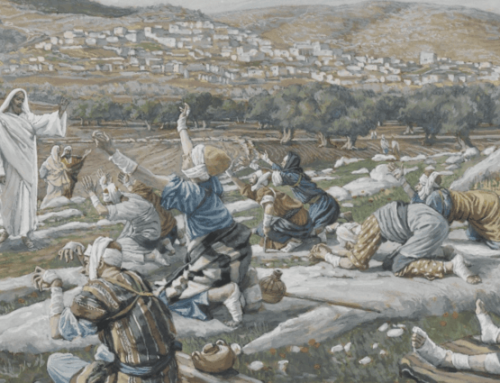
The featured image is “The Jews Took Up Rocks to Stone Jesus” (between 1886 and 1896) by James Tissot, and is in the public domain, courtesy of Wikimedia Commons.



All well and good, but we still need to be alert to the Godless wickedness which abides in the world and the power over the entire planet that these people lust for. So thoroughly corrupt are they that they will, for instance, set loose a pandemic upon the world, then attempt planet wide genocide through pharmaceuticals. They will not shrink from undermining the very bedrock of our existence as a free people by elevating the power and influence of the state to subjugate the people to their hideous will. They have no fear of even destroying the innocence of youth. You might also say that there can be no common ground between anyone from President to Pope who is onboard with this POA.
Thank you, Dr. Arbery: I have found myself many times faced with the temptation of the self congratulatory pharisee, and this essay is a tonic to such self illusions. Our Lord enjoins us to pray for our enemies, and in our times that injunction may well prove that we are praying for those who really want to destroy our freedom, even to take our lives, but in His grace: the grace He died so we could receive it, it is possible.
Thank you for this piece. I think any counsel which urges us to better understand our “opponents” can only be helpful anytime. I like the examples you used (especially the one from the Peloponnesian War) and much of the current world seems sometimes like a giant, techno-enabled, all-encompassing, 24-7 Mytilenian Debate with an ever-growing enemies list. Your article (as well as one of the things I like so much about this website – its ideal of approaching debate with magnanimity instead of merely civility) should help encourage an alternative to the current cultural norms of hyper-partisanship where anything goes. That being said, I would be wary of branding people outside one’s own fold as lusting for power, pursuing hideous wills, or out to destroy the youth. I do applaud the first commenter for being an example of what the article counseled us to avoid. Anyways, I appreciate the article and its contribution to making us all a little less sure of ourselves and our own goodness.