
Most of the Inklings had already gone through one world war, and when Germany invaded Poland in September 1939, they knew that their children—especially J.R.R. Tolkien’s sons—would have to go through a second one. It was all quite depressing.
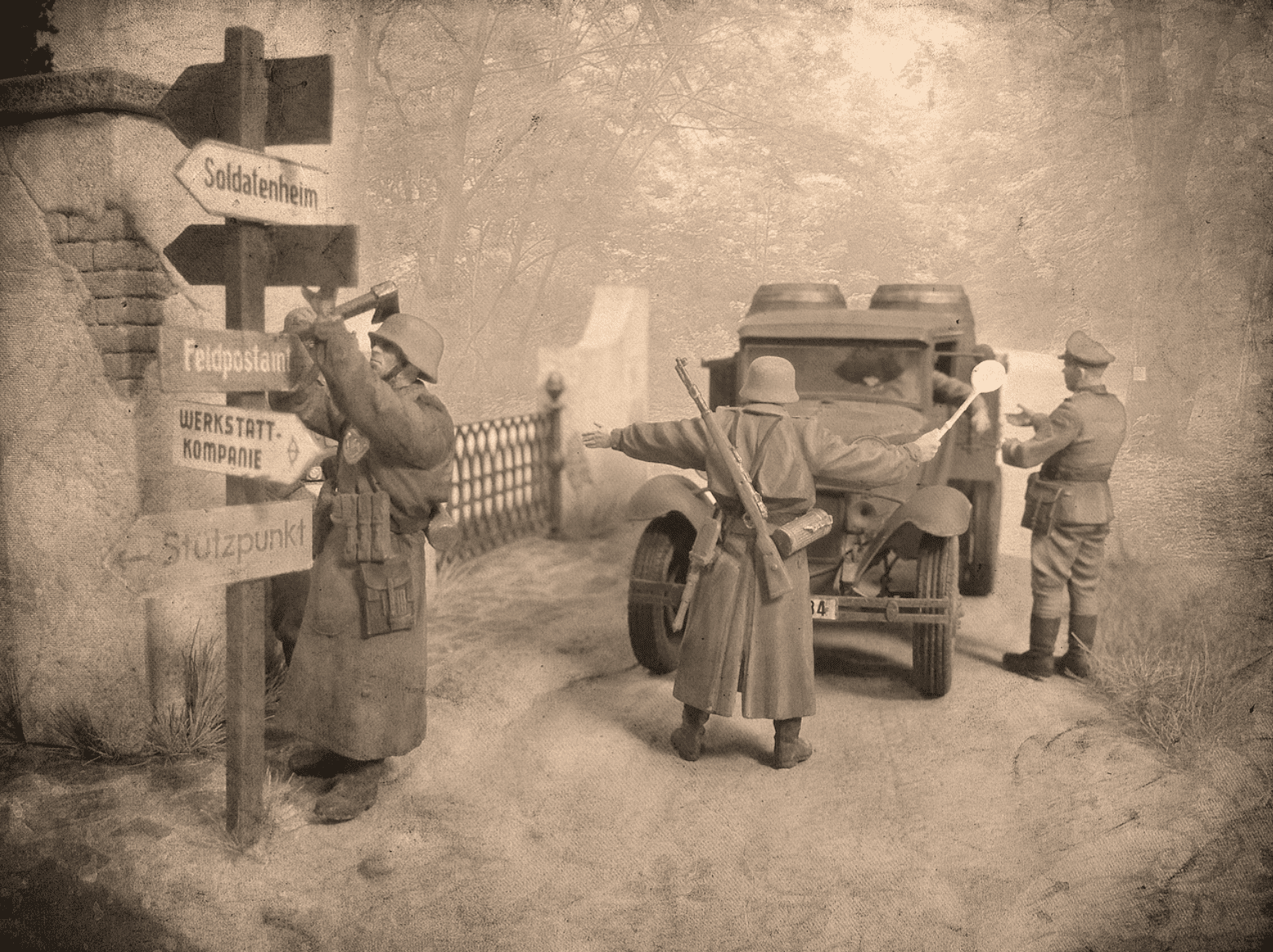 In September 1939, war descended upon Europe as the National Socialists of Germany and the international Communists of Russia raped Poland. Immediately before this violent partition, the two Lewises (Warnie and Jack), Hugo Dyson, and Humphrey Havard took a boat ride up the Thames. The news about Poland broke during their trip. “We knew then that war was imminent. The news broke on us, I think, at Godstow. In any case the return to Oxford from Godstow was in an unnatural silence. Depression was profound and tempers were short,” Havard recalled.[1]
Most of the Inklings had, of course, already gone through one world war, and now their children—especially J.R.R. Tolkien’s sons—would have to go through a second one. It was all quite depressing. In a letter to Warnie, who had been recalled to military service, Jack wrote:
I have a new Imperial Policy Bulletin which I will send on in a few days. Knowing the tone of that publication you will be interested to hear their opinion that ‘no power or coalition of powers could conceivably defeat the British Empire.’ I quite agree that one of the worst features of this war is the spectral feeling of all having happened before. As Dyson said ‘When you read the headlines (French advance—British steamship sunk) you feel as if you’d had a delightful dream during the last war and woken up to find it still going on.’ But perhaps the better view is the Frenchman’s ‘Well, that was a good armistice!’ If one could only hibernate. More and more sleep seems to me the best thing—short of waking up and finding yourself safely dead and not quite damned.[2]
Havard especially remembered the Inklings meeting that followed the collapse of France in June of 1940. The members worried that England would be next on the invasion list, and they began to enumerate the innumerable times they had publicly condemned the Nazis. “The Inklings were remembering passages in their work likely to prove obnoxious to the Nazis,” Havard wrote. “Lewis remembered The Pilgrim’s Regress and dwarfs of ‘a black kind with shirts.’ He affected to be apprehensive of their effect, given a Nazi occupation, but it was generally agreed that he was relatively safe because his work was not very political. But it was not our happiest evening.”[3]
Still, Lewis thought earning the hatred of the Nazis a badge of honor. Worries of an invasion, though, continued to plague him, and he finally threw his World War I service revolver in the river, giving the Nazis one less reason to arrest him, should they conquer England. His adopted son, David Gresham recounted:
He was also convinced that the fascists would murder him, so he threw the gun into the river: he wanted their crime to be without any justification. I can remember that when he told my mother about this episode, she replied, “I would have kept it, so that I could have taken some of the swine with me!” He said that when the Gestapo black list of people to be arrested as soon as the Germans arrived was published after the war, he was disappointed to find that he was not on it.[4]
Lewis, of course, would not have been alone among the Inklings to have criticized the National Socialist Party. Tolkien, in response to the potential German publication of The Hobbit, had openly sided with the Jews. “I regret that I am not clear as to what you intend by arisch,” he wrote, “I am not of Aryan extraction: that is Indo-iranian; as far as I am aware none of my ancestors spoke Hindustani, Persian, Gypsy, or any related dialects.” But, he continued, “if I am to understand that you are enquiring whether I am of Jewish origin, I can only reply that I regret that I appear to have no ancestors of that gifted people.”[5] In his explanation to his English publisher, Tolkien admitted that “I do not regard the (probable) absence of all Jewish blood as necessarily honourable; and I have many Jewish friends, and should regret giving any colour to the notion that I subscribed to the wholly pernicious and unscientific race-doctrine.”[6]
Throughout the war, Tolkien especially continued to lament the loss of German virtue and the destruction wrought by the war. Two of his sons, Michael and Christopher, served in the British armed forces, and Tolkien worried mightily about each of them. Some of Tolkien’s greatest letters deal with all of this. At times, he was explicit:
Anyway, I have in this War a burning private grudge – which would probably make me a better soldier at 49 than I was at 22: against that ruddy little ignoramus Adolf Hitler (for the odd thing about demonic inspiration and impetus is that in no way enhances the purely intellectual stature: it chiefly affects the mere will). Ruining, perverting, misapplying, and making for ever accursed that noble northern spirit, a supreme contribution to Europe, which I have ever loved, and tried to present in its true light.
The war interrupted Owen Barfield and Lewis’s friendship, too. During the late 1930s, Barfield would often spend the weekend with Lewis at the Kilns, and the two discussed Dante, Homer, and Virgil. “We were half-way through the Odyssey when the Second World War broke out,” Barfield remembered.[7]
Let’s face it: War reeks.
The Imaginative Conservative applies the principle of appreciation to the discussion of culture and politics—we approach dialogue with magnanimity rather than with mere civility. Will you help us remain a refreshing oasis in the increasingly contentious arena of modern discourse? Please consider donating now.
Notes:
[1] Havard, “Philia: Jack at Ease,” in James T. Como, Remembering C.S. Lewis: Recollections of Those Who Knew Him (San Francisco, CA: Ignatius Press, 2005), 355.
[2] CSL to Warnie, September 18, 1939, in The Collected Letters of C.S. Lewis, 278.
[3] Havard, “Philia: Jack at Ease,” 356.
[4] Douglas Gresham, quoted in Chad Walsh, The Literary Legacy of C.S. Lewis (New York: Harcourt Brace Jovanovich, 1979), 15.
[5] JRRT to Rütten and Loening Verlag, July 25, 1938, Letters of J.R.R. Tolkien, Letter 30, pg. 37.
[6] JRRT to Stanley Unwin, July 25, 1938, in Letters of J.R.R. Tolkien, Letter 29, pg. 37.
[7] Barfield, Light on Lewis, xiii.
The featured image is courtesy of Pixabay.




Those of us of German ancestry whose families emigrated during the previous century knew fully that WW II was near inevitable. The combination of the mad Austrian paper hanger and his Prussian martinets whose activities went back a century before set a pattern for Central Europe that was difficult to ignore, never mind that governments made their best efforts to do so. There was some hope after 1945 that that enough change had come about that the continent could at last enjoy lasting peace though at the expense of the eastern half under totalitarian governments. Unfortunately the clock seems to be running the reverse instead of forward. Santayana was more correct than we would like.