
Nowhere to be seen now are the old Jeffersonians, once a major American type, rebellious men who dared defend the rights of themselves and their communities from outside impositions. But buried somewhere deep in the American soul is a tiny ember of Jeffersonian democracy that now and then gives off an uncertain, feeble, and futile spark.

Scandalously, Thomas Jefferson once wrote to James Madison, “I hold it that a little rebellion now and then is a good thing, and is as necessary in the political world as storms in the physical.”
In the same year, 1787, in regard to what is known as Shays’ Rebellion, he wrote another friend, “God forbid that we should ever be 20 years without such a rebellion.” A lack of rebelliousness among the people would demonstrate “a lethargy, the forerunner of death to the public liberty. . . And what country can preserve its liberties if its rulers are not warned from time to time, that this people preserve the spirit of resistance?”
The “rebellion” in Massachusetts had alarmed many, especially the masters of that commonwealth, who were imbued with a Puritan longing for regulated behavior and saw the tax revolt of Capt. Daniel Shays and his farmers as a threat to their control. In Jefferson’s perspective, the “rebels” were merely adhering to good American practice. What, indeed, had the recent War of Independence amounted to but resistance to heavy-handed government? And such rebellions against unsatisfactory government officials and policies had been a regular occurrence during the long colonial history of the Americans, especially in the Southern colonies.
Persistent misrepresentation of Jefferson’s words here and elsewhere by later generations has obscured what he meant. A dangerous radical? A chronic upsetter of social order? No. Jefferson does not call for an overturn of society and its reconstruction according to some abstract plan. Think of the root meaning of the term revolution. Jefferson, in fact, is mostly satisfied with his society (Virginia), although he is interested in a few small reforms that might broaden its base. So are his followers satisfied with their portions of America. That is why they support him. Despite the hysterical and sometimes insincere denunciations of the New England clergy, the Virginia planter is no Jacobin. As he sees things, any government, with the passage of time and the accretion of abuses and bad precedents, becomes corrupted. It needs to be revolved back to its original principles.
This is not a radical program but a deeply reactionary one. What Jefferson fundamentally wants to tell us is that the people should never fear the government, but the government should always fear the people. This is not the battle cry of a movement with a radical agenda. President Jefferson comes to the White House with no agenda except to preserve the joint independence of the States United and their separate rights as “the best bulwark of our liberties.” To carry out this agenda requires a rollback of the economic and judicial corruptions introduced by the Hamilton/Adams innovators.
For the Jeffersonian democrats, Americans were fortunate to enjoy widespread property ownership, with a large body of independent citizens, and to be free of the class hegemony and conflict of the Old World, thankfully an ocean away. There is no French or Russian revolutionary fantasy here. The government is not to be used as a sledgehammer to destroy and rebuild society. In this way of thinking, the greatest enemy of society and of individual liberty is government itself. The tendency of power is everywhere and forever toward concentration. As a popular Jeffersonian saying has it, “Power is always stealing from the many to the few.”
It is this basic orientation that separates Jeffersonian democrats from “conservatives” of Jefferson’s own time and later. It explains the curious phenomenon that throughout American history the people have been “conservative,” and revolutionary changes have always come from the top down.
My point is illuminated by the argument between John Adams in his A Defense of the Constitutions of the United States and John Taylor of Caroline, the systematic philosopher of Jeffersonian democracy, in his Construction Construed, and Constitutions Vindicated. Adams’ view of history was that the popular majority always had a tendency to envy the wealth of its betters and use the government to appropriate it, and that this tendency was the chief source of destruction of a free regime.
He hoped to avoid the subversion of American republicanism by various devices that would dilute and delay an unwise popular majority: a bicameral legislature with an upper house remote from popular opinion, an executive veto, and an independent judiciary. All Adams’ devices have catastrophically failed to limit government and to preserve freedom, as Taylor plainly predicted.
For Taylor, Adams had got his history wrong. The people, in a society like that of Americans, were not dangerous. Most of the time they went quietly about their own business and demanded nothing—unless they were intolerably provoked by abuses of government. It was the “court party” that was the enemy of liberty and that would subvert the free commonwealth. History showed that there were always self-seeking minorities, would-be elites, ready to use the machinery of government to live off the labor of the majority. Sometimes this was done by force, and sometimes by fraud, as in the Hamiltonian maxim “a public debt is a public blessing.” The remedy was not to erect artificial “checks and balances” but to make sure power was widely dispersed, limited, and amenable to recall.
The Jeffersonian Constitution has been misrepresented as much as or more than Jeffersonian philosophy. It was not “strict construction,” a nonstarter, nor even states’ rights. It was state sovereignty. Jefferson (and Madison, too) may be quoted ad infinitum to this effect. The Virginia and Kentucky documents of 1798-1800 spell out beyond any doubt that the final defense of freedom in the American system is the people acting in their only constitution-making identity, that of their sovereign states. The states were the legitimate and peaceful resort to protect the liberties of their citizens and themselves as communities from federal encroachment.
Years after leaving the White House, Jefferson writes to an inquisitive foreigner,
But the true barriers of our liberty in this country are our State governments; and the wisest conservative power ever contrived by man, is that of which our Revolution and present government found us possessed. Seventeen distinct States, amalgamated into one as to their foreign concerns, but single and independent as to their internal administration.
In the last months of his life Jefferson suggested to influential Virginians that it was time once again to consider interposing the sovereignty of the state against unconstitutional federal legislation. Never for a day in his life did Jefferson doubt that the people of a state could exercise their sovereignty by leaving the Union, though it was not something to be encouraged rashly. He rather expected that the expanding country would break up into two or more confederacies. That was fine, if it was what the people wanted. Americans were rightly joined together by fellow feeling—shared blood and sacrifice—not by the armed force of Washington City.
Commentators have twisted themselves into incredible acrobatic postures and wholesaled semiplausible lies to assert that Jefferson did not really mean the plain language of what he said. Others have “explained” that Jeffersonian states’ rights was only a temporary and expedient device to defend liberty, a device now made unnecessary by the establishment of the American Civil Liberties Union. They miss the point, unwelcome to all adherents of elitist agendas and centralized power—for Jefferson, individual liberty and state sovereignty were indivisible. Properly rebellious free men defended themselves and their communities from Leviathan.
The eclipse of the Jeffersonian preference for limited power and economic freedom had less to do with politics than it did with changes in the spirit of society as the 19th century progressed. Almost from the first days of the United States, New England leadership undertook to establish the New England way as the true and only American way. This was carried out in politics, religion, education, literature, historical writing, and even in lexicography, with vigor and persistence. This is a subject worthy of a multivolume study of a phenomenon that is unrecognized today, although it was a decisive event in our history and clearly understood while it was taking place. Louis Auchincloss, in The Winthrop Covenant, gives a surface account of the persistence of this Puritan mission throughout American history.
The Puritan conquest of the North was not as easy as has been thought, but was accomplished by about 1850. James Fenimore Cooper in his Littlepage trilogy describes and laments how the unique Anglo-Dutch society of old New York was transformed by the swarm of immigrants from east of the Hudson. Meanwhile, Emerson went to Europe and absorbed the Germanized version of the French Revolution, which was really just going back to his Puritan roots. He came home a Unitarian. The mission was changed, but the intensity of the need to correct the world to conform to the New England plan remained the same. It soon brought to heel the West and the unruly Catholic immigrants.
The South was a different matter. It had developed from a different base and in a different way. Southerners were proud and determined to do it their way, individually and as a people. The South could not be converted or subverted, so it had to be destroyed, the grapes of wrath had to be trampled out. A 30-year campaign of slander and hatred, combined with economic developments, finally brought on in 1861 the circumstances in which this could be accomplished. Americans like to think that their campaign for the abolition of slavery was all about benevolence and liberty. A bit of genuine historical research into what they actually said at the time paints a different picture. The Yankees hated slavery because the slaves were a non-Anglo-Saxon element who had, in their view, hopelessly corrupted white Southerners. In the slaveholding society, white men had far too much liberty and independent power. Such liberty offended puritan sensibilities and created an evil disposition to thwart New England economic and cultural hegemony. It was not that the black man had too little liberty; it was that the Southern white man had far too much.
That crusade pretty well finished off Jeffersonian democracy. As Gen. R.E. Lee wrote to Lord Acton the year after his surrender, “the consolidation of the States into one vast republic, sure to be aggressive abroad and despotic at home,” was the precursor of American ruin. Lincoln rightly remains the truly representative American. He is the symbol of the highly successful synthesis of capitalist oligarchy, puritan conformity, and perpetual social revolution from the top down that is the mainstream of American life. There are many who find that synthesis beautiful, though most often they do not really understand what it is, identifying with one or another of the elements and not with the combination itself. Money rules and permits a politics that consists almost entirely of sham battles between the old puritans, the “conservatives,” and the secular ones, the “liberals.” From time to time they all join together in a messianic war to destroy the latest menace to Lincoln’s vision: the South, the kaiser, the Red Menace, drugs, terror, etc.
They share the sense that the meaning of “America” is a mission to bring the abstract ideals of the American standard to all mankind. The only difference is that the “conservatives” want to do it by force, and the “liberals” by welfare. A Jeffersonian, if any still existed, would insist that Americans are not here to be used for anybody’s mission, and the proper point of reference is what is good for them.
The Jeffersonian spirit survived for a while underground, and now and then a weak and confused revival occurred, as in the days of William Jennings Bryan and populism. The last significant appearance was perhaps the agrarian, non-Marxist critique of capitalism in the 1930’s. Nowhere to be seen now are the old Jeffersonians, once a major American type, rebellious men who dared defend the rights of themselves and their communities from outside impositions. But buried somewhere deep in the American soul is a tiny ember of Jeffersonian democracy that now and then gives off an uncertain, feeble, and futile spark.
Republished with gracious permission from Chronicles: A Magazine of American Culture (November 2011).
This essay first appeared here in May 2012.
The Imaginative Conservative applies the principle of appreciation to the discussion of culture and politics—we approach dialogue with magnanimity rather than with mere civility. Will you help us remain a refreshing oasis in the increasingly contentious arena of modern discourse? Please consider donating now.
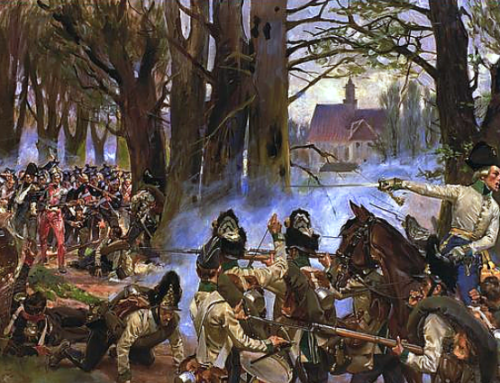
The featured image, uploaded by Wmpetro, depicts Shays’ protesters taking down a tax collector. This file is licensed under the Creative Commons Attribution-Share Alike 4.0 International license, courtesy of Wikimedia Commons.



Without getting into the Puritan-as-demon thing once again with my friend Clyde, whose work and whose character I have admired for a great many years, I would submit that it is one thing for Jefferson to have cheered on the Shaysites (I would have, too!) and another for him to cheer on the Jacobins. Jefferson the Unitarian had no more discernment about such things than Emerson the Unitarian, although I admit I hate Jefferson's heresies less. They actually had more in common. The individualism that Jefferson (somewhat hypocritically, I think) espoused amongst yeoman farmers was not unlike Emerson's essay "Individualism," and both were leery of settled social customs. Neither could take care of his own affairs. Emerson was made comfortable by the proceeds from the death of his wife, and Jefferson was bailed out twice by the public. Having said this, I would also admit that after studying Emerson hard about 40 years ago, and coming across this sentence, "I am a transparent eyeball; I know nothing; I see all," I stopped studying. Jefferson remains at least interesting.
South Carolina's Dr. Clyde Wilson is an American treasure who, for a very long time, has been championing the idea of a unique liberty grounded on the idea of state sovereignty. Think of how different this country would look had the old Americanism won the day.
Messy, but better. I agree about Dr. Clyde.
John, I think 'messy' is an excellent word to describe the possible realities inherent in a fed/const/republic. But, given human nature, the 'fall', the libido dominandi, and the rest it is, I think, the best form available to safeguard liberty while providing order. As I said, to recapture the olde Americanism should be the first objective of American conservatism.
I'm curious what Dr. Wilson thinks about the many Southern Presbyterians (e.g., RL Dabney and Gen. Jackson) who fought for the CSA and who considered Puritanism their theological heritage.
State sovereignty is a wonderful idea, but what about individual sovereignty?
Re: “A bit of genuine historical research into what they actually said at the time paints a different picture. The Yankees hated slavery because the slaves were a non-Anglo-Saxon element who had, in their view, hopelessly corrupted white Southerners. In the slaveholding society, white men had far too much liberty and independent power. Such liberty offended puritan sensibilities and created an evil disposition to thwart New England economic and cultural hegemony. It was not that the black man had too little liberty; it was that the Southern white man had far too much.”
You’d think that Dr. Wilson might have provided a quotation or two to support his claim. Even if he were correct about the motives of Puritan Yankees–how does that, in and of itself, justify either slavery or secession? As for Dr. Wilson’s assertion that “Lincoln rightly remains the truly representative American”: I hope so–the nation could do (and has done) a whole lot worse.
I agree with the analysis of Jeffersonian democracy, but I’m not sure if Jefferson himself was the best proponent of it. I think that a comparison of Jefferson with men like Taylor or Randolph shows that Jefferson had little love for the permanent things (I just cannot ignore his words on the French Revolution).
If I may comment on Stephen’s old post re: Southern Presbyterians, I think the origins thereof provide the answer. While both coming from the radical Calvinist tradition, most of the Southern Presbyterians descend from Scots, where the Kirk reigned and society itself was thoroughly Presbyterian. Conversely the northern Puritans, being descended English separatists, had a history of and inherent tendency to attempt to control others. It is a myth that the Pilgrims fled to America for religious freedom – toleration was already law in England. They came to America because upon returning to England from Holland they found that the average person wasn’t too enthused about their attempts to Purify the church. The Southern Presbyterian descends from John Knox – a pious, though intense, man with a bible. The Northern Puritan descends from Oliver Cromwell – a self-righteous psychopath with a sword.
“Jefferson does not call for an overturn of society and its reconstruction according to some abstract plan.”
Well, maybe in his saner moments. What are to make of his observation that he would rather have the whole earth desolated than see the French Revolution fail? Jeffersonian republicanism has a complicated relationship with the broader conservative tradition, and it’s not something I’ve ever felt comfortable giving unqualified assent to.
Regarding the whole Puritan issue, it’s sufficient to say that each segment of America’s founding stock had its characteristic virtues and vices. Puritan New England was a dour, abstemious sort of place, but the chief engine of Puritan social control was conscience, not law. The profoundly guilt-based society of New England (in contrast to the shame-and-honor aristocratic culture of the South) produced, in many ways, one the freest societies to ever exist, if we understand freedom to be a product of virtue and not merely the absence of external constraint.
The irony of Jefferson is that he used the power of the central Executive to conclude the Louisiana Purchase–doubling the size of the nation–partly because it tilted the scales toward a decentralized society of yeoman farmers.
“ Never for a day in his life did Jefferson doubt that the people of a state could exercise their sovereignty by leaving the Union, though it was not something to be encouraged rashly.”
I am not familiar with anything Jefferson wrote explicitly in this regard. Can anyone point to a scholarly reference that supports this assertion?
In reconstructing our founding documents, what protections might be instituted that could further prevent centralized encroachment of state sovereignties? The naturally tendency is that power will always tend toward centralized control, if for no other reason that such power tends to serve the sociopaths who desire it.
It seems that he did not explicitly address it. But that it was James Buchanan who argued that “it would violate the spirit of the Union for the remaining states to make war on the others … the Union had to remain alive in the affections of the people … Jefferson’s original notion of a voluntary Union based on consent, affection, and interest rather than force.” Brian Steele (2008): Thomas Jefferson, Coercion, and the Limits of Harmonious Union, The Journal of Southern History. (In my humble opinion, it is another matter, whose consent, affection, and interest, for example, the southern negros, or the indigeneous tribes, who were never asked).
Wholy theoretically, if natural law known only to God, and to good people in their consciences, is gravely violated by positive law, issued by the Caesar, then, good people should indeed revolt. Whether the French revolution is an example of this Mengzian, “the heavens see what the people see,” or indeed conservative, principle, Augustine’s comparison between organized crime and the government’s violation of natural law, nobody knows, because the shock waves from it have not yet settled, through 1789–1914–1989. Conservatives must acknowledge that with human knowledge of good and evil, in principle privilege of the Creator, the Caesar cannot issue positive law in arbitrary conflict with natural law, least the people shall revolt. This gives only the negative definition of natural law, since its positive definition is only for God. The Caesar would for his own wellfare do well to promote theology and history, least he would not build his law on arbitrary sand and be washed away by the Jeffersonian storm. We do not know, here in the E.U., whether the French revolution was such a storm from an angry God. God bless, a little rebellion now and then, and take good care of your rebellious constitutional amendments. Law does not fall from heaven.
Why was slavery approved of, defended, when it was Black people who were enslaved? That is the pointed question. That fact meant that “liberty” was not really valued, and that even the right to “private property” was a sham. The only moral basis for the right of private property was that for a free person to possess “what was his own”- the root of the word property- was the dignity and freedom of the person. Not power relations. But slavery of Black people, defended as “property right” was a lie. For the South, property rights were nothing but a power structure making some persons superior as beings to others.
All revolutions centralize power
The American Revolution Was a Mistake
By Gary North:
I do not celebrate the fourth of July. This goes back to a term paper I wrote in graduate school. It was on colonial taxation in the British North American colonies in 1775. Not counting local taxation, I discovered that the total burden of British imperial taxation was about 1% of national income. It may have been as high as 2.5% in the southern colonies.
The colonists had a sweet deal in 1775. Great Britain was the second freest nation on earth. Switzerland was probably the most free nation, but I would be hard-pressed to identify any other nation in 1775 that was ahead of Great Britain. And in Great Britain’s Empire, the colonists were by far the freest.
The taxation rates didn’t really matter. In the end, the Americans no longer considered themselves Englishmen, instead identifying themselves as a separate people, and they thus desired to be free of outside rule.
Though it is over a decade since this piece was written, I just now came across it.
This piece reflects a highly tendentious reading of history; what’s more, it’s a reading of history that is erroneous.
Take this line: “Adams’ view of history was that the popular majority always had a tendency to envy the wealth of its betters and use the government to appropriate it, and that this tendency was the chief source of destruction of a free regime.”
Now, I’m something of an expert on John Adams, and this conclusion is incorrect. Yes; Adams did believe that this tendency existed in the popular majority; no, Adams did not believe that this tendency was the chief source of destruction of free governments. Adams believed that greed, ambition, and vanity were the most likely sources of destruction of free governments; and I dare anyone to say that he was wrong.
Here are four relevant passages by Adams:
“You are afraid of the one—I, of the few. We agree perfectly that the many should have a full fair and perfect Representation.”
“I have never exhibited or entertained, but one opinion of Monarchy in any part of my Life. Despotism, absolute Monarchy, absolute Aristocracy, and absolute Democracy, I have uniformly detested, through my whole Life: because I knew that absolute Power, was Tyranny, delirious Tyranny wherever it was placed. A mixed Government is the only one that can preserve Liberty.”
“The two ladies Aristocratia and Democratia will eternally pull caps, till one or other is mistress. If the first is the conqueress she never fails to depress and debase her rival into the most deplorable servitude. If the last conquers, she eternally surrenders herself into the arms of a ravisher. [. . .] Men are not only ambitious, but their ambition is unbounded: they are not only avaricious, but their avarice is insatiable. The desires of kings, gentlemen and common people,—all increase, instead of being satisfied by indulgence. This fact being allowed, it will follow that it is necessary to place checks upon them all.”
“As the treble, the tenor, and the bass exist in nature, they will be heard in the concert: if they are arranged by Handel, in a skilful composition, they produce rapture the most exquisite that harmony can excite; but if they are confused together without order, they will ‘Rend with tremendous sound your ears asunder.’”
Adams worried most about oligarchy, about the corrupt few, far more than he did the tyranny of the one or the ochlocracy of the many. From his study of history, Adams concluded that, typically, the rapacities and rivalries of the few awaken the mob, and the mob summons a Caesar. But which estate pushes over the first domino? The nobility, the elites – the few. The spark that starts the all-consuming fire typically comes from the few and their intrigues, manipulations, and grandiose ambitions. Adams further understood that Meritocracy is the natural origin of all Oligarchies – hence his arguments with Jefferson regarding the natural aristocracy of virtues and talent.
“Your ‘ἄρiςτοi’ are the most difficult Animals to manage, of anything in the whole Theory and practice of Government. They will not Suffer themselves to be governed. They not only exert all their own Subtelty Industry and courage, but they employ the Commonality, to knock to pieces every Plan and Model that the most honest Architects in Legislation can invent to keep them within bounds.”
“The everlasting Envys, Jealousies, Rivalries and quarrells among them, their cruel rapacities upon the poor ignorant People their followers, compell these to Sett up Cæsar, a Demagogue to be a Monarch and Master, pour mettre chacun a sa place. Here you have the origin of all artificial Aristocracy, which is the origin of all Monarchy. And both artificial Aristocracy, and Monarchy, and civil, military, political and hierarchical Despotism, have all grown out of the natural Aristocracy of ‘Virtues and Talents’.”
And here’s a similar passage from G. K. Chesterton’s “The Man Who Was Thursday”, “You’ve got that eternal idiotic idea that if anarchy came it would come from the poor. Why should it? The poor have been rebels, but they have never been anarchists; they have more interest than any one else in there being some decent government. The poor man really has a stake in the country The rich man hasn’t; he can go away to New Guinea in a yacht. The poor have sometimes objected to being governed badly; the rich have always objected to being governed at all. Aristocrats were always anarchists, as you can see from the barons’ wars.”
Here is Disraeli: “None are so interested in maintaining the institutions of the country as the working classes. The rich and the powerful will not find much difficulty, under any circumstances, in maintaining their rights, but the privileges of the people can only be defended and secured by national institutions.”
This does not mean, however, that one should foolishly seek to eradicate meritocracy or to crush all meritocrats; rather, it means that one ought to seek to prevent meritocracies from degenerating into oligarchies, which happens quite naturally as fortunes swell, are inherited, and are combined through advantageous marriages. Social advantages accumulate and compound over time, and they do so exponentially.
Anyone who thinks that this sort of thing, if left to itself, will not spread tentacles of corruption to every corner of our government is hopelessly naïve. This was precisely Adams’s concern, as he had read about this sort of thing happening throughout all of human history.
Theodore Roosevelt also understood this. When Theodore Roosevelt argued in favour of a graduated income tax as well as a graduated inheritance tax on large fortunes, he was acting to weaken and to prevent the future supremacy of precisely this artificial aristocracy; he was attempting to preserve the beneficial effects of a natural aristocracy whilst guarding against the harmful effects of an artificial aristocracy, which always appears whenever the elites of society do not reflect the best and most gifted beings in each generation; he was acting as a guardian of our free republic.
Jefferson, who supported the Jacobins, subscribed to a Romantic view of politics, whereas Adams subscribed to a more Realist one: a more English one, really. The Jacobins, Fascists, and Bolsheviks all subscribed to the Romantic view; Clement Attlee, who was a democratic socialist prime minister of the United Kingdom, subscribed to that old English realist school of sentiment. Underlying the Romantic sentiment is a yearning to return to Eden.
In whose interests, really, is a night-watchman state, or minarchy? The answer is clear: Those of the rich, of the elites, of the nobles – of the oligarchy. In such a state, the nobles will naturally establish dominion over the people. Government is most certainly the perennial problem for the few, as it impedes their ambition. They like government only after it becomes their instrument, whereupon they use it to further enrich and empower themselves.
Here’s Attlee: “I entirely agree that people should have the greatest freedom compatible with the freedom of others. There was a time when employers were free to work little children for sixteen hours a day. I remember when employers were free to employ sweated women workers on finishing trousers at a penny halfpenny a pair. There was a time when people were free to neglect sanitation so that thousands died of preventable diseases. For years every attempt to remedy these crying evils was blocked by the same plea of freedom for the individual. It was in fact freedom for the rich and slavery for the poor. Make no mistake, it has only been through the power of the State, given to it by Parliament, that the general public has been protected against the greed of ruthless profit-makers and property owners.”
And more Attlee: “I think that some people over here imagine that the Socialists are out to destroy freedom, freedom of the individual, freedom of speech, freedom of religion, and the freedom of the Press. They are wrong; the Labour Party is in the tradition of freedom-loving movements which have always existed in our country, but freedom has to be striven for in every generation, and those who threaten it are not always the same. Sometimes the battle of freedom has had to be fought against kings, sometimes against religious tyranny, sometimes against the power of the owners of the land, sometimes against the overwhelming strength of the moneyed interests. We in the Labour Party declare that we are in line with those who fought for Magna Carta and habeas corpus, with the Pilgrim Fathers, and with the signatories of the Declaration of Independence.”
Adams believed that struggle and strife were perpetual in society, the effects of innate human passions and drives: good, free government channels these social conflicts into public institutions which are capable of resolving these conflicts before they capsize civilization.
As Lord Bolingbroke once wrote, “I am free not from the Law, but by the Law.”
And here, once more, is Adams: “Harrington says, ‘Government de jure, or, according to ancient prudence, is an art, whereby a civil society of men is instituted and preserved upon the foundation of common interest; or, to follow Aristotle and Livy, it is an empire of laws and not of men. And government, to define it according to modern prudence, or de facto, is an art by which some man, or some few men, subject a city or a nation, and rule it according to his or their private interest; which, because the laws in such cases are made according to the interest of a man, or a few families, may be said to be the empire of men and not of laws.’
“Harrington agrees, that law proceeds from the will of man, whether a monarch or people; and that this will must have a mover; and that this mover is interest. But the interest of the people is one thing—it is the public interest; and where the public interest governs, it is a government of laws, and not of men. The interest of a king, or of a party, is another thing—it is a private interest; and where private interest governs, it is a government of men, and not of laws.”
Jefferson instinctively distrusted and rebelled against any large concentration of power, not unlike Rousseau; ultimately, he came to distrust even state governments. Jefferson’s ideal, which horrified Hamilton, was not the United States of America, nor was it the Free States of America – it was the Free Townships of America.
Lincoln once wrote, “The principles of Jefferson are the definitions and axioms of free society.” I agree; and this is Jefferson at his best. At his worst, Jefferson was a despot, an anarchist, and a practised liar – a bit of a demon, really.
John Quincy Adams correctly assessed the moral qualities of Southern elites, of men like Jefferson and Calhoun: here, Clyde, are your men who “live[d] off the labor of the majority”.
Here are Quincy Adams’s reflections on the political sentiment of the Southern elites:
“It is in truth all perverted sentiment—mistaking labour for Slavery, and dominion for Freedom— The discussion of this Missouri question has betrayed the secret of their Souls— In the abstract they admit that Slavery is an evil; they disclaim all participation in the introduction of it; and cast it all upon the shoulders of our old Grandam Britain— But when probed to the quick upon it they show at the bottom of their Souls, pride and vain-glory in their very condition of masterdom— They fancy themselves more generous and noble-hearted than the plain freemen who labour for subsistence— They look down upon the simplicity of a yankey’s manners because he has no habits of overbearing like theirs, and cannot treat negroes like dogs— It is among the evils of Slavery that it taints the very sources of moral principle— It establishes false estimates of virtue and vice; for what can be more false and heartless than this doctrine which makes the first and holiest rights of humanity to depend upon the colour of the skin— It perverts human reason, and reduces men endowed with logical powers to maintain that Slavery is sanctioned by the Christian religion— That Slaves are happy and contented in their condition— That between Master and Slave there are ties of mutual attachment and affection. That the virtues of the Master, are refined, and exalted by the degradation of the Slave, while at the same time they vent execrations upon the Slave-trade; curse Britain for having given them Slaves, burn at the Stake, negroes convicted of crimes: for the terror of the example, and writhe in agonies of fear, at the very mention of human rights as applicable to men of colour.
“The impression produced upon my mind by the progress of this discussion is that the bargain between Freedom and Slavery contained in the Constitution of the United States, is morally and politically vicious— Inconsistent with the principles upon which alone our revolution can be justified; cruel and oppressive by rivetting the chains of Slavery—by pledging the faith of Freedom to maintain and perpetuate the tyranny of the master, and grossly unequal and impolitic, by admitting that Slaves are at once enemies to be kept in subjection, property to be secured or restored to their owners, and persons, not to be represented themselves, but for whom their masters are priviledged with nearly a double share of representation— The consequence has been that this Slave-representation has governed the Union— Benjamin, portioned above his brethren has ravined as a wolf—in the morning he has devoured the prey, and at night he has divided the spoil— It would be no difficult matter to prove by reviewing the history of the Union under this Constitution, that almost every thing which has contributed to the honour and welfare of the nation, has been accomplished in despite of them, or forced upon them; and that every thing unpropitious and dishonourable, including the blunders and follies of their adversaries, may be traced to them[.]”
Jefferson’s brilliant mind perceived this truth, although his heart, charmed by his amour-propre, resisted it. Consider Jefferson’s following notes: “There must doubtless be an unhappy influence on the manners of our people produced by the existence of slavery among us. The whole commerce between master and slave is a perpetual exercise of the most boisterous passions, the most unremitting despotism on the one part, and degrading submissions on the other. Our children see this, and learn to imitate it; for man is an imitative animal. This quality is the germ of all education in him. From his cradle to his grave he is learning to do what he sees others do. If a parent could find no motive either in his philanthropy or his self-love, for restraining the intemperance of passion towards his slave, it should always be a sufficient one that his child is present. But generally it is not sufficient. The parent storms, the child looks on, catches the lineaments of wrath, puts on the same airs in the circle of smaller slaves, gives a loose to his worst of passions, and thus nursed, educated, and daily exercised in tyranny, cannot but be stamped by it with odious peculiarities. The man must be a prodigy who can retain his manners and morals undepraved by such circumstances. And with what execration should the statesman be loaded, who permitting one half the citizens thus to trample on the rights of the other, transforms those into despots, and these into enemies, destroys the morals of the one part, and the amor patriæ of the other. For if a slave can have a country in this world, it must be any other in preference to that in which he is born to live and labour for another: in which he must lock up the faculties of his nature, contribute as far as depends on his individual endeavours to the evanishment of the human race, or entail his own miserable condition on the endless generations proceeding from him. With the morals of the people, their industry also is destroyed. For in a warm climate, no man will labour for himself who can make another labour for him. This is so true, that of the proprietors of slaves a very small proportion indeed are even seen to labour. And can the liberties of a nation be thought secure when we have removed their only firm basis, a conviction in the minds of the people that these liberties are of the gift of God? That they are not to be violated but with his wrath? Indeed I tremble for my country when I reflect that God is just: that his justice cannot sleep for ever: that considering numbers, nature and natural means only, a revolution of the wheel of fortune, an exchange of situation, is among possible events: that it may become probable by supernatural interference! The Almighty has no attribute which can take side with us in such a contest.”
Clyde’s defence of these Southern elites and their sentiment, and his attack on New England elites like Quincy Adams, is odious. The Union’s cause was just and righteous; the Confederacy’s cause was unjust and monstrous. Can some virtue and heroism be discovered in the hearts of individual people belonging to the Confederacy? Can some vice and villainy be discovered in the hearts of individual people belonging to the Union? Of course! But this does nothing to change the moral maths of the Civil War.
I can’t help but think of Chesterton’s observations when I think of Jefferson, Southern Baron. Jefferson’s anarchistic tendencies are derived from two sources: (1) his personality; and (2) his status as an aristocrat. This, I think, accounts for the dualistic nature of Jefferson’s sentiments. The one Jefferson seems to me inspiring, if a bit unruly, a bit of wild, spontaneous nature, the very seed of liberty; the other seems like the reactionary ranting of an arrogant and entitled lord.
Lastly, here is Lincoln on liberty and tyranny:
“The world has never had a good definition of the word liberty, and the American people, just now, are much in want of one. We all declare for liberty; but in using the same word we do not all mean the same thing. With some the word liberty may mean for each man to do as he pleases with himself, and the product of his labor; while with others the same word may mean for some men to do as they please with other men, and the product of other men’s labor. Here are two, not only different, but incompatible things, called by the same name, liberty. And it follows that each of the things is, by the respective parties, called by two different and incompatible names–liberty and tyranny.
“The shepherd drives the wolf from the sheep’s throat, for which the sheep thanks the shepherd as his liberator, while the wolf denounces him for the same act, as the destroyer of liberty, especially as the sheep was a black one. Plainly, the sheep and the wolf are not agreed upon a definition of the word liberty; and precisely the same difference prevails to-day among us human creatures, even in the North, and all professing to love liberty. Hence we behold the process by which thousands are daily passing from under the yoke of bondage hailed by some as the advance of liberty, and bewailed by others as the destruction of all liberty. Recently, as it seems, the people of Maryland have been doing something to define liberty, and thanks to them that, in what they have done, the wolf’s dictionary has been repudiated.”
Whilst reading your words, Clyde, my impression was that you learned a good deal of your political definitions from the dictionary of the wolf.
I must also admit to finding the story you tell – the independent spirit of the South, the will to power of New England, the American synthesis of capitalist oligarchy, puritan conformity, and perpetual social revolution from the top down – to be an unconvincing one.
It reads more like a confessional mythology than a dispassionate history.