
If conservatism is true, it is true for all times, all places, and all persons. It might take on a Christian character here, or a Jewish character there, or a Stoic character way over there, but it remains universally tied to certain humane principles, whatever its local manifestations. It is imagination, perhaps our highest faculty for knowing, that allows the conservative to stand not only within, but also simultaneously above, the moment.
 From The Wall Street Journal to The Fund for American Studies to a myriad of Twitterites and Facebookers over the past month or so, conservatism and its meaning have been questioned. What exactly is it? What does it mean? What are its limitations? What did it ever do for humanity? The Wall Street Journal—or, at least, its guest editorial writer back in late November—even went so far as to proclaim that all real societal advances in America have been brought about by progressives (historically, completely untrue, by the way).
Well, ok, this conversation about conservatism been going on much longer than a month. In fact, it’s really been going on throughout the entirety of conservatism’s history. All this recent confusion, I would suggest, however, comes from the Trump presidency and its aftermath, which misidentified populism as conservatism as well as conflating nationalism with patriotism. Two photos of Trump even accompanied The Wall Street Journal’s editorial (at least the online version).
So, exactly how do we define conservatism? We could readily turn to Russell Kirk or C.S. Lewis or Dan McCarthy or Patrick Deneen. One thing that holds all conservatives together—from Irving Babbitt to Deneen—is the question, what exactly do conservatives want to conserve? Indeed, for the conservative, there is no greater question.
For all of conservatism’s history, I would argue, conservatives have wanted to promote all that is good, true, and beautiful. They believe, at least in the Western tradition, in prudence, justice, fortitude, temperance, faith, hope, charity, labor, fate, and piety. These ten virtues—Greek, Roman, and Christian—have formed the basis of promoting the humane, promoting what it means to be human, to be man, to be woman, to be a person.
As has been the tradition since at least the 1890s, conservatives have also wanted to conserve the best of the western tradition (and I would date this back to Edmund Burke, though there might not be a link between Burke and Babbitt, except for Tocqueville). This is not to suggest that westerners are unique. My guess—though it is nothing more than a series of guesses—is that Hindus, Buddhists, and Confucians have wanted to preserve their respective cultures as well). But, within the Western Tradition (yes, capital W and capital T!), it’s worth remembering: Socrates, Plato, Aristotle, Zeno, Cleanthes, Cicero, Livy, Tacitus, Paul, John, Perpetua, Ambrose, Augustine, King Alfred, Petrarch, Aquinas, Thomas More, Edmund Burke, George Washington, John Adams, Alexis de Tocqueville, Nathaniel Hawthorne, E.L. Godkin, Irving Babbitt, Paul Elmer More, T.S. Eliot, Christopher Dawson, Willa Cather, Russell Kirk, Robert Nisbet, Flannery O’Connor, and others. Each of these persons carried the weight of all things before them, and they passed on to future generations what can only be regarded as transcendent and timeless truths.
Does this mean that all who have embraced the label conservatism over the last century or so are actually conservatives? Of course not. Conservatism, like all good terms, has been hijacked—sometimes by the demagogues, sometimes by the populists, sometimes by the nationalists, sometimes by the politicos, and sometimes simply by those who prostitute themselves to the public in order to make some cash.
Yet, conservatism, properly understood, remains. It is possible, and perhaps even probable, that true conservatism—as inherited from Socrates onward—is rarely understood and even more rarely put into practice in this world of sorrows. It’s also possible that ideologies such as populism and nationalism might simply overwhelm proper conservatism. Maybe, conservatism in 2022 or 2023 cannot compete with socialism or liberalism or corporatism. None of this negates conservatism. When Socrates died, he came at the end of classical Greece. When Cicero died, he came at the end of Republican Rome. When Thomas More died, he came at the end of the Renaissance. When C.S. Lewis died, if we’re to take his words at face value, he came as the last “Old Western Man.” Each, in his own way, did what he could—through logic and no-small amount of nostalgia—to preserve that which had recently been lost. If nothing else, each of these men stands as an exemplar, reminding us that we, too, must stand and proclaim, time and again, what is good, true, and beautiful, at least as our own small lights allow us to understand these things.
If conservatism is true, it is true for all times, all places, and all persons. It might take on a Christian character here, or a Jewish character there, or a Stoic character way over there, but it remains universally tied to certain humane principles, whatever its local manifestations. It is imagination, perhaps our highest faculty for knowing, that allows the conservative to stand not only within, but also simultaneously above, the moment.
One of conservatism’s greatest successes as well as one of the things that makes it impossible at times to implement is that it is based on humility, admitting that we don’t always perfectly comprehend the world. That is, it’s difficult to know how to apply to our specific situation, the universal principles. Of course, this humility is a critical recognition of our individuality. Imagine, if you will, a jury. Twelve persons watching the same trial, twelve persons seeking justice (a transcendent thing), but also twelve persons with twelve distinct viewpoints working as a community. And, if there’s a reasonable doubt within the group, innocence must be declared. I can think of no institution that better understands the complexities of the world than the jury. For all intents and purposes, it is an institution that, at its best, balances the universal and the particular.
There is an additional thing that makes conservatism both beautiful and frustrating. Unlike liberalism and socialism and corporatism, which are, by their nature, deeply utilitarian, conservatism is deeply poetic. It loves the gothic, the quirky, and the strange. Unlike liberalism and socialism and corporatism, it praises (true) differences and even celebrates them. Person A is talented at this, and Person B is talented at that. Each person brings his or her talents to the community, there to sharpen them as well as restrain our many flaws and arrogances.
So, what exactly do we want to conserve? This is a question that every person and every generation must ask. If we do it properly, we employ prudence (the ability to understand good and evil), justice (giving each person his due), temperance (the use of the created goods for the Good), and fortitude (perseverance), but we should do so through faith (the ability to see that which is unseen), through hope (the understanding that we each matter and that God makes nothing in vain), and, especially through love (to give of oneself to another). Does this translate into immediate solutions for the world? No, of course not. But, it allows us to see one another through the eyes of the divine, no matter how clouded our vision might be.
Conservatism remains, as it always must, whatever its critics might claim.
This essay was first published here in January 2023.
The Imaginative Conservative applies the principle of appreciation to the discussion of culture and politics—we approach dialogue with magnanimity rather than with mere civility. Will you help us remain a refreshing oasis in the increasingly contentious arena of modern discourse? Please consider donating now.
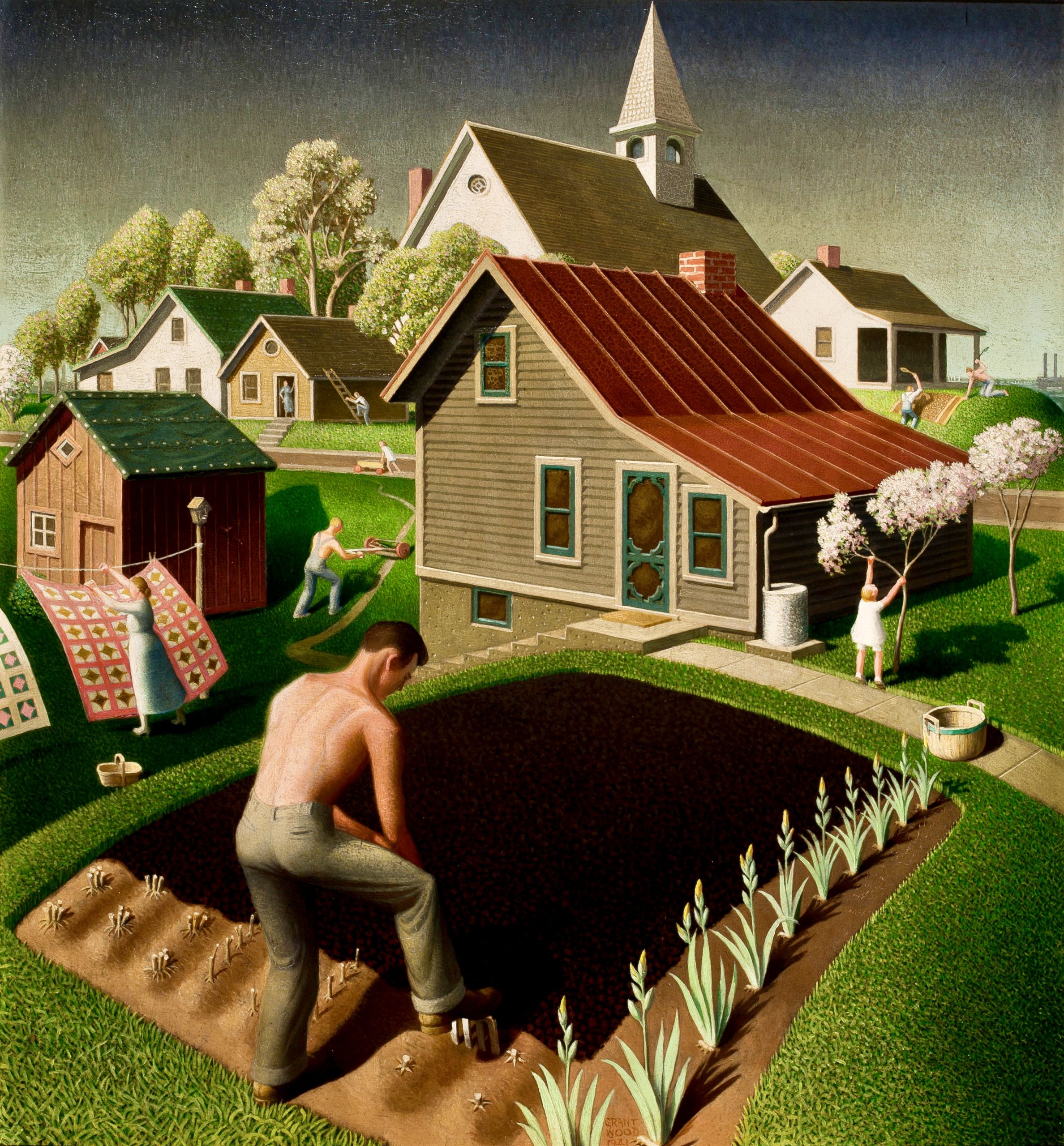
The featured image is “Spring in Town” (1941) by Grant Wood, and is in the public domain, courtesy of Wikimedia Commons.






Well done in about as few words as possible given the fact that there are countless volumes written that expand on these ideas.
Perhaps the Serenity Prayer should be the pledge of true conservatives and we may wish for all people, as it were.
Thank you for writing this essay, is perfect reading for this morning. For such a time as this. This day, this year. I will be forwarding and sharing with many!!!
This essay feels like a map. I plan to print it out and highlight every instance where a virtue is named – and evaluate if I have worked to develop that one in my own life and if I have sought to teach it to my young people.
Is also an invitation. To encourage other friends and loved ones who might have the false impression that “conservative” is a dirty word to dive in and examine it anew.
The transcendentals are timeless and worth fighting for, as they reveal Truth. But one of my favorite lines in this paper is the antidote to the weird tribalism and checkboxing and false identity/othering that is rampantly dividing and isolating our families and fellow men: “Unlike liberalism and socialism and corporatism, it praises (true) differences and even celebrates them”.
We are all one in Christ. Conservatism gives everyone room to BE and grow according to His plan. Both the person and the culture may thrive.
Happy looking back and looking forward! And always, cheers and gratitude for all the authors at Imaginative Conservative! Renewing my subscription today!
Thank you!
I no longer speak of Western Heritage or Western Tradition. I tell my children, my friends, anyone who will listen about our Western Christendom Tradition. The Capital C. gives the capital W, and T. their weight.
Christianity is now, and has been our first and best virtue for 2027 years. Aristotle, Cicero, and Alfred can best be understood through its lens. Western Christendom Heritage was so ubiquitous in the USA until the 1900s that we rarely needed to emphasize it. Nearly every church had a formal, rigorous catechisms paired with weekly liturgies. Our churches have nearly pumped that vast ocean dry now, and our Sunday Schools are reduced to pizza and pablum. (I know whereof I speak, for I am a Methodist.) Without this ocean, I think our children (my youngest is in 6th grade) are woefully ignorant regarding the good, the true, the beautiful. Even more so, as my children attend church weekly, they are still woefully ignorant of the Bible. I scrounge weekly for a way to correct this deficiency.
We are all human fish, and those fish among us who swim in the deepest waters of the WCH, are the happiest and the best fish. Without that water… we are… less than we should be.
And while the concept of the Wester Virtues is long, we perhaps forget “humility”, as in Micah’s exhortation of the 8th century BC. It is our duty to seek justice, love mercy, and to walk humbly with our G-d.
p.s. Thank you for your thoughtful writings. The Imaginative Conservative is the second website I open daily (the first being a daily lectionary).
I do wish someone other than Machiavelli had written this passage, but it does explain my feelings opening my daily readings. I am only too happy to enter your antique courts and read the comments of the IC webpage. Thank you again.
Machiavelli: “When evening comes, I return home and go into my study. On the threshold I strip off my muddy, sweaty, workday clothes, and put on the robes of court and palace, and in this graver dress I enter the antique courts of the ancients and am welcomed by them, and there I taste the food that alone is mine, and for which I was born.”
Correct me if I am wrong, but true “conservatism” is, coincidentally, true “liberalism” as adherence to the values prudence, temperance, etc. not only acknowledges “Person A is talented at this, and Person B is talented at that”, but also promotes the growth of new ideas and talents. Conservatism, when done properly, preserves the best of us. Liberalism, in contrast, seeks new ideas. They are part of a sort of “yin and yang” relationship. Both have their faults and are often hijacked. “Conservatism” has been used to entrench bad ideas (for example, slavery in the US was defended by “conservatives”). “Liberalism” has been used to promote the growth of new ideas regardless if they are good or bad (think of the confusing state that the US is in today). A true conservative of the Western Tradition is, coincidentally, a true liberal as that person is the freest one can be who not only preserves what is True, Good. and Beautiful, but also seeks new ways that these ideals are expressed in creation. I’d love to see the imaginative conservative do an article on, say, “what exactly is liberalism?” or an “imaginative liberal”. If only to compliment this article further!
a Stoic character?
hmmmm
This is well said. I will send it to younger people who have decided that anything “conservative” is for old Republicans, such as myself.
As an atheist conservative, I question whether faith and piety really have a place here. Certainly, the vast majority of conservatives are also religious conservatives, but as our constitution guarantees both religious freedom and separation of church and state, I wonder if we are not guilty of conflating the two. I would propose that conservatism exists in multiple domains: economic, political, social, and religious. Perhaps there are more.
Must a “Conservative” be so in all these domains?
Great analysis!
I have read most of the “conservative classics”, and this essay is well grounded in them. I have also read several of the books written by folks trying to hijack and exploit the name for “political purposes”
But conservatism is not “political”. It does not have an agenda or a detailed plan for the future based on some airy theory. It is not, despite those who wish to make it so, an Ideology (which is ultimately a secular religion and hence blasphemous.)
It is different things to different people in different times and places, united by attitudes and dispositions. It has a bias toward stability, continuity, order, and – – reform. Despite wishes to live calmly like Hobbits in the Shire, conservatism seems to thrive by opposing the radical world-builders to declare and defend what is worth preserving.
One can be a conservative and a Trekkie or conservative and a Young Fogy, or all at once. It is without a manifesto, no matter the ones which have been generated over the years, since it is mostly a matter of temperament and experience. At least, such has been my personal experience.