
We have the makings of one, and it explains a lot of what’s going on. It is not yet complete.
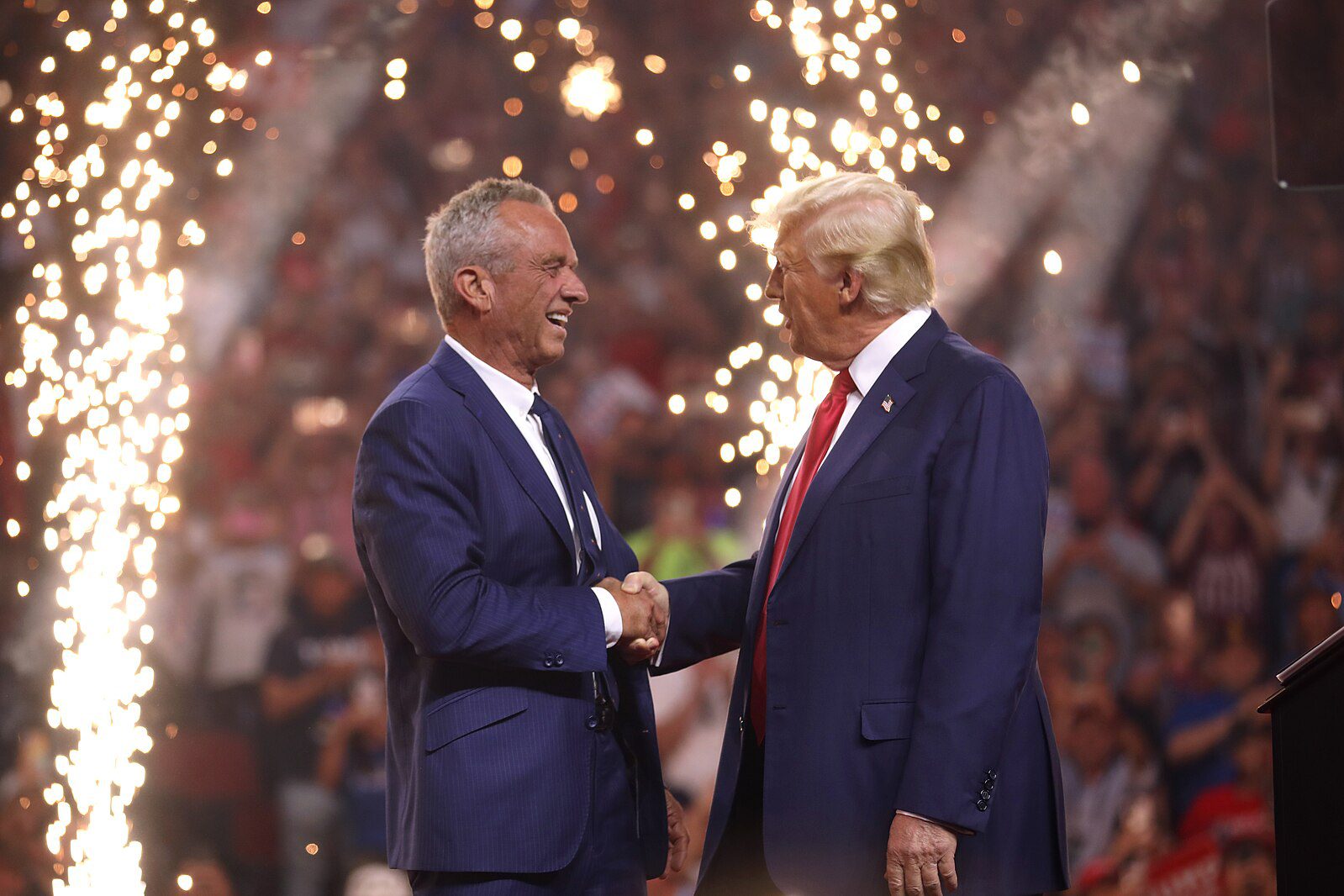 Clearly, a major political realignment is underway in this country. The defection of RFK, Jr. to the Trump campaign and the decision of Dick Cheney to join his daughter in voting for Kamala Harris is just the tip of a very large iceberg.
So just what is going on here? At first glance it doesn’t seem to make much sense. How could the son of the martyred RFK and the nephew of the murdered JFK make such a move? For that matter, how could Dick Cheney embrace the politics of a senator who voted to the left of Bernie Sanders?
Well, maybe it does make some seemingly strange sort of sense. Conventional wisdom suggests that the Republican party has changed dramatically since Donald Trump has become its thrice-married and thrice-nominated standard bearer. But that same conventional wisdom should tell us that the Democratic party has changed just as dramatically–and perhaps even more dramatically.
In fact, in many important respects the Republican party of today has become the Democratic party of yesteryear. Not all that long ago Democrats were the party of the working class. Now the GOP deserves that designation, especially when it is applied to union and non-union private employee workers.
And public employees? Earlier generations of Democrats opposed public employee unions. Now the party relies on them for votes and money, while its leaders castigate working class folks as “MAGA Republican” racists.
In addition, the stranglehold that the Democrats have had on black and Hispanic voters is weakening, especially among men. The same might be said of basing policies on skin color, whether they be affirmative action or outright quotas. They, too, are weakening. As a result, the GOP is gradually sprouting its own version of a rainbow coalition–and one based on issues, not identities.
Speaking of sprouting, once upon a time the Republicans were the party of the fat cats. Now the Democrats can easily match them in this department. They’re just different cats, who have been fattened in different ways.
Not that long ago the Democratic party was much more the pro-life party than was the GOP. That, too, has been reversed–and by a wide margin at that.
The same goes for immigration. Remember when the likes of Paul Wellstone, Bernie Sanders, and Caesar Chavez were all hawks on the subject of illegal immigration. No leading Democrat stakes out a position similar to that today. For that matter, remember when the Republican business class was lobbying for, even thirsting for, cheap immigrant labor, legal or otherwise.
Then there is the subject of Israel. Maybe this matter takes one TRU president to know another TRU president. That would be Donald Trump and Harry Truman. The latter recognized the state of Israel over the objections of many of his foreign policy and military advisers, including General George Marshall, while the former moved the American embassy to Jerusalem and orchestrated the Abraham Accords.
Speaking of foreign policy, the burden of the Cold War, especially at its outset, was mainly borne by the Democratic party with crucial support along the way from the GOP. In fact, in the end it was the Reaganite GOP that brought the Cold War to a successful conclusion. Today it is a Trump-led GOP that most evidences a willingness to stand up to the main totalitarian challenge of our day, namely China and its designs on Taiwan and perhaps elsewhere.
Returning finally to the domestic front, the Democrats were the senior partner in building both the welfare state and what has come to be termed the “deep state,” while the GOP was left to traipse along in a junior supporting role. At this point in our history we are at what might be termed a semi-crossroads: some version of a welfare state is here to stay, but many versions of the deep state must be reduced and/ or dismantled.
The current GOP is not out to dismantle the welfare state. If anything, it is committed to maintaining and solidifying it; hence its emphasis on border control. The economist, Milton Friedman, once contended that the United States could have either a welfare state or an essentially open border, but not both–and certainly not both at once.
Soviet Premier Josef Stalin once observed that the United States was the only country wealthy enough to be able to afford such a state. That would be a single state, not innumerable migrants from the rest of the world.
More than that, the United States also cannot afford an ever-expanding, highly politicized deep–or administrative–state. Such a state must be drastically reduced and politically neutered. In other words, it should become something that the original progressives envisioned that it would be, namely a source of apolitical, essentially neutral expertise.
One of those original progressives, specifically Theodore Roosevelt, was concerned about the ultimate direction of early twentieth century progressivism. On the one hand, he favored the creation of some sort of a regulatory state. On the other hand, the late nineteenth century writings of a grandson of John Quincy Adams deeply worried him. That would be Brooks Adams, who authored a book with the imposing title of “The Law of Civilization and Decay.” Its central argument was at once simple and compelling: civilizations collapse because they become overly centralized.
Avoiding such a collapse is the mission that today’s Republican party is gearing up to lead. It is not at all a fascistic mission. If anything, it is the reverse of that. Nor is it anything remotely authoritarian, let alone Hitlerian.
This is also the moment for the ultimate reversal of our two major parties. Why? Because this time the Republicans will be the senior partner in the operation. Three questions remain: Will the GOP maintain power long enough to bring this reversal off? And will the Democrats be content to serve as the junior partner in this very needed venture? Or will we drift along until the worries of Brooks Adams and Theodore Roosevelt come true.
In the meantime, all of this might help explain why an unlikely outsider like RFK, Jr. is voting for Donald Trump and why the ultimate insider Dick Cheney is casting his ballot for Kamala Harris.
This essay first appeared in the Minnesota Star Tribune.
The Imaginative Conservative applies the principle of appreciation to the discussion of culture and politics—we approach dialogue with magnanimity rather than with mere civility. Will you help us remain a refreshing oasis in the increasingly contentious arena of modern discourse? Please consider donating now.
The featured image, uploaded by Gage Skidmore, is a photograph of Robert F. Kennedy, Jr. and former President of the United States Donald Trump speaking with attendees at an Arizona for Trump rally at Desert Diamond Arena in Glendale, Arizona, 23 August 2024. This file is licensed under the Creative Commons Attribution-Share Alike 2.0 Generic license, courtesy of Wikimedia Commons.




This is not the first time this has happened. The democrats started out as a agrarian party run on Jeffersonian principles, it then became a populist party under Jackson, a southern rights party under the influence of Calhoun, a progressive party under Wilson which is largely where we are now. The GOP started as a nationalist unionist, anti slavery party that advocated for business interests and high tariffs. It remained that way until Theodore Roosevelt and pulled it into a more populist interventionist party. Then under Harding and Coolidge it became more of what we historically know from the republicans. Pro business, free ,market, low taxes, more emphasis on decentralization and allowing states to handle things. Now we get to Trump. His populism is not new, and is always despised by political elites. Times like these are always politically tense, and see political divisions rise to the level of tribalism. It will pass it always does. Sooner or later one party, probably the democrats, will emerge dominant.
Political realignments are always fascinating. And politicians have been known to jump from one party affiliation to another-witness the “sainted” Churchill in the 30 or so years before his ascension to Prime Minister.
I just wonder, however, if political “science” analysis is the key, as opposed to money and the aftermath of the Great Recession. The latter event significantly accelerated the economic populism that was growing as a result of the Reagan administration and the threat theoretically posed by NAFTA. When it comes to American politics, as James Carville said. “It’s the economy, stupid”. Or as Berthold Brecht noted, “Grits first, ethics second.”
Unfortunately neither party is devoted to the limited government established by our Founding Fathers as one party is devoted to a bloated government and pure democracy (rejected by our Founding Fathers) while the other is dedicated to a more efficient federal government that is less bloated but not aligned with the principles of a Constitutional Republic.