
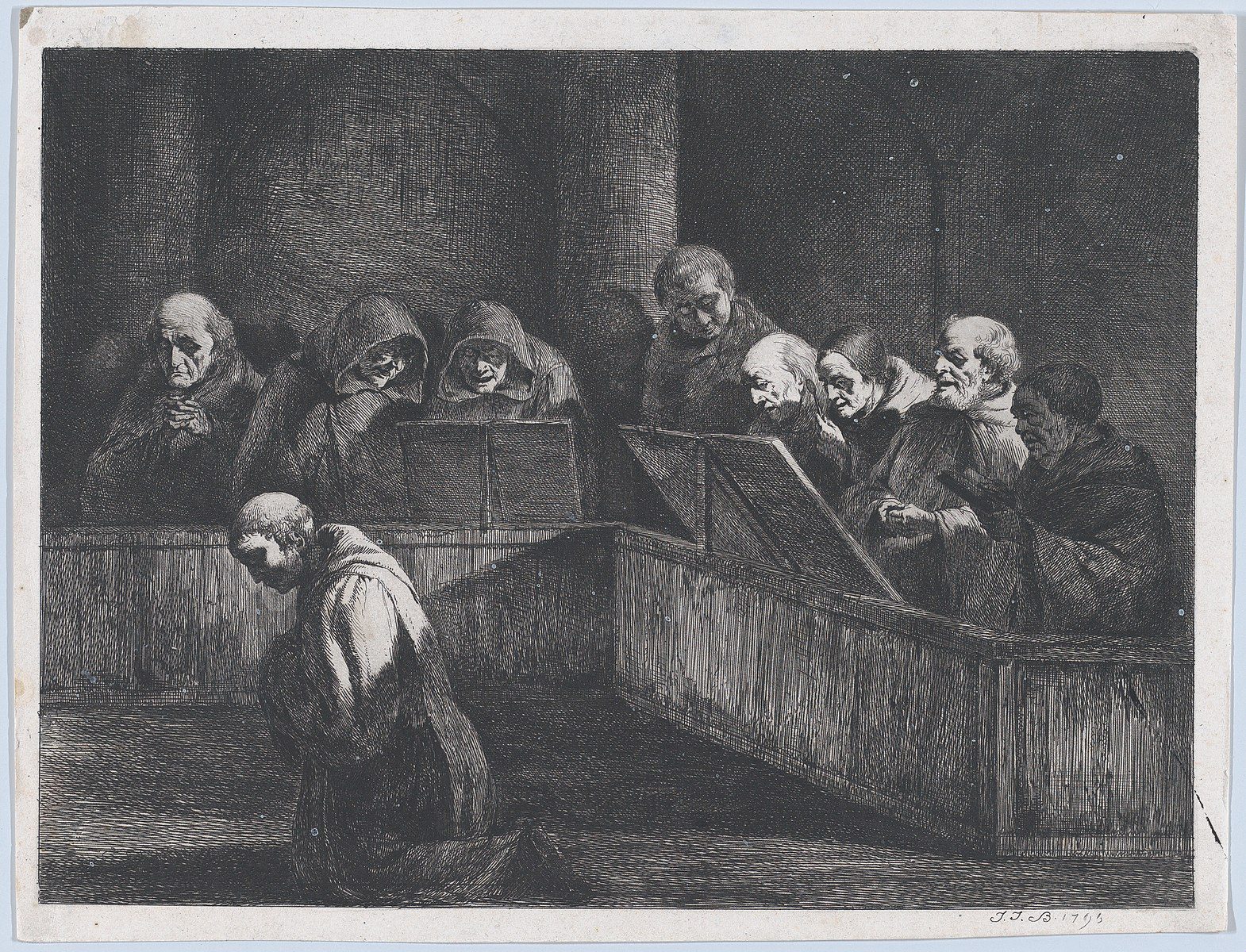
 One longstanding Church practice oriented to the worship of God has been the chanting of psalms and hymns. From the earliest times, monks engaged in liturgical chanting that complemented their often grueling lives. These monks managed to accommodate hours spent in choir while providing for their material needs.
In his French-language book, Pourquoi Mozart, author Dr. Alftred Tomatis tells the fascinating story of how he discovered the “secret” of the monks’ vigor amid their rigorous schedule.
Dr. Tomatis, an ear specialist, recounts how a particular French monastery had followed St. Benedict’s rule for centuries, which entailed several hours of chant a day.
After the Second Vatican Council in the sixties, the monks changed their centuries-old practices. They stopped chanting in Latin and explored the possibility of continuing their chant in the vernacular. When no agreement was reached on how to do this, they decided to stop chanting altogether and replace it with more updated and perhaps more “pastoral” ministries in line with the reforms.
The new schedule had major consequences on the lives of the monks. For centuries, Benedictines have thrived with little sleep. These monks now became fatigued and listless. Even when given more hours of sleep, they continued to be constantly tired.
A decision was made to change the centuries-old vegetarian diet to include meat in the hopes of giving the monks more energy. However, their health did not improve. There seemed to be no way to find the cause of their problems, and the proposed solutions only seemed to make matters worse.
At this point, Dr. Tomatis visited the monastery to test the monks’ hearing. He was surprised to see that many of them suffered from hearing impediments. Upon examining the sequence of changes, he determined the only change related to hearing was the cessation of chanting the psalms together in choir.
He recommended that the chanting resume to see if their conditions might change.
When the monks returned to their old routine of chanting the hours of the office, they experienced an amazing transformation. Most of them became energized and could function again with little sleep. They did not need the new diet. Gregorian chant sufficed to fix their health problems.
In an interview on a Canadian radio station, Dr. Tomatis explained what had happened from his professional perspective. He has long studied the effects of sounds and frequencies on a person. He said the cerebral cortex can become “charged” or positively stimulated by sounds like Gregorian chant.
Thus, he held that the daily chanting sessions brought energy to the monks’ bodies and minds. The regularity and rhythms of the chants have an impact that orders the monk and allows him to do extraordinary things.
Of course, the physical effects of the music are only part of the story. However, it is a fascinating part in an unbelieving world that values only material benefits. Other experts have also studied the effects of chant and found that it can lower blood pressure and help reduce anxiety and depression.
However, the real story is the spiritual impact of the chanting upon the soul. Such music is supernatural in that it lifts the person up toward heaven and the things of God. Its beauty fills the souls with admiration and love of God. When the practices of Faith put the soul in order, the body naturally becomes ordered.
The real conclusion from this story is not how Gregorian chant can serve as a health aide. It is that putting the soul in order should be the first priority. Afterward, everything falls into place.
The Imaginative Conservative applies the principle of appreciation to the discussion of culture and politics—we approach dialogue with magnanimity rather than with mere civility. Will you help us remain a refreshing oasis in the increasingly contentious arena of modern discourse? Please consider donating now.
The featured image is “Monks Chanting” (1795), by Jean-Jacques de Boissieu. This file is made available under the Creative Commons CC0 1.0 Universal Public Domain Dedication, courtesy of Wikimedia Commons.






Remarkable!
Excellent story – and credible…
I wonder if LISTENING to chants can have the same positive physical effects, or does one need to voice the chanting?
How cool is that?!!!!!!
There’s nothing like beginning the day in silent prayer with the low tones of Gregorian chant in the background.
This article was fascinating! Chanting has always been beautiful to hear and now evidence that it is healthy, too! I love how God has provided so many wonderful things for us.
And any chant less than Gregorian does not suffice. I don’t know what kind of chant is done at our church, but it’s ugly.
I love listening to Gregorian chants to fall asleep by!
I love Gregorian chant and really wish some of it would return to church services.
After reading this article, I’ve decided to put on Gregorian chant as I do my morning prayers. I found this article extremely fascinating.
Let me preface by saying I’m not a catholic. But I believe God, in his infinite wisdom created many mechanisms (for, lack of a better term) within us. Science also tends to prove that a cats purring can have a healing effect on humans and other animal species.. while I am what is called a cat person and may be biased in my belief of that theory. Other instances show that dairy cattle produce more and sweeter milk when serenaded with soothing music. I’m sure many of you have seen videos of cattle being drawn to music performed near them, as well as other animals. I would postulate that this music mechanism was a gift from God to all his creations. I would also take it as an example of something once taken on faith, then forgotten, only to be “rediscovered.” Isn’t is wonderful?
My uncle Paul was a Trappist monk, brother Raphael, at the Abbey of Gethsemani, Trappist, Kentucky.
They chant the Liturgy of the Hours during the day.
Their chanting of the prayers gives one a very beautiful, spiritual feeling. Similar to what the author has said about the Benedictines Gregorian chant.
I was an instrumental music teacher for 35 years and professional musician as well a strong Catholic. I recognized the effects of music on my students and myself. We had a men’s Gregorian Choir in my youth and I wish we could see that return. It was so spiritually strong and emotionally beneficial. I would like to see a return of this prayer form much needed today.
This is true.. good… and beautiful ~
I fully agree. I am not a doctor or a priest, just a lay person. No matter what, humanity thinks illness is left to doctors, it is not so. One must want to be healed, must spiritually then mentally and last physically. It’s only then when we can accept the cross that is given that we are healed.
Thank you for this amazing, beautiful and informative piece! It resonates well with my wife and me since we have visited monasteries where we were able to chant the prayers/psalms with the monks.
Science supports what our Church has practised for centuries.
God bless you all.
JJScott
BC
Canada
Wait a minute. This article does not address the possibility of a slightly different reason for the surprising health benefits of singing chant. My guess is that it’s primarily due to singing together in a group for hours each day rather than singing Gregorian chant specifically. Yes, the chant is lovely and does turn one’s heart and mind towards God when truly praying the text. But any amount of choral singing for several hours a day, no matter the text, most likely will have the same effect. I say this as a lifelong choral singer who was taught something along these lines many years ago.
But the article pointed out that the monks replaced the chant with non chant singing, and that that’s when their health began to deteriorate. So, I think your hypothesis is disproved.
I currently lead discussion groups on the Vatican II documents and will share this article to highlight the church’s teachings on the beauty and power of all sacred music and the statement in Sacrosanctum Concilium that Gregorian Chant is one of the highest forms of sacred music. Thanks!
Loved this article! My husband and I have been on a journey to improve health and sleep. I can’t sleep without background noise, so last night I put on Relevant Radio 24 hr Sacred Hymns which were playing Gregorian chant. Not sure if it’s coincidence or what but my sleep score was the highest so far this year! My score typically ranges between 74-87, last night was 91! Think I’ll make this my night time go to.
Beautiful perspective! Food for thought for those moved to listen to Gregorian Chant, and I am by no means suggesting that listening is a bad thing; far from it!
Actively chanting as opposed to passively listening are worlds apart neurophysiologically, psychologically, communally, and spiritually. Not to the same extreme, but watching a football game doesn’t have the same impact as being on the field..
When chanting, we are joining in with the heavenly hosts and the communion of saints in heaven, as revealed in Revelation, in praising God. Our eternal reward will be to endlessly praise God, and our true salvation is in praising God.
The resonance of a chant inside one’s heart and head is different than hearing it externally. Our actively praising God brings us in closer relationship to Him. Our participation in joining together to do so transforms our experience to knowing the heavenly rewards here on earth.
Now, I shall step down off my soapbox and continue my day listening to some Gregorian Chants.
Love this! I’m in awe! I’m only starting to love Gregorian Chant. I’m currently trying to master singing the Gregorian Chant version of the holy rosary! (although my voice is not really good anymore and easily cracks). Trying to muster all the courage to be able to join in leading a live rosary where only 2 people sing. Cant wait! Please pray for me!