
“Stalag 17,” set in a German prisoner of war camp during World War II, is a genuine Christmas movie, albeit a complex one: at once a mystery, a comedy, a war story, and a morality play, all wrapped in barbed wire.
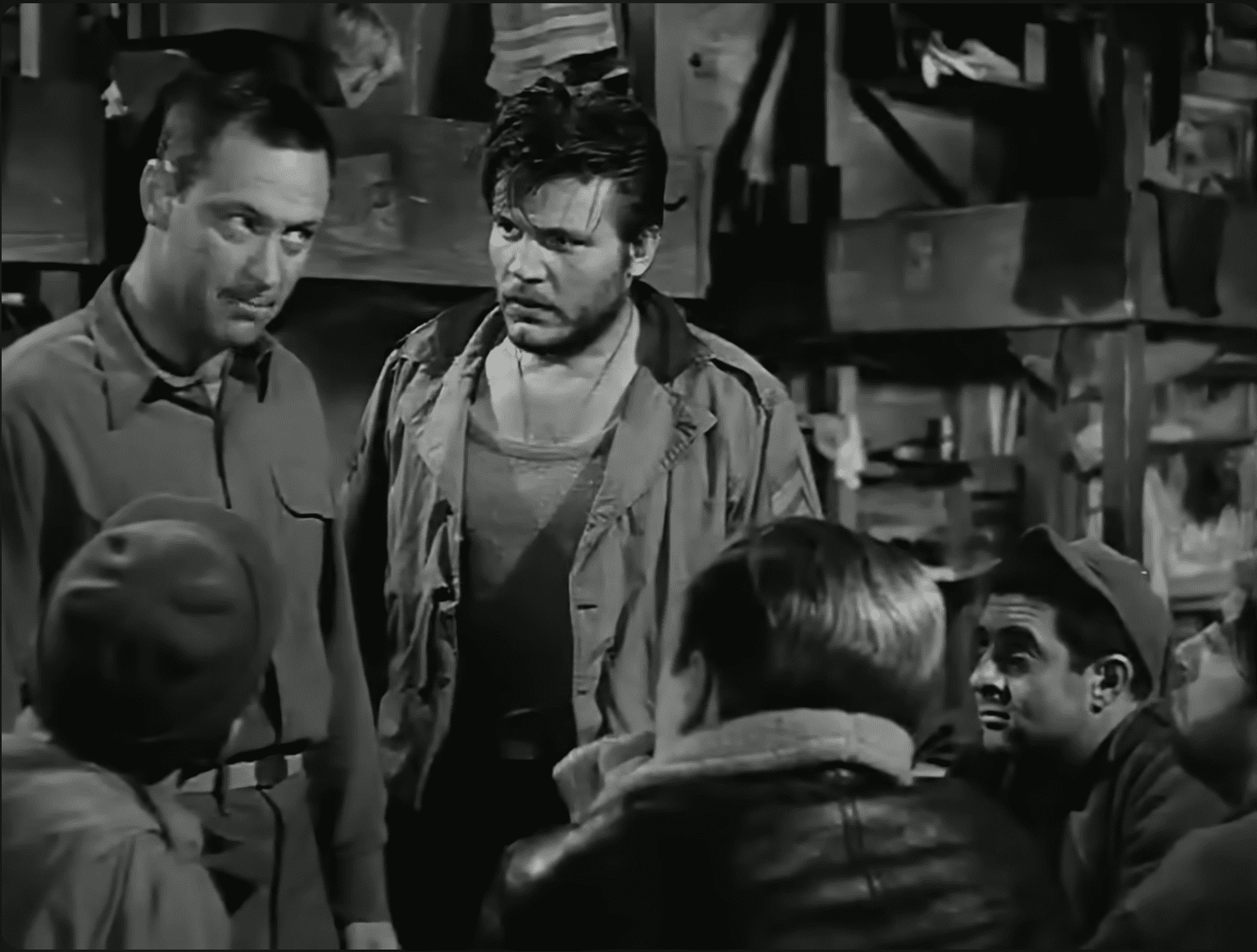 Die Hard changed the definition of a “Christmas movie,” mostly providing dads an excuse to escape The Polar Express and Elf. But if Die Hard qualifies merely because of a holiday backdrop, then so does Billy Wilder’s 1953 masterpiece, Stalag 17. The difference? Unlike the Bruce Willis action flick, Stalag 17 is a genuine Christmas movie—albeit a cynical, barbed, and deeply moral one.
It was the week before Christmas and all through the camp,
Not a soldier was stirring, caught tight in its clamp.
The stalag stood silent, with shadows that creep,
While dreams of escape kept the men from their sleep.
The film opens with a drum corps and “Cookie,” our narrator, introducing American POWs in a German “stalag.” The story unfolds in the bleak lead-up to Christmas, 1944. The screen fills with makeshift decorations, like dog-tag-laden trees. But structurally, the film is a darker iteration of Dickens’ A Christmas Carol.
Sergeant J.J. Sefton is the Scrooge. Flashbacks, instead of a ghost of Christmases past, reveal him to be a prison-savvy hustler. His Scrougish enforcement of his business’ rules—a la “Christmas is a poor excuse every 25th of December to pick a man’s pocket”—sows the seeds of resentment among his fellow prisoners. Then the ghost of Christmas present arrives, and those seeds blossom into poisonous fruit when the American POWs hastily conclude that Sefton is the traitor, whipping themselves up into a mob.
The most fervent member of this lynch mob is “Duke,” revealingly named for a title of nobility. Duke, in all his hot-headedness, comes closest to embodying the villain, even more so than the actual spy, but he’s not. Not really. The ensuing beating, led by Duke, inspires Sefton to turn his entrepreneurial skills, not for revenge on Duke, but to uncover the real spy. One final allusion to the future, should they meet again, incarnates the cynical heroism of Sefton, followed by a sly fraternal salute.
In most Christmas films, the Scrooge or Potter figure is a soulless capitalist, a bourgeois exploiter of the proletariat. In It’s a Wonderful Life, Mr. Potter is the villain; in A Christmas Carol, Scrooge is redeemed only by joining the masses. In both, the collective is unquestionably good.
Stalag 17 is far more complex. Sefton is a resourceful entrepreneur and, thus, nouveau riche. His eggs, wine, abundant cigarettes, and special privileges they buy—including a visit to the women’s prison—provoke the envy of his fellow prisoners. They, like Duke, covet his bounty, which they liken to “Macy’s basement.” Even James Dunbar, a recently captured lieutenant and the scion of a wealthy, aristocratic Boston family, is impressed with Sefton’s trove. New money encounters old money. Dunbar harbors a secret the Nazis crave. The one thing that unites the Americans, from Duke to Sefton, is their determination to keep the secret and Dunbar from the Nazis.
You might think that in a World War II movie, the Nazis would be the villains. But they merely serve as the backdrop, the foil for the unfolding of the true war simmering in the barracks. Nor is the blue-blooded Dunbar the villain. Sefton will mock him, but will be willing to risk his life for him. Class warfare just doesn’t work in America, or American POW camps. Envy—the envy we pretend not to feel for the successful in A Christmas Carol and It’s a Wonderful Life—is the true villain of Stalag 17. It incites the masses to become mobs out for vengeance on anyone who betters them, betraying the ideals for which they are suffering in a POW camp.
The real villain is the covetousness and the self-righteous class-hatred that enflames the mob that beats Sefton and loots his treasures. As Leftists always do, they dress their looting up as a virtue. But it’s not, as they learn by the end of the movie, with even Duke admitting, “Brother, were we all wet about you.” Stalag 17 is It’s a Wonderful Life without the romanticism and with redemption, as if the “riff-raff” of Bedford Falls stormed Mr. Potter’s house, looting everything, beating him mercilessly, leaving him battered and grimly resigned to his loss before deciding to rescue George Bailey from prison. Then the “riff-raff” learn they were wrong to loot Mr. Potter, and so are redeemed too. That’s Stalag 17.
Sefton’s and the mob’s redemption—peace on earth—doesn’t include the breakdown of individuality, with everyone, including Sefton, marching lock-step to “When Johnny Comes Marching Home.” When redeemed, American individuals remain individuals. Yes, Sefton is willing now to lay down his life for a brother-in-arms. But even in redemption, Sefton remains a pragmatist. He’ll risk his life but only when there’s a reasonable chance of success. He has a decoy: the spy he ferreted out.
The Christian message isn’t that Christ came as a mere moral influence, a warming tale that causes our Grinch-like hearts to grow three sizes. Christ had a reasonable, even an absolute, chance of success. Stalag 17 captures this grim, tactical hope. It is a mystery, a comedy, a war story, and a morality play wrapped in barbed wire. It deserves a spot in your lineup. As a bonus, it’s free on YouTube.
__________
The Imaginative Conservative applies the principle of appreciation to the discussion of culture and politics—we approach dialogue with magnanimity rather than with mere civility. Will you help us remain a refreshing oasis in the increasingly contentious arena of modern discourse? Please consider donating now.
The featured image is a still from the YouTube version of Stalag 17.






I saw this movie when I was a teenager.
Along with everyone else, I watched “Hogan’s Heroes” back then. After seeing “Stalag 17”, I remember thinking, “Hmmm. Being locked-up as a prisoner-of-war in a camp run by Nazis probably wasn’t a barrel of laughs.”
I would say I have forgotten the deeper aspects of the movie described in this article. But I haven’t really forgotten; rather, they just never registered in my childish mind.
Will have to see this one again.
Billy Wilder! This is a must-see movie.
I’ve loved this movie for years. I first saw it on TV. I was fascinated and enthralled by the characters, the story and the interactions between the prisoners, the camp commandant, and the go-between, Sergeant Schultz. All are very human and very believable. At first I felt Sefton must be the villain and was waiting for his deserved comeuppance. When it proved he wasn’t the traitor but the clean-cut all American type, I realized that people aren’t always what they seem to be. That to judge by appearances and come to conclusions too soon was a mistake–I was about twelve years old. The lessons that movie taught me never left me. I think it’s a classic everyone should see, not only at Christmas but whenever we need reminding of the values it instills, especially in our time when we are overly quick to judge, especially on social media.