
The Church is like an old schoolmaster, the schoolmaster of the centuries, and as such it has seen so many students pass before it, cultivate the same poses and fall into the same errors, that it merely smiles at those who believe that they have discovered a new truth.
 One of the catchwords which keeps unthinking minds from Truth and Life is the phrase: “The Church is behind the times.” The “acids of modernity” are supposed to have eaten away traditional morality, and yet the Church clings on to the same beliefs and practices held centuries ago. Not only that, but if we are to believe her critics, the Church never does the worldly thing. The worldly thing to do today, according to the modern mind, is to accept divorce and birth control as progressive and forward-looking practices, and yet the Church refuses to compromise, even in the slightest, her centuries-old teaching, that she might harmonize the better with the demands of the twentieth century.
Thousands of people, it is said, would join the Church tomorrow if she would only relax her moral discipline, or re-adjust her idea of God to suit the new astrophysics, or recognize divorce as the Christian sects have done. But the Church remains adamant: the world asks for one thing, the Church gives it another. “If she will not change, then she shall die,” is the pronouncement of modern prophets.…
The Church has been robed in the garment of a fool because she never does the worldly thing. Her saints are fools because they plunge after poverty while other men dig after gold; her saints crucify their bodies, as other men pamper them, they dare “to swing the earth a trinket at their wrist,” while others prostrate themselves before it. Her devout nuns are fools who leave the lights and glamours of the world for the shades and shadows of the cross, where saints are made. Her priests are fools, because they practice celibacy in a world which has gone mad about sex. The Vicar and Pontiff is a fool for refusing to relax the doctrine of Christ concerning the sanctity of marriage, when every Christian sect under the sun has relaxed it. Yes, the Church is a fool, and all her faithful members are fools, but they are fools only from the world’s point of view, not from God’s point of view. For with the foolish things of the world hath God chosen to confound the wise, and with the weak things of the world, to confound the strong.
The Church must always bear the taunt of being unmodern and unworldly, as our Lord had to bear it before Herod. And the divine Master warned us that it would be the mark of the divinity of the Church. “I have taken you out of the world…therefore the world will hate you… If I had left you in the world, the world would love its own… Remember, it hath hated me before you.” In other words, if you ever want to discover divine religion on the face of the earth, look for the Church that does not get along with the world. The religion that gets on with the world and is accepted by the world is worldly; the religion that does not get on with the world is other-worldly, which is another way of saying that it is divine.
But because the Church is other-worldly, and seeks first the Kingdom of God and His justice, it must not be thought that it is out of touch with the world. The Church is not behind the times; it is beyond the times. It is not modern; it is ultra-modern. It is not a slave to the fashions of the twentieth century, for it must keep its head to serve the thirtieth century. The Church is very modern if modern means serving the times in which we live, but it is not modern if it means believing that whatever is modern is true. The Church is modern if modern means that her members should change their hats with the seasons, and even with the styles, but it is not modern if it means that every time a man changes his hat, he should also change his head, or in an applied sense, that the Church should change its idea of God every time psychology puts on a new shirt, or physics a new coat.
It is modern if modern means incorporating the new-found wisdom of the present into the patrimony of the centuries, but it is not modern if it means sneering at the past as one might sneer at a lady’s age. It is modern if modern means a passionate desire to know the truth, but it is not modern if it means that truth changes with the calendar, and that what is true on Friday is false on Saturday. The Church is modern if modern means progress toward a fixed ideal, but she is not modern if it means changing the ideal instead of attaining it.
The Church is like an old schoolmaster, the schoolmaster of the centuries, and as such it has seen so many students pass before it, cultivate the same poses and fall into the same errors, that it merely smiles at those who believe that they have discovered a new truth, for in the Church’s superior wisdom and experience, it knows that many a so-called new truth is but the new label for an old error. Experience has taught it that the modernism of 1932 is not the modernism of 1942, and that what one generation believes to be true, the next will believe to be false; and that the surest way to be a widow in the next age is to marry the spirit of this one. Today the Church is accused of being behind the times, because it does not go mad about Freud. I dare say that in fifty years from now if one of the teachers in any of our great universities mounted his rostrum and talked Freud, he would be considered just as antiquated and behind the times as a politician who today might mount a soap-box at the corner of Forty-second and Broadway, and open a campaign for William McKinley as President.
It is about time that the modern world gave up expecting the Church to die, because she is “behind the times.” Really, she is behind the scenes, and knows just when the curtain will fall on each new fad and fancy. If an announcement had been made a thousand times about a death, and the funeral never took place, men would soon begin to take the funeral as a joke. And so it is with the Church. She is always supposed to be behind the times, and yet it is she who lives beyond the times. At least a hundred men in every century since her birth, have tolled the bells for her funeral, but the corpse has never appeared. They are always buying coffins for her, and use the coffins themselves. They are always assisting at her apparently last breath, and yet she moves amid their dust. They are always digging her grave, and it is a grave into which the diggers fall. The taunt that she is behind the times and out of touch with the world will never bother her, for she knows that it is easy to be in the swim, in the sense of being up to the times, for even a dead body can float downstream. It takes a live body to resist the current. It is easy to say we should change our morality to suit the so-called new ideas about sex, just as it was easy to say a few centuries ago that one should be a Calvinist. It is always easy to let the world have its way; the difficult thing and the noble thing is to keep God’s way. It is easy to fall; there are a thousand angles at which a thing will fall, but there is only one at which it will stand, and that is the angle at which the Church is poised between heaven and earth, and from the angle she has sung a requiem over all the prophets of the past who ever said she was dying, and she will continue to chant requiems over all the prophets of the future, for the story of her life is the story of John in the courtroom of Herod.
Salome danced, and as she danced she kept pace with the time, to be the earthly symbol of all those who change to keep up with the times. As she danced, two men lost their heads, Herod lost his head figuratively, for he believed that a man should change with the times, and that it was lawful to live with another man’s wife. John lost his head literally, for he believed that a man should not change with the times, and that it was not lawful to live with the wife of another. The Church believes that John was right, and Herod wrong, and being a saint, which is the foolishness which purchases eternity, means losing one’s head John’s way rather than Herod’s.
__________
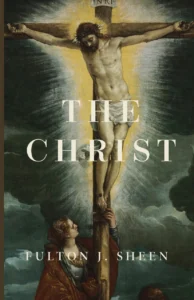
This essay is taken from The Christ.
Republished with gracious permission from Cluny Media.
Imaginative Conservative readers may use the code IMCON15 to receive 15% off any order of not-already discounted books from Cluny Media.
The Imaginative Conservative applies the principle of appreciation to the discussion of culture and politics—we approach dialogue with magnanimity rather than with mere civility. Will you help us remain a refreshing oasis in the increasingly contentious arena of modern discourse? Please consider donating now.
The featured image is “Gothic Cathedral by the Water” (1813), by Karl Friedrich Schinkel, and is in the public domain, courtesy of Wikimedia Commons.




This is very good, and very Chestertonian. But I’m surprised at the lack of attribution. Those thousand angles at which one falls, and only one at which one stands; and that live body going against the flow while a dead one floats with it are striking images. But I’m surprised that a man as scrupulous as Sheen didn’t acknowledge their origin–G.K. Chesterton