
“Strong art destabilizes the self,” a reader commented on my recent essay, “that’s its job.” Really? On the contrary, great art edifies. It engages the isolated and alienated self with goodness, truth, and beauty. It moves us beyond the confusion of the unstable self towards the true stability found in the fusion of sanity and sanctity.
 G.K. Chesterton said of his relationship with his brother that they were always arguing but never quarreled. This distinction between an argument and a quarrel is something I always try to keep in mind when I find myself in a lively discussion with someone with whom I disagree. An argument is an engagement between two or more parties aimed at bringing all participants closer to the truth. It is the pursuit of clarity in charity. A quarrel is a disagreement in which charity is absent and in which clarity suffers in consequence. It is, therefore, in the spirit of a good argument that the following is offered.
A reader named “Dave” has commented in a lively manner on my essay “Richard Wagner and the Seduction of Nietzsche”.
Describing himself as “a huge fan of Wagner and Nietzsche, having studied both music and philosophy for years,” Dave complains of “a lot of issues” in my essay which he seeks to highlight “for honesty’s sake”. He accuses me of confusing “aesthetic experience with doctrinal conversion”:
Nietzsche being “violently shaken” by Parsifal proves he was moved, not that he glimpsed theological truth. He was a trained philologist and hypersensitive to art. Strong art destabilizes the self, that’s its job. You’re leaping from “emotionally overwhelmed” to “offered divine grace and rejected it.” That’s not an argument, that’s wild speculation and projection dressed in incense.
Here are the words of Nietzsche, extolling the praises of Parsifal, which I quoted and commented upon: “I cannot think of it without feeling violently shaken, so elevated was I by it, so deeply moved. It was as if someone were speaking to me again, after many years, about the problems that disturb me – naturally not supplying the answers I would give, but the Christian answer, which after all has been the answer of stronger souls than the last two centuries of our era have produced.” I commented that “Wagner’s brilliance, inspired by his new-found Christianity” seemed to have “violently shaken” Nietzsche’s philosophical resolve, leading him perhaps to question his own philosophy. “It was as though Nietzsche was being granted the grace to see the error of his ways and to repent.”
Dave suggests that I am “confusing aesthetic experience with doctrinal conversion” and yet I never speak of “doctrinal conversion”. He argues that Nietzsche being “violently shaken” by Parsifal “proves he was moved, not that he glimpsed theological truth”. I would respond that “glimpsing theological truth” should not be conflated with “doctrinal conversion”. Glimpsing truth is not the same thing as embracing it. It seems clear to me that Wagner’s brilliance had provided such a glimpse to Nietzsche. He was not doctrinally converted by the glimpse he’d been given and I don’t claim that he was.
I am not so much interested in my alleged confusing of “aesthetic experience with doctrinal conversion” as Dave’s own confusing of aesthetic experience with psychological instability. “Strong art destabilizes the self,” he asserts doctrinally, “that’s its job.” Really?
Aside from Dave’s evident Nietzschean preference for that which is “strong” over that which is “good” or “true”, are we really meant to accept the doctrine that art leads to madness? On the contrary, great art edifies. It engages the isolated and alienated self with the goodness, truth and beauty which supersedes and transcends the self itself. It enables the self to escape its own selfishness so that it can attain the selflessness which is necessary for love. This is the power of great art. It moves us beyond the confusion of the unstable self towards the true stability found in the fusion of sanity and sanctity.
Dave raises a further objection to my reference to Nietzsche’s mental breakdown a year or so after his engagement with Wagner’s Parsifal. “Nietzsche had a mental breakdown from which he never recovered,” I wrote. “This is the tragedy of Nietzsche and the tragic consequence of Nietzscheanism, the latter of which would lead to the madness of Hitler, and the madness of today’s Pride movement.”
Dave distils my meaning as follows: “He criticized Wagner and within a year, he collapsed mentally. Therefore, his pride led to his madness.” He then refers to modern scholarship which links Nietzsche’s collapse to possible neurosyphilis, frontotemporal dementia, or other neurological degeneration. “You’re implying divine punishment or psychological consequence without evidence,” he argues. “That isn’t a fact, it’s theological fan fiction.” I would respond by stating unequivocally that it’s not for me to judge the state of any man’s soul, nor to call down “divine punishment” on anyone. I am, however, very happy to imply that madness is a logical consequence of a philosophy that replaces goodness and truth with the triumph of the will and the idolization of strength over virtue. Nietzsche would no doubt have baulked at the ugly truth that both the Nazis and the Pride movement have been greatly influenced by his elevation of pride (egocentrism) over love (self-sacrificial selflessness) but he is nonetheless responsible, at least indirectly, for these monstrous manifestations of aspects of his philosophy.
Ideas have consequences and evil ideas have evil consequences. It is with this axiomatic truism that I will end my defence and make my case.
__________
The Imaginative Conservative applies the principle of appreciation to the discussion of culture and politics as we approach dialogue with magnanimity rather than with mere civility. Will you help us remain a refreshing oasis in the increasingly contentious arena of modern discourse? Please consider donating now.
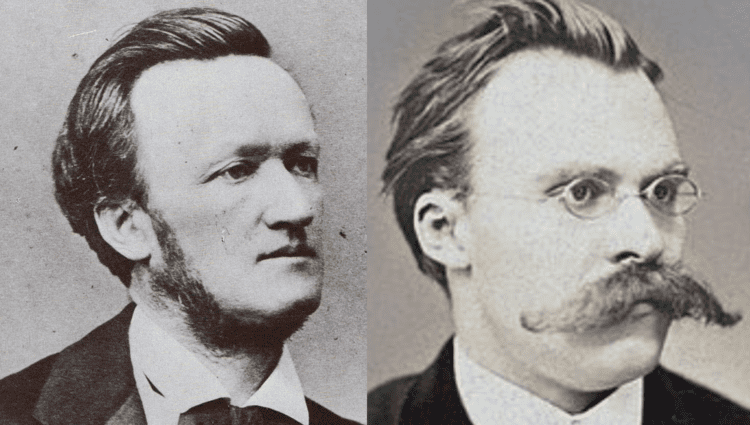
The featured image is combines a photograph of Richard Wagner and a photograph of Friedrich Nietzsche. Both images are in the public domain, courtesy of Wikimedia Commons.




The syphilis theory has pretty much been debunked. Apparently, the doctor who admitted Nietzsche to the asylum merely assumed his symptoms accorded with those of late-stage syphilis and marked the papers accordingly. In the late 19th/early 20th centuries, that was frequently the “default “ diagnosis for conditions such as Nietzsche’s. Subsequent physical examinations made no mention of the physical evidence for the (mis)diagnosis, and a number of contemporary researchers link his insanity to a brain tumor, manic-depressive disorder, or frontotemporal dementia.
What might be the foundation for saying that the job of art is to destabilize the self? Many have said it in slightly different words–e.g., that the purpose of art is to make us uncomfortable or to move us out of our safe space. But to move us where? To make us uncomfortable to what end?
That task, fundamentally, belongs to the Holy Spirit. And the Holy Spirit can use art—or anything else—to make us uncomfortable, to move us out of our safe space, and to destabilize the self. And the Holy Spirit does so to show us our sinfulness, prompt us to repent, and direct us to Christ and the Father. Without that foundation and framework, art is a rudderless boat heading into a storm.
Of course, this reminds me of one of my favorite observations from Chesterton – one of those unpacked profundities he mentions in passing that one returns to again and again as it unfolds its meaning (see below). I think it is likely that Wagner’s piece allowed Nietzsche, for one awful instant, to remember that he had actually forgotten, despite his philosophical obsession with the self.
“We have all read in scientific books, and, indeed, in all romances, the story of the man who has forgotten his name. This man walks about the streets and can see and appreciate everything; only he cannot remember who he is. Well, every man is that man in the story. Every man has forgotten who he is. One may understand the cosmos, but never the ego; the self is more distant than any star. Thou shalt love the Lord thy God; but thou shalt not know thyself. We are all under the same mental calamity; we have all forgotten our names. We have all forgotten what we really are. All that we call common sense and rationality and practicality and positivism only means that for certain dead levels of our life we forget that we have forgotten. All that we call spirit and art and ecstasy only means that for one awful instant we remember that we forget.”
The best art helps us transcend ourselves, and thank God! For one moment, we are free. A little more of that surrender would have been good for poor Nietzsche and his blind love of the ego, something he could never truly understand by worshipping it. I love that, of all people for GKC to compare Nietzsche to, he chose Joan of Arc.
Could I just leave a general comment about Wagner? I enjoy his music much more in its inward-looking moments — Wesendonck Lieder, Parsifal. He set the scene for Mahler’s Nature-worship and Schoenberg’s, too (the beginning and end of Gurrelieder). Wagner’s nobility infuses Bruckner.