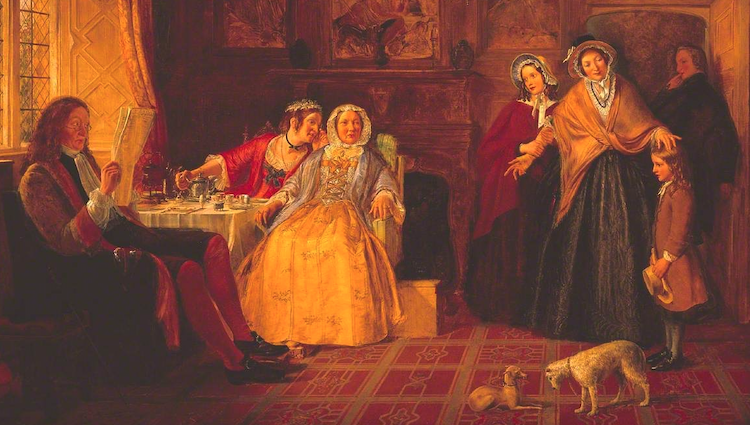
The Celtic Mind: How Adam Smith and Edmund Burke Saved Civilization

By |2016-01-16T12:56:30-06:00October 3rd, 2012|Categories: Adam Smith, Bradley J. Birzer, Conservatism, Edmund Burke, Featured|Tags: |

One contemplates the power, depth, and breadth of the finest 18th-century minds only with some trepidation and humility. Or at least, one should. The favorite study of the great men of that day, famed editor of The Nation E.L. Godkin explained in 1900, was the glorification of the person against political power. In “opposition to [...]
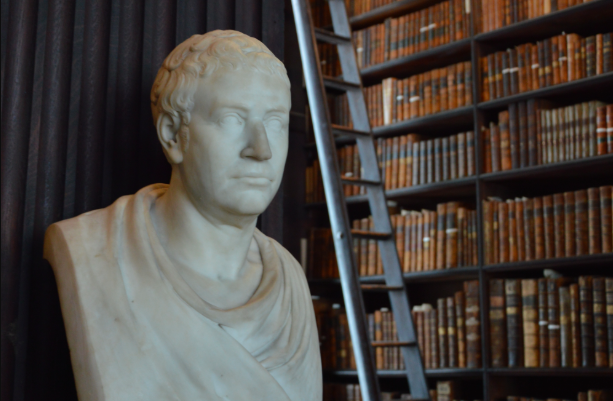
Edmund Burke and the Politics of Empire

By |2020-01-12T13:30:50-06:00September 29th, 2012|Categories: Edmund Burke, Political Science Reviewer, Politics, William F. Byrne|

On Empire, Liberty, and Reform: Speeches and Letters of Edmund Burke, ed. David Bromwich (New Haven: Yale University Press, 2000). Empire and Community: Edmund Burke’s Writings and Speeches on International Relations, ed. David P. Fidler and Jennifer M. Welsh (Boulder, CO: Westview Press, 1999). Edmund Burke was one of those rare figures who combined profound [...]

Use of Poetry: One Man’s Life

By |2015-12-11T15:25:55-06:00September 26th, 2012|Categories: Quotation, T.S. Eliot|

To do the useful thing, to say the courageous thing, to contemplate the beautiful thing: that is enough for one man’s life. Few men have known better than he* how to give just place to the claims of the public and of the private life; few men have had better opportunity, few of those having the [...]

Still Questing for Community

By |2019-09-10T17:04:54-05:00September 26th, 2012|Categories: Books, Community, Conservatism, Robert Nisbet, Russell Kirk|Tags: |

In the retrospect of forty years I can see my book, The Quest for Community (first published by Oxford University Press in 1953), as one of the harbingers of what would become by the end of the 1950s a full-fledged renascence of conservatism. There had been authentic and forthright individual conservatives before the 50s; among [...]

New Groundbreaking Study of Edmund Burke

By |2013-11-27T14:57:07-06:00September 17th, 2012|Categories: Books, Edmund Burke, Ian Crowe, Lee Cheek, Patriotism|

Patriotism and Public Spirit: Edmund Burke and the Role of the Critic in Mid-18th Century Britain, is a groundbreaking study of the great political philosopher Edmund Burke. The book provides a scholarly advancement of existing knowledge regarding Burke and the intellectual milieu that was so important to his development as a thinker. Chapter one offers an [...]

Artists at Home: Frost and Faulkner

By |2016-08-03T10:37:25-05:00September 4th, 2012|Categories: Christendom, Featured, Literature, M. E. Bradford, Robert Frost, South|Tags: |

M.E. Bradford It is a paradox of our times that close observers of the American literary scene residing beyond our borders receive, from the self-appointed guardians of “high” culture and the life of the mind within this country, so little really useful direction or assistance in identifying what American writing is worthwhile or [...]

The War on Terror and the Quest for Community

By |2014-01-16T22:24:46-06:00September 2nd, 2012|Categories: Community, Conservatism, Foreign Affairs, Politics, Robert Nisbet, War|Tags: |

There will be ample disputation at this week’s and next’s presidential nominating conventions, but one point is virtually sure to unite them: a rhetorical commitment to the “War on Terror” and, particularly, to the troops fighting it. Already, Paul Ryan has offered up the obligatory salute to the troops who have “defended our freedom”—which is, [...]

Big Big Train: England is Now

By |2016-02-12T15:28:37-06:00August 30th, 2012|Categories: Christianity, G.K. Chesterton, Music, Progressive Rock, T.S. Eliot, Western Civilization|Tags: , , , |

In the last of his Four Quartets, “Little Gidding”—arguably the finest work of art to emerge in the twentieth century—the Anglo-American poet, T.S. Eliot, offered the following: A people without history Is not redeemed from time, for history is a pattern Of timeless moments. So, while the light fails On a winter’s afternoon, in a [...]

The Effects of War on Education in the Writings of Russell Kirk and Robert Nisbet

By |2015-04-28T01:30:51-05:00August 13th, 2012|Categories: Education, Glenn Davis, Robert Nisbet, Russell Kirk, War|Tags: |

This is part 2 of this essay, for part 1 click here. Glenn Davis According to Nisbet, warfare seduces largely because acts of war demand certain qualities of character from its participants which the community values: valor, heroism, courage, and sacrifice. Individuals who are given the opportunity to manifest these moral qualities, often [...]

A Proper Patrimony: Russell Kirk and America’s Moral Genealogy

By |2016-04-15T10:03:56-05:00August 6th, 2012|Categories: Books, M. E. Bradford, Roots of American Order, Russell Kirk|Tags: |

The Roots of American Order, by Russell Kirk It is nowadays the fashion to think of these United States as a wholly “invented” polity, as the pure and miraculous handiwork of those gifted political craftsmen who were our honored forefathers and whose high achievements we celebrate during this commemorative year. It is also the conventional [...]

Burke’s Wise Counsel on Religious Liberty and Freedom

By |2017-08-13T15:36:37-05:00July 27th, 2012|Categories: Edmund Burke, Freedom of Religion, William F. Byrne|Tags: |

Edmund Burke, the eighteenth-century British statesman, has long been a popular figure for political conservatives to cite. But his views on religion get relatively little attention. This is a shame, because Burke has a lot to offer those concerned about matters of religion, morality, and politics in contemporary American life. He is a figure who [...]

Conservatives and Libertarians: Uneasy Cousins

By |2020-09-23T15:40:41-05:00July 15th, 2012|Categories: Conservatism, Edmund Burke, John Stuart Mill, Libertarians, Robert Nisbet|Tags: |

Modern political conservatism takes its origin in Edmund Burke’s insistence upon the rights of society and its historically formed groups such as family, neighborhood, guild and church against the “arbitrary power” of a political government. By common assent modern conservatism, as political philosophy, springs from Edmund Burke: chiefly from his Reflections on the Revolution in [...]

A Neglected Defender of the Humane Tradition: Canon Bernard Iddings Bell

By |2016-07-26T15:54:32-05:00July 9th, 2012|Categories: Bernard Iddings Bell, Books, Christianity, Lee Cheek|

Clergyman, educator and social critic, Bernard Iddings Bell (October 13, 1886-September 5, 1958) was born in Dayton, Ohio, and educated at the University of Chicago (B.A., 1907), Western Theological Seminary (S.T.B., 1912), The University of the South (S.T.D., 1923), and he also received numerous honorary degrees. In college Bell temporarily rejected his Episcopal Church upbringing. Under the [...]

Go to Top