
For most liberal arts colleges, mathematics courses are simply modern math stuck on to a “humanities” program. But if liberal education is not just meant to familiarize students with classics of the humanities, or the polish of culture, but to free the student to find the truth for himself, shouldn’t math be just as emphasized as the rest of the liberal arts?
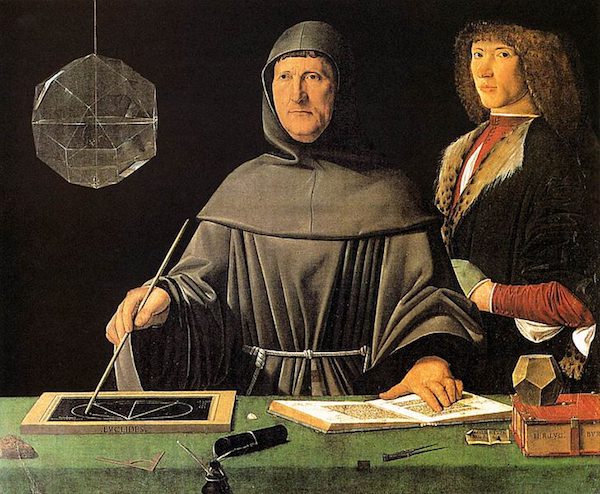 Without doubt, one of the most important courses I had at Thomas Aquinas College was freshman mathematics—a year-long study of all thirteen books of Euclid’s Elements. While very often we were discussing Euclid’s principles and reasoning, much of the course was occupied with demonstrating the propositions from memory on the chalkboard—no notes and only minor nudging. I was not a gifted student in math, so I spend over an hour every night, writing out the propositions to make sure I had grasped all the steps. (My sister, by contrast, would look first at the propositions on the way to class, and then, if called upon, would figure out the proposition from the diagram. I am envious to this day.) The course was not just a training in geometry, but in logic. You could not just “cram” a proposition. The whole thing fit together, one logical link after the next.
The college’s emphasis on mathematics (which included four years of primary texts in mathematics, including Euclid, Archimedes, Apollonius, Descartes, and Lobachevski) is unusual among liberal arts colleges. Only the secular St. John’s College (Annapolis, Santa Fe) offers the same program. The college’s rationale for this emphasis came from the fact that liberal education traditionally included not only the trivium (logic, rhetoric, grammar) but the quadrivium (arithmetic, geometry, music, astronomy). For most liberal arts colleges, the mathematics courses are simply modern math stuck onto a “humanities” program of literature, history, and philosophy.[*]
When I graduated from college and later found myself teaching high school, I persuaded the headmaster to let me teach Euclid to upper classmen. (This tends to be a trademark of TAC graduates—they will always smuggle Euclid into the program given half a chance). I covered far fewer propositions and gave a lot more nudging, and on the whole it went well. Later on, we studied conic sections out of Apollonius and the calculus out of Newton. I saw the same thing happening with them that I had undergone myself. They started to think of math in terms of principles and arguments, and the “logical links” that allowed a proposition to be proved.
Years later, I met a teacher who had been teaching Euclid to “Honors Geometry” students in a private school, who shared with me the common complaint of even high performing math students—”I don’t get proofs!” This is well worth reflecting on. What do they think is happening in mathematical reasoning if they “don’t get proofs”? “I will tell you what’s happening” said the math teacher, “they think of math as an arbitrary system full of meaningless formulas that we plug numbers into and get the approved result.” This fit with an observation that came from my sister who, as I observed earlier, was always good in math. She told me that when she was in high school, algebra was her favorite subject. Why? “Because it made no sense at all—you just have to memorize the formulas and go with it.”
By contrast, one of my favorite moments in college was reading Descartes’s Geometry, and seeing the geometrical diagram for the quadratic formula. (Yes, there actually is a diagram). This formula that I had accepted on faith all through my second year of algebra was visible and provable. More often than not, algebra teachers do not condescend to show students diagrams. Believe! Believe!
Liberal education is not just familiarizing oneself with classics of the humanities, or the polish of culture. Its ultimate goal is to free the learner to find the truth for himself. Algebra is certainly a useful tool for so many tasks in modern life, which indeed are impossible without it. But geometry, studying as it does objects that are evident to the mind and imagination, serves the reason directly, apart from technical application. It is not logic, but one of the easiest ways to experience how logic works. Without this, an important experience is missing. Instead of math helping the student see the need to define, to judge the evidence of principles, and to find logical links in reasoning, students are given what feels like an arbitrary system of symbols. This is the very opposite of liberation.
The Imaginative Conservative applies the principle of appreciation to the discussion of culture and politics as we approach dialogue with magnanimity rather than with mere civility. Will you help us remain a refreshing oasis in the increasingly contentious arena of modern discourse? Please consider donating now.
Notes:
[*] Marcus Berquist’s essay “Liberal Education and Humanities” is particularly clear and illuminating in defense of the traditional approach.
The featured image is “Portrait of Luca Pacioli” and is in the public domain, courtesy of Wikimedia Commons.




Excellent. Wish I had studied it.
I didn’t read Euclid in college, but one of the single best things I did as an undergraduate was a tutorial on symbolic logic. The way of thinking I learned there has stayed with me all these years.
How would I propose this kind of mental fun for my students, elementary and secondary?
Obviously, classical respectively modern mathematics differ in world views. The debate was settled in practice, in disfavour of e.g. Leibniz and Russell, by the Göttingen school. From which came great mathematical physicists like Courant, Weyl, and Noether. Even unto my own Danish high school days, language students had a course on classical mathematics, while I was a mathematics student who learned a lot of modern mathematics. It was only with my participation in the Nordic (and also the International) mathematical olympiad that I became aquainted with classical topics. Certainly, this is not the place for laments on the sexual revolution, but why must Danish school pupils be compulsory indoctrinated with this, while Western knowledge is banned to them? Also, there is computer science, which is outright dangerous in the hands of materialists.
P.S. Sacred scripture is quite healthy in its reservation towards delusions. The socalled liars paradox, studied in perhaps too great detail by suicidal mathematicians like Gödel and Turing, is briefly dealt with, by the Psalmist (“all humans are liars,” Ps 116), and by the Apostle (“Cretans always lie,” Tit). Perhaps it is even resolved by our Lord himself (Matt 7:1). Said quotation from the sermon on the mount is frequently abused in internet debates, contrary to it. Solomon was also prophetic, when he hinted to the failure of calculus based scientism (Eccl 1:15). It seems that he gladly accepted PI = 3 (from the circles inscribed hexagon) as his approximation. Aegyptians, on the other hand, used sqrt(PI/4) = 8/9, which is only of historical importance. Euklid and Archimedes gave us the circle, with circumference diameter multiplied with PI, and the sphere, with area diameter squared multiplied with PI. Christendom, of course, is good also for science, but first and foremost for human beings. And it always took bitter debates to convince nobody. Calculus is still worthwile, e.g. regular calculus as well as vector calculus. And the complex numbers are geometrical (because multiplication with sqrt(-1) is said to rotate a vector in the Euklidean plane with one right angle) and arithmetical (socalled analytical continuation of equations on natural numbers). However, all this still assumes a bit of geometry.