
Without a deep religious faith, Whittaker Chambers could hardly have made his stand against Communism and, in fact, almost failed to do so.
“The one essential condition of human existence is that man should always be able to bow down before something infinitely great.” —Stepan Trofimvovitch, in The Possessed, by Fyodor Dostoevsky
Whittaker Chambers’ Witness is the record of both the phenomenon named by that title and also part of the record of his pilgrimage in faith. Like many such pilgrimages, it begins with a movement within the mind. Near the beginning of the book, he describes what may be called an epiphany, the experience of seeing that there was for him a clear choice to be made between two competing religious views: one represented by Communism, the other by Christianity. I quote from it briefly here:
Then there came a moment so personal, so singular and final, that I have attempted to relate it to only one other human being, a priest, and had thought to reveal it to my children only at the end of my life. . . One day as I came down the stairs in the Mount Royal Terrace house, the question of the impossible return [to life without Communism] struck me with sudden sharpness. . . As I stepped down into the dark hall, I found myself stopped . . . by a hush of my whole being. In this organic hush, a voice said with perfect distinctness: “If you will fight for freedom, all will be well with you” . . . What was there was . . . an awareness of God as an envelopment, holding me in silent assurance and untroubled peace.”[1]
We cannot miss noting that this moment is deeply emotional, intuitive, and non-rational, as indeed befits the nature of such experiences. It is not so far removed in kind from St. Augustine’s ancient vision at Ostia on his way to conversion. Just such an internal spur may be needed to start one on the journey that takes place also outside the mind.
As if to anticipate the charge of irrationality, he goes on to say, “I did not seek to know God’s will. I did not suppose that anyone could know God’s will. For as I was to tell a grand jury ten years later: ‘Between man’s purpose in time and God’s purpose in eternity, there is an infinite difference in quality’ [Kierkegaard]. . . Nor did I ever regard myself as an instrument of God. I only sought prayerfully to know and to do God’s purpose with me.”[2] Yet even with those qualifications, he is in fact acknowledging a role that he grew into as a testifier to that purpose.
Later he reflects on that decision: “The crux of this matter is the question whether God exists. If God exists, a man cannot be a Communist, which begins with the rejection of God. But if God does not exist, it follows that Communism, or some suitable variant of it, is right.” Chambers, in a memo to Henry Luce, draws a sharp dividing line between those who put their total faith in man over against those who put their faith in God first, the choice “between God and no God.”[3] Some readers of such a passage—those of the far left and secularists in general—will of course object to the stark simplicity of the contrast. And indeed, it falls on the side of the simplistic. But it has the advantage of making the choice unmistakably clear. However complex the person, the times, the circumstances, the decision remains. It is the same one with which Flannery O’Connor’s troubled prophet has struggled, as seen in her modern parable, “A Good Man is Hard to Find.” During a rambling discussion with the Grandmother—a fallible, fickle witness of grace—the Misfit opines, “I don’t want no hep . . . I’m doing all right by myself.” The autonomous soul always thinks that way. It is as old as Eden—and fraught with mischief. Yet he struggles still, for he cannot believe or disbelieve, but remains caught on the horns of a dilemma.[4]
While Chambers’ spiritual journey is ultimately distinct from the political dimension, it cannot be understood apart from his early commitment to the Communist worldview and way of life and his ultimate revulsion from them. In one respect it may be said that he simply changed faiths, radically different faiths to be sure. Each one in its own way called for a belief in a reality that cannot be seen and experienced in advance of its actualization. That is to say, the Communist dream is of an order that, while it may be far off into the future, will one day be implemented. Orthodox Christianity, by contrast, projects a transcendent order not to be realized in this world. Moreover, both share a hunger for what I would call existential import, that is, an overarching meaning for one’s life. For Chambers, as for other Christians, that import resides in an ultimate communion in love beyond the temporal order toward which one journeys in hope. The Christian in the interim prays for God’s will to be done. Yet he or she knows all the while that the prospect of its being done here and now is faint and far from view.
Chambers’ ultimate witness is not political. He is homo viator and bearer of testimony, who makes his way in the world with a deep, abiding, and sometimes troubled faith in Providence as acting in the world if in mysterious ways. He himself may be an instrument of that Providence, but it is not invariably clear to him how he is to be used or to what precise purpose. But then, is it ever clear for any of us?
Three principles may be singled out that help define Chambers’ journey. One must always be careful, however, in presuming to encapsulate in absolute terms another’s spiritual life. Such a life is invariably more mysterious than one’s own. That said, the principles are:
- Religious faith inescapably embraces a deep mystery. The ways of God are inscrutable, and the ways of God and man often seem largely irreconcilable even as one seeks to conform to God’s will. (We see this view reflected in the passage from Witness just cited.)
- The acceptance of suffering is redemptive in itself for the person who suffers and potentially has incalculable benefit for those for whom it is offered. Martyrdom in some form can be part of the experience of suffering as Chambers makes abundantly clear elsewhere in the earlier cited passage from Witness.
- A belief in the transcendent, the infinite—specifically in a religious sense—is essential to life, that is, a life with meaning and purpose. And one sign of that transcendence is beauty, in both nature and art.
With these principles as guide, we can look at the external data of Chambers’ journey and selections from his writings as a way of gaining an appreciation of a journey remarkable for its depth, intensity, honesty, deep commitment, and courage. My fundamental argument or assumption here is that Whittaker Chambers’ religious witness is at least as important as the earlier political one and his abandonment of it. Also, without a deep religious faith Chambers could hardly have made his stand against Communism and, in fact, almost failed to do so.[5]
These principles will illuminate—if not fully explain—the various affiliations and turns of Chambers’ spiritual life: his abiding Quakerism, his sojourn in the Episcopal Church, his attraction to both Catholicism and certain tenets of Neo-Orthodox Protestantism, and not least his fascination with the concept—or some would say myth—of the Third Rome. Each of these was a shaping influence on his journey.
Chambers’ relationship with Quakerism was generally a bedrock of support throughout much of his life. (Oddly enough, a number of the key players in the drama of the Hiss trial—Chambers and his wife, Hiss, and Richard Nixon—were to one degree or another identifiably Quakers.) If there is a constant in Chambers’ checkered, spiritual journey, Quakerism is it, as long as the appropriate qualifications are made. What becomes clear, however, is that over time that particular path was not altogether smooth.[6]
Chambers had been familiar with the Society of Friends since boyhood, based on conversations he had with grandmother Chambers, as he recalls in Witness. A keynote of his account of her recollections of childhood is the experience of peace found in a Quaker meeting house, where she went with her mother.[7] This memory, he relates, would spark one of Chambers’ own deepest aspirations. As with many such hopes, it would entail time, struggles, and setbacks before he could attain an equanimity such as his grandmother had described. (Such states are inherently transitory.) One of the setbacks occurred shortly after Chambers left Columbia University and travelled to Philadelphia to join the Friends Service Committee for a mission to Russia. By his account, however, the Philadelphia group learned of the atheist play he had written in college and accordingly wrote him off. The rejection left a wound that took seventeen years to heal. At the time he asked himself “Where in Christendom is the Christian?”[8] It is the haunting question of many a pilgrim.
What I call his sojourn in the Episcopal Church began in early 1941, the fruit of friendship evangelization on the part of a Time colleague. He was baptized in September of 1941 at the Cathedral of St. John the Divine in New York City.[9] But partly under the influence of the Journal of George Fox, the English founder of Quakerism, coupled with a growing dissatisfaction with the Episcopal communion as represented at St. John’s, Chambers began his return to the Quaker communion.[10] My hunch about Chambers’ return is that, given his spiritual temperament, the liturgical tradition of the Episcopal Church—a component shared by Catholicism, Lutheranism, and Eastern Orthodoxy among others—formed less a bridge than a barrier to his search for God. In light of the first principle stated at the outset—faith as embracing a deep mystery—some of the core Quaker tenets lend themselves more happily perhaps to a quest to one with his temperament. Quaker spirituality recognizes God as greater than man and at the same time holds that “there is that of God in everyone.” Moreover, each person can experience God directly and without mediation (of the Eucharist and other sacraments).[11] Such an understanding and approach, I would suggest, does not begin to exhaust the mystery of the relation between God and man and woman. What it does do perhaps is bring the religious quest into sharper, simpler focus.
During his stress-filled tenure at Time (1939-1948) and later during the equally stressful period of the Hiss trial (1949-1950) and its aftermath, Chambers needed a religion that could assure him that he was not alone, that he was trying to do God’s will—as difficult as that was to fathom—and that in the end all would be well. The successes and failures of this quest form the story told in the pages of Witness and elsewhere.
One other fundamental Quaker belief, particularly relevant to the title of his autobiography, is the bearing of witness in word and action.[12] The decision to testify against Alger Hiss, as described in Witness, was neither mean-spirited nor facile. Chambers was conflicted over the prospect of bringing harm to others as well as oneself. And it was only the impetus of religious faith that enabled him to go forward. (Whether Hiss was found guilty or not, Chambers in his own mind knowing he was, was prepared to sacrifice himself in a cause larger than either man.) Chambers was ready to testify in order to make the point—bear witness—that Communism was a great evil whether or not the West saw the need to be, or deserved to be, saved from it.
But apart from that issue, Chambers asserts that the core meaning of the Case and of his life was that his witness was moved by religious faith—which if it cannot so move is worse than useless.[13] One could psychologize upon our subject all day long and conclude at the end of it that he had a martyr’s complex, was narcissistic, mean-spirited, etc. Chambers indeed is an odd fish in many ways; his enemies and the enemies of ordered liberty have exploited certain quirks and derangements of his personality in numerous diatribes.[14] But is it really so hard to believe him when he says “A man does not wish to destroy himself”? Moreover, if one thinks that Chambers’ witness in the Case was merely about testifying against Hiss and Communist infiltration in government, that person has had the experience but missed the meaning, to paraphrase Parson Eliot in another context (The Four Quartets, “Dry Salvages,” II).
The witness Chambers makes not only in the Hiss trial but afterwards was not merely to accuse but to warn and save. He returns to the purpose and meaning of martyrdom in a 1954 letter to William F. Buckley, Jr.: The point in Witness was not that if we destroy Communism we can go about or lives as usual. Rather it was to say, “This struggle is universal and mortal, and only by means of it, on condition that you are willing to die that your faith may live, can you conceivably recover the greatness which is in the souls of men. Therefore, I go a little in advance—to try to win for you that infinitesimal slightly better chance.”[15]
In reading Chambers’ insightful essay on the book of Jonah from the Old Testament, one can hardly miss the parallel between himself and that all-too-human figure as “word-bearers.” Both are called by God to take a message of warning to a great people. In each case, the messenger is fallible and arguably focused overmuch on his own role in the drama, irrespective of the larger picture. In each case, the mission, as experienced by the messenger, ends in one form of failure or another. While Chambers is neither theologian nor Bible scholar, the essay is a revelatory gem of exposition—illuminating both the text and our author.[16]
The image of Jonah also weighs on his mind in a passage from Witness recounting a particularly poignant episode during the first Hiss trial. At one moment in the case, a Kodak expert had testified that the famous film that Chambers had secreted years before, a key piece of evidence, had been manufactured in 1945. Chambers knew better, and on further investigation by the experts the 1930’s date Chambers claimed for the film was indeed verified. The in-between time was, however, a dire, dark hour, one in which he contemplated ending it all. “God is against me, “he said to himself. Like Jonah, he saw himself as “merely a rejected instrument” and no less abject than his Biblical counterpart.
Might he have also recognized in Dante’s Pier della Vigna, in Canto XIII of the Inferno—a familiar text—another companion on the way through the dark wood, along with the exiled Dante himself. As a result of political machinations surrounding Frederick II, Pier, his trusted advisor, was falsely accused of betraying his master. Blinded and thrown into prison, he took his own life rather than live in such a state.[17] Pier’s end could serve as model or cautionary tale.
Chambers quotes approvingly, in this time of trial-within-the-Trial, Kierkegaard’s dictum about the gulf between God’s purposes in eternity and man’s in time. (This is decidedly not a Quaker view, let alone a Catholic one.) Similarly, he appreciates the deeply paradoxical nature of Christian faith as articulated by other major Protestant theologians of the day: Niebuhr, Tillich, and Barth.[18] Thus, Chambers’ response to the first and mistaken report about the film’s date may seem a too-easy sliding off into self-pity and despair. Even so, with all his flaws and quirks upon him, he still shows remarkable resilience and courage in the face of great odds and a capacity for sacrificial suffering, offered for the common good.
In any event, out of the experience of the Hiss case and its aftermath, the ultimate value of suffering for Chambers becomes paramount. Some will see this as merely morbid; Chambers sees in sacrificial suffering a means to an end that can hardly be achieved in any other way. One does not have to seek it out or confect it; it is inherent in the nature of religious reality:
Suffering is at the heart of every living faith. That is why man can scarcely call himself a Christian for whom the Crucifixion in not a daily suffering. For it is by the hope that surmounts suffering that true tragedy surmounts pain and has always had the power to sweep men out of the common ugliness of ordeal to that exaltation in which the spirit rises superior to the agony which alone matures it by the act of transcending it. . . For in suffering, man motivated by hope and faith affirms that dignity which is lit by charity and truth. This is the meaning of the eternal phrases: lest one grain perish, and unless a man dies, he shall not live—phrases as hackneyed as history and as fresh as the moment in which they rose upon the astonishments of the saints. . . Let us say it flatly: What the age needs is less minds than martyrs—less knowledge . . . but that wisdom which begins with the necessity to die, if necessary, for one’s faith and thereby liberates that hope which is the virtue of the spirit.[19]
This passage and others like it suggest to me a view of suffering and martyrdom rather more characteristic of the Catholic tradition than that of Quakerism, not least in its reference to martyrdom. In any case, the issue of sacrificial suffering for Chambers was more complex and fraught with inner conflict more than even this passage may suggest. For it was not simply a matter of taking on suffering oneself for the sake of others but of inflicting it upon others. Even a casual reading of Witness reveals the troubled state of mind his witness (in every sense) brought about.
As for Catholicism and Chambers’ attraction to it, it is not hard to find further evidence of a decidedly Catholic perspective in some of his writings and, perhaps, even a Catholic sensibility. The issue, raised in the April 4, 1954 letter to Buckley, of whether religious faith can still impel one to right action, was one Chambers returned to in later letters to that correspondent, where he comments on a passage from The Drama of Atheist Humanism by Fr. Henri de Lubac. Lubac, he says, points to the phenomenon of many who are drawn to the Faith—Catholicism seems to be indicated—but yet turn back at the threshold. Why? These people may be attracted by the compelling message of the Gospels. They may sense an answer to their quest for answers to life’s deepest questions. But then they encounter Christians who are listless, lukewarm, indifferent. They encounter, that is, the church of the Laodiceans (Rev. 3: 15-16) in a modern incarnation. They do not condemn us; they just can’t take us seriously and walk away. There’s nothing there to motivate anyone.
Yet in a striking passage in the same letter, he goes on to say, “There is only one fully logical conservative position in the West—that of the Catholic Church. . . the Church is the only true counterrevolutionary force . . . because it contains the revolution wherever the revolution manifests that wound.”[20] That is, the Church absorbs the wound that the (Communist) revolution inflicts on its victims, whether individually or collectively. And just over a year later he writes to Buckley again on the issue of what it will take to face “our new reality” in the Cold War period with Communism still a threat to a West not fully committed, in Chambers’ view, to saving itself:
Philosophizing to be authentic must grow out of our new reality, and there take its stand. Burke and High Anglicanism have the least possible to do with that. They, too, are chips, tossed on the blackly running stream, now a torrent. Only the Catholic Church has dared to look steadfastly at that torrent, and measure what it costs a man’s soul to make its passage, not in terms of deflecting hope, but in terms of what cruelly is. But the Church is, by no means, at one on this.[21]
Clearly Chambers has an admiration for the Church, despite the citation from de Lubac (from which he quotes selectively). He admired it from a distance, though, and yet perhaps drew strength from its witness. In an essay on St. Benedict written the same year Witness (1952) was published, his admiration for that figure’s “saving and creative sanity”—as against extremes of sterile asceticism—is abundantly clear. While written in his role as a journalist, it betrays, it seems to me, a personal attraction to Benedict, as suggested by his allusion to a Benedictine medal sent him by a friend and blessed by Thomas Merton.[22] Chambers’ reading of the history of the West suggested that its intellectual and moral confusions in his time stemmed in part from the gradual dissolution of Christendom—which Benedict and his followers had sought to build and preserve.
And following his stay in St. Agnes Hospital in Baltimore after a heart attack, he records a memorable conversation he had there with Fr. Alan, a Passionist chaplain, in which he asks the priest for his thoughts on a passage in Witness which names the West as the losing side. “Who says that the West deserves to be saved?” is the reply that came, one which for Chambers pinpointed the main issue. It was not whether the West had the military and economic might to survive. It was rather whether it had the will and a “faith held religiously whether or not it is wholly religious” sufficient to inspire people in the struggle against its enemies, Communism being only one of them.[23] (Whatever the precise nature of this faith, it is clear that neither Chambers nor anyone else could easily find in Quakerism a theological support for taking up of arms against its enemies.)
While Chambers refers in letters to other Catholic priests with whom he had developed friendships and with whom he had serious theological conversations, there is no indication that he ever entertained the idea of converting. Ralph de Toledano puts his finger on one aspect of the Church that Chambers did not admire. He saw the Church as existing “in the City of Man, not the City of God.”[24] Whether the characterization is completely fair cannot be decided here. The role of the Church in the world over certain centuries of its history certainly lends credence to the charge, but one wonders whether Chambers might have found in Dante’s Divine Comedy and De Monarchia a decidedly different construct on the relationship of ecclesia and empire.[25]
Instead, Chambers appears to have taken his cue from a conversation in Dostoevsky’s The Possessed, a book well known by Chambers, where Shatov recapitulates Nikolay’s attack on the Church (on the same basis de Toledano refers to): “[By] announcing to all the world that Christ without an earthly kingdom cannot hold his ground upon earth, Catholicism . . . proclaimed Antichrist and ruined the whole Western world” [emphasis added].[26] Dostoevsky’s animus against Roman Catholicism is well known and needs no further attention here except as a bridge to another influence on Chambers’ own view on the subject. This is the vision of The Third Rome. Toledano writes, “What Chambers said about the Third Rome reflected his failure to come to terms with the Roman church—a failure shared by me.”[27] What I argue here is that Chambers’ fascination with the myth did not provide a satisfactory solution to the problem he saw with Roman Catholicism. If anything, it rather obscured the issue.
But first, what exactly is The Third Rome concept? One of the longest sections of Cold Friday is devoted to it. A brief summary, along with a few citations from Chambers and The Possessed, will, however, have to suffice here. The myth rests on the idea that the Russian people, or more precisely the Orthodox peasantry, are God-bearing and constitute a redemptive power not only for fellow Russians but for all mankind. In the same conversation between Shatov and Nikolay cited earlier, the former asks, “do you know who are the only ‘god-bearing’ people on earth, destined to regenerate and save the world . . .”? The redemptive power resides in principle not in political leaders but in the capacity of the people for suffering. The myth is embodied and symbolized geographically in Moscow—as the third Rome following Rome and Byzantium—by the domes of St. Basil’s, which before the Revolution could have been viewed from afar by a peasant traveling to the great city. He would have stopped short at the sight in awe and reverence, Chambers imagines.[28] Chambers also alludes in his text to Henry Adams, that fellow American pilgrim to Russia and scion of political aristocracy, who describes the golden domes of Russian churches as upside-down turnips providing no improvement on that vegetable. Clearly, such a mind would not be capable of responding in awe to much of anything beyond its own brilliance. But at least it is a mind that looks at Russian religiosity with eyes wide open.
It seems to me that Chambers, on the other hand, by virtue of his deep and lasting fascination with the myth, gives too easy an assent to a version of gnostic heresy. He describes the religious feelings of the Russian peasant toward two signal beliefs: “the Kingdom of God is within you; a reign of righteousness and justice is possible on earth” [emphasis added].[29] Few would quarrel with the first assertion. It is the latter belief that is problematic. Somehow, at some point, this chosen people is supposed to effect a divinely ordered utopia in the temporal realm. Although cast in a different ecclesial identity and location, this outcome seems not to differ substantially from the problematic status of the Catholic Church in relation to the world named by Chambers to de Toledano and by Dostoevsky’s Shatov to Nikolay. That is, the Church exists in the City of Man and not the City of God. Similarly, in the Third Rome myth Church and world—or empire (see “reign”)—are conflated, confused.
As Eric Voegelin in the New Science of Politics argues, “The spiritual destiny of man in the Christian sense cannot be represented on earth by the power organization of a political society; it can be represented only by the church.” Moreover, Voegelin is not overly impressed with the Third Rome concept, seeing it in the historical stream of other analogous movements, ancient and modern: “The Russian idea of the Third Rome is characterized by the same blend of an eschatology of the spiritual realm with its realization by a political society as the national-socialist idea of the Dritte Reich.”[30] It is, in short, just one more gnostic, millennialist fantasy.
Chambers, to his credit, does call attention to the unfortunate blending of the salvific mission of the Russian peasantry with the “messianism of Communism in which the working class is the instrument of salvation.”[31] But it is not clear that he detects the gnostic worm at the root of the Third Rome myth itself. Could it be that his Russian and European intellectual orientation and his former commitment to the Communist dream have shadowed his vision here? It is hard to say. It is clear, though, is that despite the spell the myth almost cast upon him, it deterred him apparently from entering the Catholic Church, if indeed that was ever an option seriously considered. (I for one, given his attraction to the Church’s highly developed doctrinal tradition, along with his in-depth discussions with several Catholic priests, tend to believe that he did consider crossing the Tiber.) For all practical purposes he remained a Quaker, if a somewhat unorthodox, unsettled, and troubled one.[32]
One major principle with a Third-Rome connection that resonated with Chambers is the importance of a belief in the transcendent. One of the three principles named at the outset, it is essential for a meaningful human life. In Witness, Chambers cites his religious hero Dostoevsky on the point of “the eternal necessity of the soul to be itself.” It should be emphasized, however, that the soul can only be itself by recognizing the infinite greatness of God and its own limitations. On at least two occasions, Chambers alludes to the well-known, dying speech by Stepan Trofimovitch in The Possessed: “The one essential condition of human existence is that man should always be able to bow down before something infinitely great. If men are deprived of the infinitely great, they will not go on living and will die of despair.”[33] Chambers notes of the passage: “it took him [Stepan] a pointless lifetime to reach the insight and his last strength to frame it.”[34] Arguably Chambers, in Witness, in correspondence, in the pages of Cold Friday, in essays on St. Benedict, Reinhold Niebuhr, and others, was giving his remaining strength to make the same case before night descended. The hunger for the infinite, he goes on to argue here, is not detached from reality as we both know and pursue it. The two quests are really one. “It is for that we crave a little height, to reach some notion of the meaning of our reality . . . .”[35] Chambers is easily seen as a pessimist; and occasionally he seems to fall into a black hole. After all, he had acknowledged that in exiting the Communist world he had chosen the losing side.[36] Like many a pilgrim on journey through the dark wood of this world, he finds the way hard and discouraging at times. But he never finally succumbed to despair, despite coming only too close.
One aspect of the transcendent that cannot be overlooked is the phenomenon of beauty as a sign of divinity. That it is addressed in The Possessed should come as no surprise. Again, it is Stepan who makes the case in his lecture before the strangely mixed audience in Part III. While not a cogent spokesman, he nevertheless articulates what is for Dostoevsky, and Chambers, a vital point: without beauty life is impossible, that is to say, not worth the candle.
Independently of the Russian, Chambers along with many an intuitive soul, Quakers among them, came to much the same insight in the context of nature. In Witness, he recalls the riveting boyhood experience of encountering dozens of twittering goldfinches hovering over thistles in bloom in a field covered with them. Almost overwhelmed by the sheer beauty of the scene, he held the hedge for support and said aloud: “God.” The experience yielded to him the intuition that “God and beauty are one.”[37] In this insight he is not alone, as at least two Catholic scholars attest. Jacques Maritain, for one, writes, “Beauty is one of the divine attributes . . . [God] is beauty itself, because He imparts beauty to all created beings.”[38] Chambers was to return to the theme later in life in a passing comment on a non-religious Beethoven Violin Concerto, which nevertheless betrays “a tone of divinity.”[39] And still later, he recounts the experience at a Quaker meeting house with his young daughter of their watching a strand of spider web stretched entirely across the room combined with the singing of birds outside. “In that silence, I gave thanks to God that I had come home.”[40]
It is home toward which the wanderer tends finally to move, whether or not he finally arrives. And whether or not home turns out to be that which one had so long sought. Silas of Frost’s “The Death of the Hired Man” for one comes back to a place he claims as home, but it is such only because “they have to take him in,” deservedly or not. Dante’s Ulysses, aka Odysseus, unlike Homer’s hero pursues knowledge to the ends of the earth and ends his life at sea far from home, a tragedy out of pride and his own making. O’Connor’s grandmother on her brief, unlikely transit from narcissistic vanity to a moment of grace, goes home to the Father of Souls, having fallen victim to the Misfit as potential prophet gone astray in his murderous travels through the Georgia backwoods.
Whittaker Chambers, like so many others of his time, came home from wandering in the ideological, gnostic wilderness of Communism, a pilgrim who bore the marks of his journeying well after crossing back into what was left of the West and Christendom. For many he is a turncoat twice over, a pathological liar, and worse. No one can convince a True Believer otherwise. But for some, he is one of us, we that is who like him make our way brokenly through this vale of soul-making day by day, drawing closer as we can to the light that is always offered to those who seek it with open mind and heart, and a modicum of humility.
What we may, in sum, see in Chambers’ spiritual journey is the imprint of not one or another spiritual tradition but rather an amalgam of elements drawn from several. Along with many of us, he like Tennyson’s Ulysses is a part of all that he has met. Even if, it may be said, not all the parts perfectly cohere. Yet what he came to finally was a home like many homes: imperfect, peculiar, unique, that is to say, human, yet oriented toward the transcendent. He was drawn to Catholicism and to Russian Orthodox spirituality of the Third Rome. He was shaped by the theological perspective of Neo-Orthodox Protestantism. He must have found something initially inviting about the Episcopal Church, as many do. But at heart, in sensibility, his default position was that of Quaker. And that is so, even if he was seen by some of them as a bit of a black sheep.
Toward the end, he had reason to regret his return to that habitat. Sam Tanenhaus, his biographer, recounts that in 1951 his daughter’s application to Swarthmore, an elite Quaker institution of the higher learning, had been rejected despite her sterling academic record. Inquiries indicated likely blackballing because of the political record of her father. (Were the Swarthmore Quakers bearing their own special brand of Christian witness?) Earlier of course, many of the Quakers had sided with Hiss, although not all, as Chambers attests. Tanenhaus cites a family friend to the effect that while Chambers late in the day reaffirmed his status as a Quaker, he began to pull away and lose enthusiasm altogether.[41]
The spiritual pilgrimage of Whittaker Chambers presents to us the story of a man who, broken from the beginning, sought a cure in an ideology that itself was broken and worse—a snare and a dark delusion perpetrated by soulless men and women for whom every means is justified by their ends.[42] Chambers’ life pattern is certainly not one to serve as a model. But what can serve us well in our own journey is the story of his search for a merciful God who again and again seeks to bring the one lost sheep back into the fold. All things considered, it is, I think, the witness and the pilgrimage of one who sought God with heart and soul and mind and strength and was finally found.
The Imaginative Conservative applies the principle of appreciation to the discussion of culture and politics—we approach dialogue with magnanimity rather than with mere civility. Will you help us remain a refreshing oasis in the increasingly contentious arena of modern discourse? Please consider donating now.
[1] Whittaker Chambers, Witness (New York: Random House, 1952), 84. Interestingly, Chambers refers in this passage to “a priest,” but as far as I know he did not have any one particular priest in mind. See also his account of the struggle between Christianity and Communism, 699. In an earlier essay on Chambers, “Whittaker Chambers & the Nashville Agrarians: The Ground Beneath Their Feet,” Imaginative Conservative, February 10, 2021, I address the relationship between farming and faith.
For Chambers, and others, a farm is both home and altar, held in stewardship.
[2] Witness, 85. I would suggest that his disavowal of not perceiving himself as an instrument of God is less than accurate, as we will see. With regard to intuition and faith, see also a passage in Witness where the author describes Christian belief as a paradox within paradoxes, “its logic, human beyond rationality” (507). It is a mode of knowing that is anathema to the rationalistic, secular, gnostic mind.
[3] Whittaker Chambers, “The Direct Glance,” Cold Friday, ed. Duncan Norton-Taylor (New York: Random House, 1964), 68. Irving Howe, a socialist of the day, in a review of Witness, “God, Man, and Stalin,” 81-89, Alger Hiss, Whittaker Chambers, and the Schism in the American Soul, ed. Patrick Swan (Wilmington, DE: ISI Books, 2003), attacks the thesis but in doing so fails to understand Chambers’ point, being more intent perhaps to make several of his own. The memo to Luce is recorded by Sam Tanenhaus, Whittaker Chambers: A Biography (New York: Random House, 1997), 171, and is dated May 6, 1942. Cited hereafter as Whittaker Chambers.
[4] Flannery O’Connor, “A Good Man is Hard to Find,” Flannery O’Connor: Collected Works (New York: Literary Classics of the United States, 1988), 150. We may recall also that Russian pilgrim who near the beginning of his long exile in America castigated the secular consciousness regnant in the West which had “made man the measure of all things.” See Aleksandr Solzhenitsyn, “Harvard Address,” The Solzhenitsyn Reader: New and Essential Writings, 1947-2005, ed. Edward R. Ericson and Daniel J. Mahoney (Wilmington, DE: ISI Books, 2005), 574.
[5] See Witness, 746, 773-774 for two references to suicide as a way out.
[6] There were actually two trials. The first, in 1949, ended in a mistrial. The second, in 1950, resulted in a conviction of perjury. For the sake of simplicity they are referred to as “the trial” or “the case.”
[7] Witness, 129-130.
[8] Ibid., 167.
[9] Sam Tanenhaus, Whittaker Chambers, 165. See also Witness, 483. Chambers describes in Witness childhood attendance at an Episcopal Church where his parents were nominal members. The affiliation of Chambers and his brother ended when they were named as the bearers of whooping cough germs (115).
[10] Witness, 483. While Chambers admired the “solemnity” of the Cathedral, the small group he worshipped with at Vespers—work prevented his attending Sunday morning worship—seemed to him to be less the bearers of Good News than elderly survivors of an age that would not long outlive them. His daughter’s marriage in the Episcopal Church in Westminster is described by Tanenhaus (474) as partly a concession to the groom, but only partly that.
[11] See www.quaker.org. Within the section, What Quakers Believe, see “9 Core Quaker Beliefs – QuakerSpeak.” (Cited hereafter as “9 Core Quaker Beliefs.”) See also,Witness, 483-484 and Tanenhaus, Whittaker Chambers, 171. I would not attempt to make the case that a liturgical worship tradition, sacraments, a priesthood, et al., inherently form a barrier to seeking God, only that for some that may be true. For others these things are efficacious, even essential. In any event, it takes patience, time, and discipline to learn the “grammar” of worship in any communion, whether that be the Mass, praise singing, or silent waiting.
[12] “9 Core Quaker Beliefs.” See also Tanenhaus, Whittaker Chambers, 171.
[13] Witness, 700.
[14] See, for example, David Cort, “Of Guilt and Resurrection,” 133-138, in Alger Hiss, Whittaker Chambers, and the Schism in the American Soul. Cort was a former Time colleague and fellow student at Columbia.
[15] Odyssey of a Friend: Whittaker Chambers’ Letters to William F. Buckley, Jr., 1954-1961 (New York: Putnam’s Sons, 1969), 62. Cited hereafter as Odyssey. The letter is dated April 6, 1954.
[16] “Jonah,” Cold Friday, 265-268. We find a like-minded reading of that story in Robert Frost’s, A Masque of Mercy, Collected Poems, Prose & Plays (New York: Literary Classics of the United States, 1995): “He [Jonah] “can’t trust God to be unmerciful” (394) and, as we know, is chagrined when He finally shows mercy.
[17] Chambers recalls re-reading the Divine Comedy during the first Hiss trial (Witness,766). He notes (with tongue in cheek?): “the subject matter fitted easily into the context of my experience.” The Inferno comes readily to mind. One editor of the poem refers to the temptation to suicide in Canto XIII as an expression of the autonomy practiced by Adam and its “fundamental illogic and falsity.” Anthony Esolen, Notes, Inferno (New York: Modern Library, 2002), 439-440. True enough. One wonders, however, just how luminous such illogic and falsity would appear to a man under the combined pressures of, say, a hostile media, political enemies intent on destruction, an unfriendly work environment, the likely loss of employment, and the threat of an untimely death.
[18] Witness, 769-770 and 506-507. Chambers’ indebtedness to such theologians, along with the shaping influence of Kafka and Dostoevsky, for instance, tended to put him at odds with Quaker theology. In the second passage from Witness cited here (506-507), Chambers refers to his piece on Niebuhr, “Faith for a Lenten Age,” as “my most personal statement about religious faith.” See H. Larry Ingle, “Whittaker Chambers, Alger Hiss, and Quaker Leadership: A Problem for Friends,” Quaker Theology, Fall 2016 (Issue #29), https://quakertheology.org/whittaker-chambers-alger-hiss-and-quaker-leadership/. One of the Friends critical of Chambers’ Quakerism was Clarence Pickett, a prominent Quaker official who had sided with Hiss.
[19] “The Direct Glance,” Cold Friday, 86-87. The passage cited here parallels a number of texts on the meaning of the Crucifixion in the Catechism of the Catholic Church, Second Edition (Washington, DC: United States Catholic Conference, 1997). See, for example: “The way of perfection passes by way of the Cross. There is no holiness without renunciation and spiritual battle” (#2015). See also “The Devil” (1948) Ghosts on the Roof: Selected Journalism of Whittaker Chambers, 1931-1959, ed. Terry Teachout (Washington, D.C.: Regnery Publishing, 1997), 173-174. Cited hereafter as Ghosts.
[20] Odyssey, 138. The date is given as “October 9???, 1956.” By the “wound,” cited earlier in the letter, Chambers means the radical precariousness of a man’s life in the midst of the revolution (see Odyssey, 133, 137). The “wound” by extension points back to the “wound, where the spear, century by century, pierces the side [of Christ]” (137).
[21] Odyssey, 190-191. The date of the letter is July 7, 1957. To be fair to de Lubac, the section which Chambers cites from The Drama of Atheist Humanism (San Francisco: Ignatius Press, 1998), ends on a more positive note than we may have been led to believe by Chambers’ selection (see 125-129). What can rescue Christianity from the slough of despond is not a change in its doctrines, worship, and practice, de Lubac argues, but rather a transformation in the hearts of believers. That itself is, of course, a tall order in every age.
[22] “The Sanity of St. Benedict,” Ghosts, 261, 263. Merton, we may recall, had been a student at Columbia following Chambers’ tenure and was another spiritual traveler who underwent a major conversion on his way to the monastic life, a story told in his The Seven Storey Mountain.
[23] “St. Agnes,” Cold Friday, 12. See also page 21 for a reference to Fr. Bazinet, the oldest of his Catholic priest friends and Chambers’ letter of March 17, 1954 to Ralph de Toledano in Notes from the Underground: The Whittaker Chambers-Ralph de Toledano Letters: 1949-1960 (Washington, DC: Regnery Publishing, 1997), 162. Subsequently referred to as Notes. Finally, in the same volume we find that Chambers’ son John had entered the Catholic Church in the 1950’s, his father referring to him as “a fearful Papist” (239). While tongue-in-cheek, perhaps, the epithet that suggests a certain self-distancing from the Church.
[24] Ralph de Toledano, Notes, 314. Chambers singles out this same posture about early Calvinism in his 1948 Time essay on “The Protestant Revolution,” Ghosts, 248.
[25] The De Monarchia of Dante Alighieri. In brief, Dante’s argument is that the Empire and the Church represent two different orders of power. The former addresses man’s physical nature and being in the world; the latter addresses his spiritual state. Both have their origin in God and should not be confused or be in conflict with one another. That such was not the case in his own time, Dante recognized as well as anyone. For him the existing state of affairs was an aberration.
[26] Fyodor Dostoevsky, The Possessed, trans. Constance Garnett (Norwalk, CT: Heritage Press, 1987), 211. Sam Tenanhaus in Whittaker Chambers, 333, cites a conversation in which our subject spoke of re-reading the novel for the sixth or seventh time.
[27] Notes, 304.
[28] Notes, 300-301; Cold Friday, 175-181; The Possessed, 209. Chambers observes in the Cold Friday passage that suffering is a constant in Russian life, which elicits in at least some profound compassion when it is directly encountered in another person (180).
[29] Cold Friday, 173. Gnosticism is both an ancient and modern heresy, both religious and secular in its multi-form manifestations. In essence, it seeks knowledge by way of the rational intellect at the expense of intuition, “heart,” or what Aquinas calls intellectus. It does so, generally, in its quest for power over being and ultimately over people. Eric Voegelin, who is cited here, has analyzed the nature of the beast with great insight. See also Marion Montgomery’s The Trouble with You Innerleckchuls (Front Royal, VA: Christendom College Press, 1988) in which the author relates the phenomenon to the fiction of Flannery O’Connor, who here and there skewers those “innerleckchuls” who have eaten the gnostic apple, worm and all, and found the meal most tasty. Her Hulga in “Good Country People” is one of them.
[30] The Collected Works of Eric Voegelin: Volume 5, Modernity Without Restraint, ed. Matthew Henningsen (Columbia, MO: University of Missouri Press, 2000), 174, 180. This volume includes three related works: The Political Religions, The New Science of Politics, and Science, Politics and Gnosticism. In the latter of these he identifies Marx not only as a gnostic but as a philosophical fraud.
[31] Cold Friday, 184. The point I would make is not that Chambers is himself a gnostic but rather that in this instance he may not realize fully the implications of The Third Rome concept. Marion Montgomery includes Chambers in a short roster of conversions from Gnosticism, whereby he, along with T. S. Eliot and Richard Weaver, turned a “key from within [its] self-imprisonment.” See his “Modern, Modernism, and Modernists,” The Truth of Things: Liberal Arts and the Recovery of Reality. Dallas: Spence Publishing, 1999), 275.
[32] The Catholic tradition has many notable theologians from the early centuries of the Church onward. I venture to say that the Quaker tradition has few, even allowing for its shorter existence.
[33] The Possessed, 571.
[34] Ibid., 84. He alludes to it also in a late letter (March 26, 1960) to Ralph de Toledano, Notes, 324.
[35] Cold Friday, 84. One cannot help thinking that Chambers is echoing Robert Frost’s “Choose Something Like a Star” in this passage: “It asks a little of us here/It asks of us a certain height. . . to stay our minds on and be stayed.” The search for reality, both finite and infinite, requires the seeker not to be swayed by either praise or blame. At the very least the two men shared a common perspective on both the liberal and Communist mind. Peter J. Stanlis, in “Rehabilitating Robert Frost: The Unity of his Literary, Cultural, and Political Thought,” Imaginative Conservative, April 2, 2012, and elsewhere makes the case. See in particular the section, “False ‘Freedom’ in Art and Society.”
[36] Cold Friday, 11.
[37] Witness, 117.
[38] Jacques Maritain, Art and Scholasticism, With Other Essays, tr. J.F. Scanlan (North Stratford, NH: Ayer Company Publishers, n.d.; reprinted Kessinger Legacy Reprints, 2010), 24-25. See also Thomas Dubay in The Evidential Power of Beauty: Science and Theology Meet (San Francisco: Ignatius Press, 1999). He writes, for instance, “Beauty and design are indeed the language of God” (201).
[39] “In Egypt Land,” Ghosts, 137-138. One of the assumptions about beauty as sign of divinity is that it can inhere in virtually any natural thing, whether or not it is seen as having anything expressly to do with God.
[40] Witness, 485. While the peace of the moment is paramount, its beauty is also implied. Chambers acknowledges to his daughter that “the voice of God was not heard that day,” that is, in the meeting as such. But the Deity was sensed in what a Catholic might name as the sacramentality of nature. Catholics are not alone, of course, in discerning it.
[41] Tanenhaus, Whittaker Chambers, 474. H. Larry Ingle in the essay cited above (my note 17) challenges Tanenhaus’ description of Chambers’ late relationship with the Society but does not entirely contradict it. See his text and note 18.
[42] The issue of collectivist ends justifying any means is at the heart of the argument between Rubashov, the protagonist, and Ivanov in Darkness at Noon, trans. Philip Boehm (New York: Scribner, 2019), 139, a novelby Chambers’ friend and comrade in the ideological wars, Arthur Koestler.
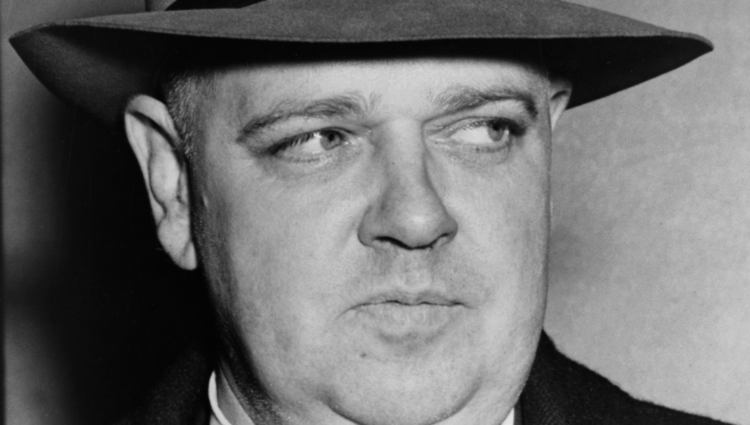
The featured image (detail) is a photograph of Whittaker Chambers in 1948. This image is available from the United States Library of Congress‘s Prints and Photographs division and has no known copyright restrictions, courtesy of Wikimedia Commons.





Wonderful and inspiring article. thank you.
A very well thought out essay. Thank you, Dr. Hubert!