
Glenn Ellmers has written an enlightening biography of the late Harry Jaffa, a political theorist whose views on the American Founding have become conventional wisdom in certain conservative circles. But I find Willmoore Kendall’s views more persuasive, and his warning about the danger of the Jaffa thesis more prescient.
The Soul of Politics: Harry V. Jaffa and the Fight for America, by Glenn Ellmers (416 pages, Encounter Books, 2021)
 Glenn Ellmers has written an enlightening biography of the late Harry Jaffa, a political theorist whose views on the American Founding have become conventional wisdom in certain conservative circles.
Jaffa was a student and devotee of Leo Strauss, the German, Jewish refugee from Europe, whom Jaffa first met when Strauss was teaching philosophy at the graduate level at the “New School” of New York. As Dr. Ellmers notes, “Jaffa was among his (Strauss’) very first Ph.D. students.” Strauss went on to great fame as a professor, and his followers are scattered throughout academia. They are known as “Straussians,” and Harry Jaffa represented one strain of Leo Strauss’ teachings. He and his followers became known as the “West Coast Straussians.”
Strauss’ political thought is subject to various interpretations. As Dr. Ellmers notes, “the ever-growing literature on Leo Strauss can fill a small library. Depending on whom you read, he (Strauss) was a liberal democrat, a self-styled Nietzschean, a pious Jew, a nihilist who thought philosophy was impossible, a philosopher King, a quasi-fascist enemy of liberal democracy, a metaphysical theorist with no genuine interest in politics, or an atheistic theologian who devoted decades to proving the non-existence of God.”
Strauss has even been blamed for “George W. Bush’s invasion of Iraq,” since one of the main proponents of the war was Paul Wolfowitz, Deputy Secretary of Defense in the George W. Bush Administration and a self-proclaimed Straussian.
Suffice it to say, Harry Jaffa became completely absorbed in Strauss’ teachings: “Over the next seven years,” author Ellmers writes, “he attended nineteen courses taught by Strauss, in New York and then Chicago. In addition to classes at the New School, Jaffa would often spend Saturdays in Strauss’ home in Riverdale, just north of Manhattan.” Jaffa became Strauss’ protégé, and he arranged for Jaffa to get a teaching position at the University of Chicago.
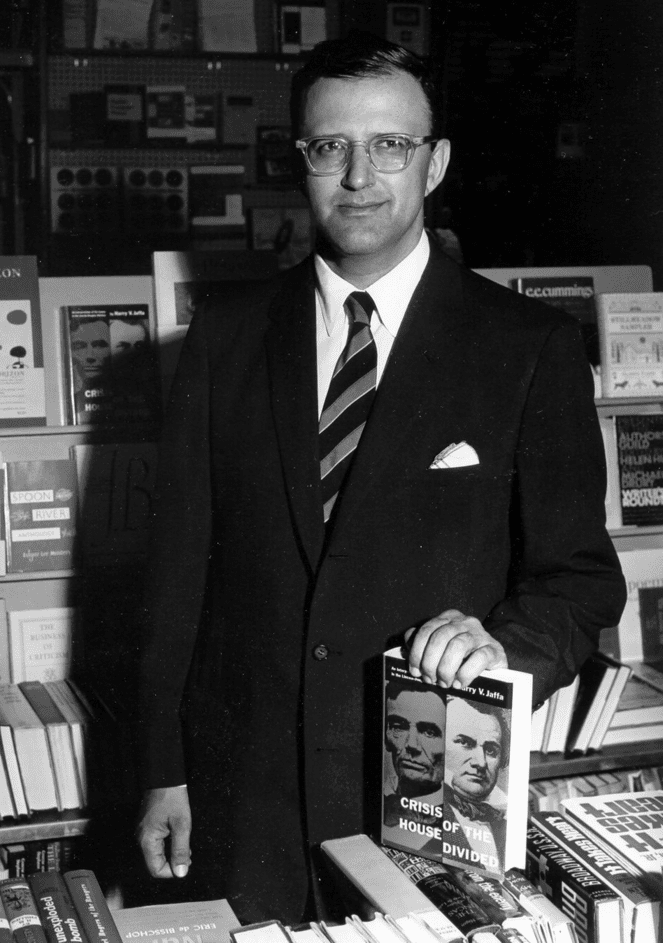
Harry V. Jaffa
Jaffa made a name for himself as a scholar with the publication of his book, Crisis of the House Divided: An Interpretation of the Issues in the Lincoln-Douglas Debates in 1959. He also had a brief foray into politics when he wrote the famous line which Senator Barry Goldwater uttered in his acceptance speech for the Republican nomination for President in 1964: “I would remind you that extremism in the defense of liberty is no vice. And let me remind you also that moderation in the pursuit of justice is no virtue.”
Both Crisis of the House Divided and the line in Goldwater’s nomination speech became controversial. As a young conservative myself at the time, I remember cringing at that line. Barry Goldwater already was being portrayed as a right-wing extremist in the mainstream media, and my immediate reaction was that the expression simply reinforced that image and would damage his campaign for president. Which it did.
Glenn Ellmers discusses the “Goldwater incident” at some length. The first draft of the speech was written by Goldwater speechwriter Karl Hess… and rejected. Jaffa was commissioned to write a new draft, which contained the inflammatory language. As Dr. Ellmers writes, “it caused a major row among his deputies.” But the line stayed in, and the rest is history. Jaffa later claimed that “it was probably imprudent for Goldwater to vent his frustration that way.” The furor ended Jaffa’s brief foray into politics.
But the controversy over the thesis of Crisis of the House Divided is ongoing even today. Harry Jaffa argued that the American Founding was fundamentally flawed because of the existence of slavery and was redeemed only by the “equality” language in the Declaration of Independence. Jaffa believed in the “centrality of the Declaration of Independence for understanding American constitutionalism,” as his biographer notes. Jaffa saw Abraham Lincoln as the man of greatness who freed the slaves and who brought America back to the principles enunciated in the Declaration of Independence.
But the controversy over the thesis of Crisis of the House Divided soon erupted and has continued to the present. It began with Willmoore Kendall’s review—entitled “Source of American Caesarism”—of the Jaffa book for National Review on November 7, 1959. Dr. Ellmers describes the Kendall critique in this way: Kendall argued that
“Jaffa’s Lincoln sees the great task of the 19th century as that of affirming the cherished accomplishment of the fathers by transcending it.” That meant seeing “the equality clause as having an allegedly unavoidable meaning with which it always pregnant, but which the fathers apprehended only dimly.” To fulfill the potential for self-government, Jaffa makes Lincoln the “anti-Caesar, himself as indifferent to power and glory as Caesar is avid for it.” But by establishing, even glorifying, the precedent of what Jaffa himself called a messianic savior, Kendall feared that Jaffa would launch his readers, “and with them the nation, upon a political future the very thought of which is hair raising: a future made up of an endless series of Abraham Lincolns, each persuaded that he is superior in wisdom and virtue to the fathers, each prepared to insist that those who oppose this or that new application of the equality standard are denying the possibility of self-government, each ultimately willing to plunge America into civil war rather than concede this point.”
Willmoore Kendall, a co-founder of National Review, taught William F. Buckley and Brent Bozell, Jr. at Yale, He warned that Jaffa’s revisionist interpretation of the American Founding, if followed, would lead to great problems for America in the future. As a side note, in 1964 Willmoore Kendall was highly critical of the Jaffa line in the Goldwater nomination speech (“Extremism in the defense of liberty is no vice…”). Kendall thought that language was foolish, and he hated it.
Larry P. Arnn, who has written the introduction to Dr. Ellmers’ biography, speaks to Jaffa’s reinterpretation of the founding: “From Lincoln, Jaffa worked his way back to the founding and discovered things in it that had been forgotten.” (Some would say Jaffa “discovered things” that were not there in the first place.) According to Dr. Arnn, Jaffa in his lectures saw “Aristotle as Lincoln, Xenophon as the founding” (N.B.: Xenophon was a “Greek military leader, philosopher and historian”). What Xenophon had to do with the American Founding is hard for me to fathom. And seeing “Aristotle as Lincoln” seems quite a reach. But, with Lincoln and Leo Strauss as his guides, Jaffa makes clear his view that “equality was at the center of the founding’s natural theology.” In Jaffa’s words, “the Founding Fathers intended that the United States of America would be a new Rome.”
This view of the American Founding was new and alien to many conservatives. Dr. Ellmers notes that previously “the authoritative text for many conservatives was The Basic Symbols of the American Political Tradition” by Willmoore Kendall and George Carey. Dr. Ellmers’ book elaborates on Kendall’s thesis that America was “derailed from its true organic roots.” He quotes from the Kendall/Carey book:
“America moved away from the unique and defining principles and practices central to the political tradition of our founding fathers, those associated with self-government by a virtuous people deliberating under God. In their place, it is contended we have embraced a new largely contrived “tradition” derived from the language of the Declaration of Independence with “equality” and “rights” at its center … [Lincoln] turned our tradition upside down by linking our beginnings or founding as a united people with the Declaration of Independence.”
You have to give Glenn Ellmers credit for admitting that Basic Symbols of the American Political Tradition was viewed as the “authoritative text” for “many conservatives” pre-Jaffa.
No longer is that the case. Now, the Harry Jaffa interpretation of the American Founding is the prevalent view in most “conservative” circles. Why is that? One reason is the complete takeover of National Review by the Straussians and Neoconservatives. Jaffa worked on Buckley to change his views on Lincoln and the American Founding with some success. Later, Richard Brookhiser, who succeeded William F. Buckley, Jr. as editor of the magazine, embraced Straussian viewpoints, and the magazine reflected that. Dr. Ellmers quotes Mr. Brookhiser as saying, “when I came to read the founders on my own, I saw how right Jaffa was.”
Equally important was the role of the Claremont Institute, which has pushed Jaffa’s interpretation of the American Founding consistently from the beginning down to the present. Moreover, Claremont’s (and Jaffa’s) influence was greatly expanded when the Jaffaites got one of their own, Larry Arrn, appointed as President of Hillsdale College. Dr. Arrn was a student of Harry Jaffa at Claremont, and Hillsdale is known as a conservative institution. As mentioned above, Dr. Arrn wrote the introduction to the present biography of Jaffa, and Jaffa’s papers are housed at Hillsdale. Dr. Ellmers got his Ph.D. at Claremont and is a research fellow at Hillsdale. Both institutions churn out graduate degrees to students who are taught Jaffa’s views and who often are hired as professors at mostly conservative institutions. Meanwhile, Kendall’s views on the American political tradition have been either ignored, misrepresented, and/or denigrated by the Jaffaites.
Thus, the dominant interpretation of the American Founding in conservative circles came to be that of Harry Jaffa, not Willmoore Kendall. Any conservative who deviates from the Jaffa narrative is deemed a “Neo-Confederate.” That includes Willmoore Kendall, Russell Kirk, Joe Sobran, and Mel Bradford, among others. The Jaffaites constantly frame the argument among conservatives (as does Dr. Ellmers in this biography) as Abraham Lincoln vs. the Neo-Confederates. One can safely ignore the thought of Willmoore Kendall by labeling him as a Neo-Confederate. To Dr. Ellmers’ credit, the author does acknowledge that Kendall’s views differ from the so-called Neo-Confederates; however, Glenn Ellmers gets it wrong in referring to Willmoore Kendall as a “paleoconservative.”
This neglect of Kendall’s thought may be changing. A new biography of Willmoore Kendall by Christopher Owen has been published and is attracting a lot of attention. The Kendall/Carey book Basic Symbols is being rediscovered by many young conservatives. Kendall is no “paleoconservative” as author Ellmers alleges in his book, but a “conservative populist,” as Kendall’s biographer, Christoper H. Owen, correctly observes.
While Kendall believed that Americans were basically conservative (Americans, he liked to say “are conservative in their hips”), Jaffa was much more elitist, his faith resting in the great leader concept (the “philosopher-king,” like Lincoln); he indeed had scant regard for the common man.
Glenn Ellmers maintains that Harry Jaffa changed his view later in life about the American Founding being fundamentally flawed, and that Jaffa gained a greater appreciation for the American political tradition towards the end of his career. That may be true, but Harry Jaffa still saw Abraham Lincoln as a “messianic figure sent by Providence to guide the American people through their trial by fire, a sacrifice in blood to expunge the sin of slavery and purify this almost chosen people. To Jaffa and his followers, Lincoln was seen as a “Christ-like figure.”
By contrast, Willmoore Kendall and George Carey worried that Lincolns’ words and thoughts were associated “with the egalitarianism that characterizes the modern centralized welfare state.”
As a conservative, I find Kendall and Carey’s views on the American Founding more persuasive, and their warning about the danger of the Jaffa thesis more prescient. Glenn Ellmers obviously feels otherwise.
Let the debate begin.
The Imaginative Conservative applies the principle of appreciation to the discussion of culture and politics—we approach dialogue with magnanimity rather than with mere civility. Will you help us remain a refreshing oasis in the increasingly contentious arena of modern discourse? Please consider donating now.
The featured image is a photograph of Harry V. Jaffa in a bookstore circa 1959 –1962, and is in the public domain, courtesy of Wikimedia Commons.



Thank you for the insightful reflection.
As a regular reader of NR, I have always felt a certain disconnect from their positions that I could never quite identify. Your article today has helped me understand why I have felt that way about NR. Thank you.
I appreciate your compliment. As one who read National Review and got to know many of the key figures involved with the magazine, I witnessed, sadly, the transformation of NR.. In its early days, it was an inspiration to young conservatives like myself and others.
I have always marveled that Kennedy’s inaugural lines:
“Let every nation know, whether it wishes us well or ill, that we shall pay any price, bear any burden, meet any hardship, support any friend, oppose any foe to assure the survival and the success of liberty. ”
are lionized as literature. Yet Jaffa’s (Goldwater’s) shortened version of the same sentiment made people gasp and cringe.
I think it was that by 1964 several crisis has spooked the nation and the world. Kennedy had not yet dealt with the many crisis thrown at him (and notably NOT to Ike who was a known quantity to the Soviets). The young President was going to be tested almost immediately and several times. Nuance in speech and manor was demanded by 1964. And the whiz kids gave us some “nuance,” with a bow on it.
Kendall’s insight that Americans feel conservatism “in their hips” is an excellent explanation for the present revulsions against the politicization of education and the media. May they persist and increase!
I wish I shared Pauken’s optimism that there is a revival of interest in Kendall. He was influential in my college days (my doctoral dissertation — never written — was to have been an exploration and documentation of the shift in the Basic Symbols from the Declaration to the Gettysburg Address) but none of my colleagues, even at MountLibertyCollege.org (q.v.) knows anything about him. Let alone the students.
I guess that I have been a “Jaffaite” all along but never knew it. I was a minor in 1964, but favored Goldwater, so I have been a conservative a long time. I always thought that the Declaration of Independence framed the ideals of the Revolution, while the realities on the ground of the existence of slavery were contrary but could neither be ignored nor eliminated overnight by the Constitution. I have also known for several years the admiration of the Founders for Greek and Roman philosophers and leaders – but never thought that they viewed the founding of the US as a sort of renewal of the Roman Republic.