
In “The Consolation of Philosophy,” Boethius is not writing to console us, but to console himself. Philosophy’s role in the work is more than thought: She represents a form of superior wisdom which is easy to forget in moments of strife. Still, for the literary man who has studied books most of his life, like Boethius, this wisdom is never gone and can be recovered.
 Men’s minds are obviously such that when they lose true opinions they have to take up false ones, and then a fog arises from these false ideas, which obscures that true vision. -Boethius, The Consolation of Philosophy
The previous essay of this series, which focused on the 14th century mystic text, The Cloud of Unknowing, introduced the theme of knowledge and Christianity. The focus of The Cloud of Unknowing is on the importance of contemplation—its effects on the mind and soul as it relates to religious experience—as a respite from adversity or what the author calls the “active life” which we all must lead as workers, family members, or students in society. The anonymous monk who wrote The Cloud of Unknowing tells us that contemplation is an exercise in humility, moreover, because it asks that we set aside not only our daily activities but also the knowledge that we carry within us from those activities. As the monk explained, entering this “cloud of unknowing” is similar to entering a “darkness,” where we know nothing and are therefore open to experiencing what comes from the exercise. This approach may sound silly, even outdated for our day and age. As the mystic scholar Evelyn Underhill wrote in her introduction to The Cloud of Unknowing, contemplation was a common practice in the Middle Ages in Europe and all over the world.
What does contemplation have to do with knowledge, if contemplation requires giving up our preexisting knowledge? In one sense, this question is not directly answered by the monk. It is possible to think of some responses, however. We might be familiar with the idea that setting aside preexisting knowledge opens us up to greater absorption of unknown concepts. This fact is certainly part of the answer to the question. Contemplation, moreover, requires a dispositional shift that is different from our usual methods of thinking. When we think, we follow a process that builds one previous knowledge. When we contemplate, the process combines familiarity with wonder, resulting in a much more open-ended process. Still, what kind of knowledge does this method produce?
We must now turn back from the 14th century to the 6th century to articulate the answer to this question and revisit that classic work: Boethius’ The Consolation of Philosophy. The background to the work may be familiar to some readers, but it is worth mentioning here for readers who have not explored the work before. Boethius wrote the work in prison whie awaiting trial under the charge of treason, for which he was eventually executed. As the title of the work implies, Boethius finds consolation in this moment of adversity through what he calls “philosophy.” Certainly, he is not simply talking about philosophy as we might think about it: As a field of study that analyzes the various branches of knowledge to better understand existence and reality. Indeed, Boethius’ understanding of philosophy and the ways it may serve to console a burdened soul is largely influenced by his Neoplatonism. The monk who wrote The Cloud of Unknowing was also influenced by Neoplatonism, which in his case allowed him to combine Christian mysticism with spiritual metaphysics of Classical antiquity. The important thing to bear in mind about Neoplatonism and its influence on Boethius and the anonymous monk is its concern with salvation—that is, a life after this one. In both The Consolation of Philosophy and The Cloud of Unknowing, the view towards another life drives the thoughts of these two Christian authors. As a brief side note, however, the influences of Neoplatonism exists in all three of the Abrahamic religions, so the thoughts presented in these texts are not strictly Christian.
We are now closer to understanding what Boethius means by philosophy and how it serves as a source of consolation. The next step requires actually reading the work itself. Two things stand out: When you flip through the pages of The Consolation of Philosophy, one of the most striking features is how it alternates between discursive meditations and poetic meditations. For this reason, the work reads almost like a journal or diary of various entries. The second element that stands out is Boethius’ use of various points of view. He sometimes writes in the first person, sometimes in the second. His use of the first person, moreover, is not merely self-expository or one directional. That is to say, Boethius is not only presenting his thoughts to us, his audience: His writing is a conversation with himself through a figure he presents as a woman, who we eventually discover is the embodiment of philosophy. Boethius, then, is not writing to console us; he is writing to console himself. Philosophy’s role in the work is more than thought: She represents a form of superior wisdom which is easy to forget in moments of strife. Still, for the literary man who has studied books most of his life, like Boethius, this wisdom is never gone and can be recovered through proper remembrance. Let’s look at one of the poems in Book I. The second stanza encapsulates this sentiment:
A river wandering down the hills
Can be dammed and stopped by fallen rock
From the high crags.
You too, if you want
Clearly to see the truth
And to walk the right road straight,
Cast out joy,
Cast out fear,
Rid yourself of hope and grief.
The mind is clouded, checked,
Where these hold say.[1]
Like our anonymous monk in The Cloud of Unknowing, Boethius describes the all-too-human tendency to “cloud” our minds with emotions, reasonings, and expectations. Boethius likens this tendency to a rock’s obstruction of a river. The implication here is that both the river and the fallen rock are natural occurrences—knowledge (a river) is as natural in its flowing as it is in its being dammed—of which we must be aware, since both are likely. Truth, Boethius tells us, requires that we set aside our positive and negative emotions. Philosophy leads to truth, but there are other sensitive moments that will normally get in the way of this journey.
Now, Boethius’ use of philosophy as a character in his writings might make it seem as though Philosophy fortuitously appears to him in his most desperate moment. We might criticize, as a result, Boethius’ luck at having Philosophy be such a direct and explicit teacher to him. Consider the following conversation between the two of them:
“Now tell me, since you are not in any doubt that the world is guided by God, do you perceive what kind of governance it is guided by?” “I can scarcely understand your meaning,” I [Boethius] said, “much less answer the question.” “I [Philosophy] was not mistaken, was I, when I said that something was missing, leaving as it were a crack in a strong wall, through which the sickness of your troubles stole into your mind? But tell me, do you remember what is the end of all things, towards what purpose does the whole universe aim and move?”[2]
We must remember that Boethius is having a conversation with himself, even though he switches back and forth between himself and Philosophy. In this sense, Boethius’ form of inquiring himself is very much similar to the way that Aristotle and Plato write; that is, through the use of characters who represent a certain way of thinking, except that Boethius is only conversing with one other character. This character, of course, represents his philosophical education. Boethius responds to Philosophy’s questions in the subsequent dialogue:
“Yes;” and I said they came from God.
“Then since you know their origin, how can you not know their end? The nature and strength of these troubles is such that they can dislodge a man, but they cannot tear him out and completely uproot him. Now I would like you to answer this: you are aware that you are a man?”
“How could I not be?”
“Then can you say, what is a man?”
“Are you asking me if I know that I am a moral, rational animal? I do know that, and admit to being such.”
“And do you not know that you are anything more?”
“I am nothing more.”
“Now I know,” she said, “that other, more serious cause of your sickness: you have forgotten what you are. So I really understand why you are ill and how to cure you. For because you are wandering, forgetful of your real self, you grieve that you are an exile and stripped of your goods; since indeed you do not know the goal and end of all things…”[3]
Philosophy hints at a deeper understanding of man. This definition, we eventually learn, is a Christian understanding of man as sharing in God’s image. Man for Boethius is more than a “moral, rational animal,” but knowing this fact requires a journey to understand it. As Philosophy says to Boethius, he is “wandering” and forgetting himself because he is viewing his own suffering and pain as a mark of injustice done to him. As philosophy says, “you do not know the goal and end of all things.” Recall our epigraph. Boethius learns and tells us something similar as in his poem, cited above. The loss of “true opinions” results in the adoption of false ones, which in turn becomes an inhibitor for the vision that is necessary to form these true opinions. The Consolation of Philosophy demonstrates how Boethius is reminding himself how to think, but it is also an example of how Boethius consoles himself in his distraught situation by looking beyond rationality and morality.
Philosophy consoles Boethius by making him realize that his frustration against his current misfortune is a result of him being “faint with desire and longing” for his “previous good fortune.”[4] Philosophy, however, gives Boethius a sharp reply; that it is “simply the change” in fortune that is resulting in his frustration. The conversation turns into a criticism of fortune’s whims, where Philosophy reminds Boethius that he “never had anything worth having” at fortune’s hands and, therefore, has not “lost anything.”[5] This point is more critical than it may seem. Boethius (through the voice of Philosophy) is telling us that fortune neither gives nor takes unless we view it so. Philosophy adds, moreover, that the “sudden and complete” changes in man’s affairs do not happen “without some sort of disturbance of the mind,” meaning that changes do not happen unless the mind perceives it as a change.[6] The point may appear to be a mind-over-matter type of comment, for Boethius seems to imply that fortune is never the reason for change; only the mind’s disturbances. There are moments where Philosophy does provide us with some platitudes, such as when she rhetorically asks Boethius, “why then do you mortals look outside for happiness when it is really to be found within yourselves?”[7] That said, Boethius may also be telling us something more complex through Philosophy: Change is not the result of fortune; change happens regardless of our ability to cope with it. Our minds, then, perceive change as a cause of fortune’s good graces or punishment, but this perception is distorted and leads the mind to error.
Near the end of the work, we learn that Boethius struggles to accept the perennial problem that is free will; “that God foreknows all thing and that there is any free will.”[8] He meditates for some time on this problem, making the argument that if nothing escapes God’s knowledge, then no action can truly be free. The problem for Boethius, who is in jail and stripped of all his possessions as he awaits a trial to be executed, is how God could let this happen to him. Certainly, this is a question that has been asked by innumerable thinkers and individuals, perhaps even by us. Philosophy knows this retort, of course, and remarks how Boethius’ complaint is “the old complaint about providence…”[9] Philosophy explains to Boethius the difference between “prevision” (praevidentia) and “providence” (providentia) to help him to realize that God’s knowledge “does not alter the proper nature of things, but sees them present to him just such as in time they will at some future point come to be.”[10] Philosophy’s point is about the different way in which time moves for God and for us. Her analysis is intricately philosophical, but sufficiently allays Boethius’ concerns. Free will is true, she asserts, as a result of God’s omniscience.
To close these two essays requires looking back at our title that describes the “two ends” of knowledge. There may certainly be more ends, but these two are the central takeaways from The Cloud of Unknowing and The Consolation of Philosophy. The first is that knowledge lies in the awareness of knowing when knowledge is no longer necessary for spiritual (mystic) contemplation; counterintuitive as this phrasing may strike, this conclusion was the monk’s lesson to us in his work. The second end, imparted by Boethius, is that knowledge is always with us as a result of our years of study and dedication to the liberating arts and, as a result, provides us with the tools to console ourselves in times of struggle. It is no easy feat, however, for it requires overcoming our rational and moral minds that assume to know many things. When life (not fortune) throws an unpredictable event at us, our minds can’t help but to try to make sense of it. It is here that Philosophy can serve a greater purpose by being connected to the wider Christian teaching, not just about providence, but more importantly about the importance of faith as true knowledge. This is the conclusion of The Consolation of Philosophy, but it is a conclusion that I won’t articulate beyond this point. The way that lady Philosophy persuades Boethius requires reading The Consolation of Philosophy, and it is an argument that is not worth repeating here if it will come at the expense of the reader picking up this timeless work for himself.
This essay was first published here in June 2021.
The Imaginative Conservative applies the principle of appreciation to the discussion of culture and politics—we approach dialogue with magnanimity rather than with mere civility. Will you help us remain a refreshing oasis in the increasingly contentious arena of modern discourse? Please consider donating now.
Works Cited:
Boethius, Anicius Manlius Severinus. The theological tractates. New ed., Reprinted. The Loeb classical library 74. Cambridge, Mass: Harvard Univ. Press, 2003.
[1] Anicius Manlius Severinus Boethius, The theological tractates, New ed., reprinted, The Loeb classical library 74 (Cambridge, Mass: Harvard Univ. Press, 2003), 173.
[2] Boethius, 169–71.
[3] Ibid.
[4] Ibid., 175.
[5] Ibid., 176.
[6] Ibid., 177.
[7] Ibid., 195.
[8] Ibid., 395.
[9] Ibid., 405.
[10] Ibid., 427.
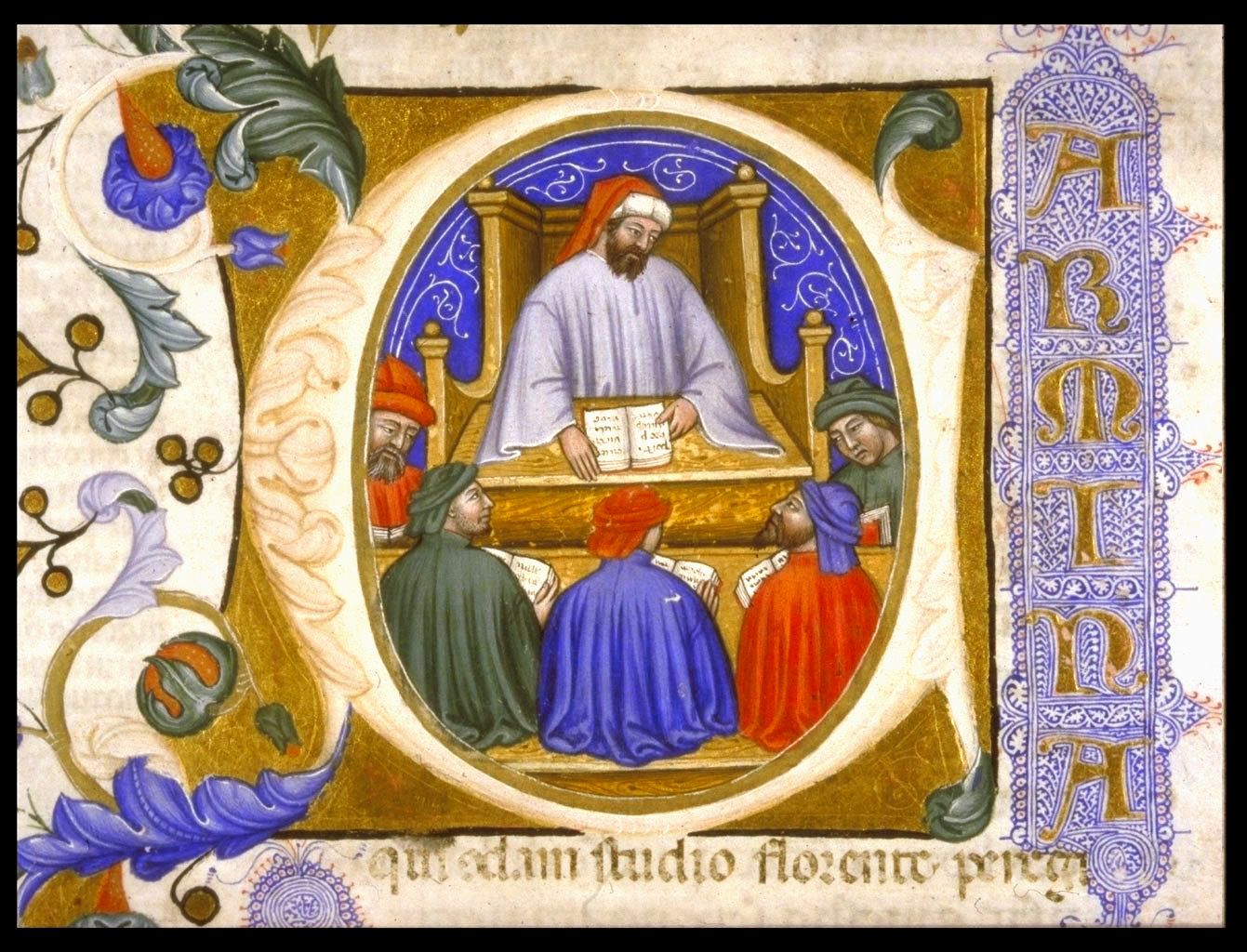
The featured image is “Boethius teaching his students (initial in a 1385 Italian manuscript of the Consolation of Philosophy), MS Hunter 374 (V.1.11), Glasgow University Library.” This file is in the public domain, courtesy of Wikimedia Commons.



I have not read The Consolation…, and in all honesty, it’s not likely I will. But I learned of it here, and in one of The Great Courses. So I know next to nothing! But I will say this: the sufferings of man don’t alter his end, which is union with God. If we can embrace this, then Philosophy has done her job.