
C.S. Lewis believed that every nation possesses what he called a “haunting,” a “Logres,” which baptizes it with a unique inner life. What, or where, is America’s Logres? Who is the mythological hero that could guide the American identity the way Arthur guided Britain and inspired generations of English poets and artists?
During my undergraduate years, I was in search for something that I could call the American myth. I asked my American literature professor, and he pointed me to the mythos surrounding “the immigrant,” “the frontier” and “the American Dream.” I think he was right, in a sense, but it wasn’t quite what I was looking for.
As a kid, I struggled to understand why books like The Chronicles of Narnia, The Wind in the Willows, and Peter Pan were so much more meaningful to me than Tom Sawyer and Huckleberry Finn. Tom and Huck were certainly enjoyable, and enough of their adventurous spirits rubbed off on me to keep me in plenty of trouble. But still, I felt that something fundamental was missing in the soul of American literature. Was it my penchant for fantasy? Perhaps, but even Superman, my favorite childhood superhero, left something to be desired. The comic books claimed he was an alien, but there was nothing really alien about him. Superman was too much like Clark Kent.
“The Myth of the Immigrant” is probably an accurate way of defining the American identity. America is in reality a nation of immigrants. The meta-narrative of the archetypal immigrant sprung out of this reality and played an important role in securing America’s position as the theatre of the world—Hollywood and Broadway being our largest cultural contributions to the world stage. Walt Whitman would have praised it as the “parade of democracy,” but I might put it a little more sardonically as a carnival of cultural simulacra. A country that is home to everyone is also a country that is home to no one. To be the world of endless opportunities may elevate us on a pedestal, but to be forever elevated on a stage is more tragic than comic. We become strangers in our own home. We become like the raven from Noah’s ark, forever flying freely over the waters, but finding no place to land.
Facing what could be called my own literary crisis, C.S. Lewis became the voice to my unrest. In his novel That Hideous Strength, Lewis poses England’s essential struggle as the battle between Britain, (manifested in the tyrannical technocracy of Bragdon College) and Logres (the name for the kingdom of the legendary King Arthur). Ransom, who is the seventy-ninth Pendragon, and his confidants in the manor at St. Anne’s, are seen as the heirs of Logres, which, in Lewis’ view, is the true lifeblood of England—of which Bragdon and the N.I.C.E. are imposters. It is Logres which has always kept England grounded in her true identity. As Lewis writes, “In every age [Britain] and the little Logres which gathered round them have been the fingers which gave the tiny shove… to prod England out of the drunken sleep or draw her back from the final outrage into which Britain tempted her.”
Lewis believed that every nation possesses what he called a “haunting,” a “Logres,” which baptizes it with a unique inner life. For China, it was the Tao. For the ancient Greeks, Logos. For France, the Culte de la Raison. To put it another way, each nation’s “haunting” plays the role of John the Baptist. It is the herald, the forerunner, the wild voice crying in the wilderness that prepares the way for the Lord. As Ransom says in That Hideous Strength:
If one is thinking simply of goodness in the abstract, one soon reaches the fatal idea of something standardized—some common kind of life to which all nations ought to progress. Of course, there are universal rules to which all goodness must conform. But that’s only the grammar of virtue. It’s not there that the sap is. [God] doesn’t make two blades of grass the same: how much less two saints, two nations, two angels. The whole work of healing [Earth] depends on nursing that little spark, on incarnating that ghost, which is still alive in every real people, and different in each. When Logres really dominates Britain, when the goddess Reason, the divine clearness, is really enthroned in France, when the order of Heaven is really followed in China—why, then it will be spring. But in the meantime, our concern is with Logres.
It is my contention that in regard to our “haunting,” America suffered a premature birth. Her success could be likened to the sower’s seed which fell upon shallow soil, sprang up too quickly, and withered. Unlike Britain, where the seeds of Christianity were originally sown on the haunted, Pagan-Christian soil of Logres and Beowulf, American Christianity was founded explicitly by peoples whose Christian beliefs had taken root in the native soils of other nations before being transplanted to American soil. Puritanism was a Christian tree uprooted and transplanted to American soil. Having originated in Calvin’s Geneva, it was transplanted to Holland before being re-transplanted to Britain and then to America.
I am not arguing, as some have argued, that we would be better off if we returned to our so-called “Pagan” or “primitive” roots. Rather, I see paganism as a necessary precursor to Christianity, and therefore needs to be properly engaged with in order for Christianity to take firm root. Lewis understood the problems of a Christianity poorly transplanted. He called himself “a converted Pagan living among apostate Puritans” [1] and held “a firm conviction that the only possible basis for Christian apologetics is a proper respect for Paganism.”[2] In Lewis’ view and mine, each nation’s haunting mythos has its own unique flavor which can only find its ultimate actualization in Christ, but a world truly united under Christ would not render every nation the same. Rather, it would make each flag fly more boldly. Christianity is the single, uniting drop of red dye, but every solution it mixes with will produce a different color.
My discovery of Logres and the role it played in English literature gave me a lead in my search for the American myth. What, or where, is America’s Logres? Who is the mythological hero that could guide the American identity the way Arthur guided Britain and inspired generations of English poets and artists? We could certainly use such a hero at this crucial time in the matter of America. This is the point where I believe we arrive at our principle incongruity with the motherland. America does not, in any real sense, have a King Arthur. George Washington may be our best candidate, but we must understand the necessary qualifications of the mythological hero. For one thing, he must be mythological. George Washington cannot fill the role of King Arthur because he lacks any kind of historical ambiguity and therefore cannot function as a mythological figure. (I would categorize the story of the cherry tree as more moralistic than mythological.) Nor would a purely fictional character, like the Lone Ranger, be a sufficient substitute for Arthur. Arthur’s defining characteristic is his “solar blend” of fantasy and reality. He probably wasn’t real, but he certainly wasn’t entirely “made up” either. Historical or not, he was the indisputable cornerstone of historical realities, and his mythological dimensions made his impact on British literature even greater than it would be otherwise. It is this friction between two worlds, this unresolved tension, which furnishes the Arthurian myth with inexhaustible meaning. The most disappointing fact about the Lone Ranger is that he is not historical. The most disappointing fact about George Washington is that he is.
One of the major themes of American literature is that of the “new frontier.” This sounds promising. There must be in every nation’s haunting something which resembles a frontier. But again, the American vision of the frontier disappoints. Logres was not a traversable frontier: It could not be crossed by crossing the Mississippi. If our guiding myth is based on a traversable frontier, what becomes of our identity after we cross it? We have crossed the Mississippi, the Rockies, the dessert, reached the Pacific and put men on the moon. We have quite literally left no stone unturned, leaving us with nothing but the cheap speculations of Star Trek—a pseudo-mythology which, compared to Logres, is vapid and stifling. The aliens are disappointingly explainable and lack symbolic value. They are political beings, not supernatural ones. As little more than recycled gun-slinging westerns set in space, Star Trek boldly goes where every man has already been.
A nation’s haunting is not the frontier between the known and the unknown, but between the known and the unknowable, or what Kant called the knowable phenomena and the unknowable numinous. Tolkien appropriately called his mythological landscape “the perilous realm” and that is what a haunting must be: perilous, not merely dangerous, like the main theme of Tchaikovsky’s “Swan Lake” which seems to announce to the listener, “Tread lightly, O man, for you stand on the edge of Fairyland.” Remove thy sandals, for the ground you stand on is holy. These and more are the qualities of a haunting. A nation that worships science as a religion has as its haunting something more akin to Huxley’s Brave New World.
A critic may rightly point out that what I am merely looking for is Romanticism. Lewis would perhaps concede the point, but with a caveat: It is only a certain breed of Romanticism. As he wrote in his preface to The Pilgrim’s Regress, it is a particular ingredient, typically found in the Romantic tradition, which is the main attraction: the ingredient of a profound longing that cannot be satisfied. No matter what fortune or misfortune befalls us, the longing remains. Lewis writes, “Another personality can become to us ‘our America, our New-found-land’. A happy marriage can be achieved. But what has any of [this] to do with that unnamable something, desire for which pierces us like a rapier at the smell of a bonfire, the sound of wild ducks flying overhead, the title of The Well at the World’s End, the opening lines of Kubla Khan, the morning cobwebs in late summer, or the noise of falling waves?”
Lewis emphasizes here the importance of the impassible frontier. A nation becomes most truly itself when it transcends itself, and we can only reach transcendence when we have identified, in T.S. Eliot’s famous words, “the still point of the turning world.” Transcendence requires imagination, and imagination is precisely what the American mythos lacks. Is your story American if it includes apple pie? Yes, but it would be far more American if it was a bewitched apple pie and turned the man who consumed it into a Louisiana bullfrog. The American Dream is the story of Cinderella, but it is missing the fairy godmother. And without the fairy godmother, it is a hollow, useless story. No wonder the dream is now crumbling before our eyes.
Those who have attempted to take on the calling of a poet in America inevitably wrestle with the absence of an American Logres. T.S. Eliot is perhaps the strongest testimony to this acute deficiency. Eliot was born in St. Louis but ultimately made his career as a poet in England. The Waste Land, which among countless traditions, including Arthurian myth, can be interpreted as Eliot’s own struggle with the instability of the American mythos. “These fragments I have shored against my ruins” is his best attempt to instantiate a guiding myth for the West, or, in our case, a Wild West struggling for values that will restore order and meaning.
Understanding the shape of our national emptiness, we are left with two important questions. First, who or what was the root cause of this deficiency? The easy scapegoat is of course the English Puritans, who were famously distrustful of all iconography and hints of pagan spirituality, and disliked Romanticism in general. Granted, the contours of their transplanted culture certainly played a role. But as Puritans have produced their own share of great literature in both Old and New England, as a whole they cannot be fairly accused of lacking imagination. I suspect that Deism, imported from France and Britain in tandem with Puritanism, contributed more to the problem. The founding documents of the American Republic were constructed primarily on the soil of the Enlightenment, employing religious principles only insofar as they reflected a humanistic view of man. The religious language of Puritanism was employed to evoke solemnity and resolve. “Life, liberty and the pursuit of happiness” reflects Deist and humanist values. “Endowed by the Creator” is Puritan. The Jefferson Bible probably did more long-term damage to the imaginative health of our nation than the Salem witch trials ever did. To the extent that the Puritans were actually culpable for destroying our capacity for wonder, it was due at least as much to the unhappy marriage between Puritanism and Deism, not necessarily from Puritanism itself.
The second question is this: Is there any hope? Are there any strains in our literary and cultural corpus where we may search and find the seeds of an American Logres? In my own reading, I have found that a true sense of a distinctly American haunting is poignantly felt in the writings of two American writers: Flannery O’Connor and Nathaniel Hawthorne. The former was Catholic; the latter a Puritan. Both deeply felt the spiritual illness in their own societies, and both offered their respective art as pointers to a cure.
Hawthorne’s critique of Puritan society was what fed the production of his stories that are now categorized as “dark romanticism.” However, the fact that he tenaciously refused to abandon the Puritan faith, even when he could not fully embrace it, may indicate that he believed that Puritanism and Romanticism could be reconciled. In his preface to House of the Seven Gables, Hawthorne writes:
The point of view in which this tale comes under the Romantic definition lies in the attempt to connect a bygone time with the very present that is flitting away from us. It is a legend prolonging itself, from an epoch now gray in the distance, down into our own broad daylight, and bringing along with it some of its legendary mist…
The imagery of mist, imminently important to Tolkien as well as Hawthorne, is of much interest to our project of identifying the American haunting. Here we have something which intimates the mysterious and impenetrable.
Hawthorne warns the reader not to expect him to give much detail to the setting of his story, nor a vivid description of “local manners.” The clay of Hawthorne’s world is made for “constructing castles in the air.” Hawthorne concludes:
[The author] would be glad, therefore, if… the book may be read strictly as a Romance, having a great deal more to do with the clouds overhead than with any portion of the actual soil of the County of Essex.
Hawthorne’s insightful meditation on place is later picked up by O’Connor. American literature, perhaps more than any other culture, attaches immense importance to region. It matters a great deal whether your story is set in Louisiana, Georgia, Tennessee, New York, or California. The reader expects the author to pay special attention to whatever unique subcultures may exist there. For Hawthorne, this attention conflicts with the interests of the author of Romance. That isn’t to say that locality should not play a role in our literature. But it most emphatically should be the backdrop, not the focus.
But I think O’Connor said it best when she observed that the South was not Christ-centered, but “Christ-haunted.” Her fiction was nothing less than the fruits of this idea, and consequently she was not surprisingly criticized for her “unrealistic” depictions of Georgia.[3] In her talk on “the Grotesque in Southern Fiction,” O’Connor reflects on Hawthorne’s vision and what she calls the “modern romance tradition.” “We have become so flooded with sorry fiction… on the notion that fiction must represent the typical, that in the public mind the deeper kinds of realism are less and less understandable.” O’Connor states that the writer in the modern romance tradition must “lean away from typical social patterns, toward mystery and the unexpected” [emphasis mine].
[The writer is] looking for one image that will connect or combine or embody two points; one is a point in the concrete, and the other is a point not visible to the naked eye, but believed in him firmly, just as real to him, really, as the one that everybody sees. It’s not necessary to point out that the look of this fiction is going to be wild, that it is almost of necessity going to be violent and comic, because of the discrepancies that it seeks to combine.
O’Connor’s insights are an excellent articulation of Eliot’s “still point.” With writers like O’Connor and Hawthorne, perhaps we have reasons to believe that there really is a “secret Logres” in the heart of America. And, if so, there is no doubt that, like the character Ransom in That Hideous Strength, this is the Logres that we as American writers and poets must fight to preserve. In the midst of our cancel culture which constantly places American history and meaning under critique and assault, let us be precise about what is at stake and what truly worth cherishing.
As a writer I still cannot say for certain that there is an American Logres or if there is, which train will take us there. Perhaps the train has already left the station. However, I am convinced that we must be continuously on the lookout for it, for to miss this train will be our undoing. Even if we have already missed it, we must do our best to run after it. Perhaps we could say that we have missed it because it has not yet even arrived. Am I speaking in contradictions? All mystery speaks in contradictions. That is what makes it mysterious. In Eliot’s words, “We shall not cease from exploration, and the end of all our exploring will be to arrive where we started and know the place for the first time.” “The future is a faded song” he said, and “the way forward is the way back.”[4]
This essay was first published here in August 2020.
The Imaginative Conservative applies the principle of appreciation to the discussion of culture and politics—we approach dialogue with magnanimity rather than with mere civility. Will you help us remain a refreshing oasis in the increasingly contentious arena of modern discourse? Please consider donating now.
Notes:
[1] C.S. Lewis, Surprised by Joy: The Shape of My Early Life (Broadway, NY: HarperCollins Publishers Inc., 1955), p. 53.
[2] C.S. Lewis, “Letter to the Rvd Henry Welbon” (Wheaton, IL: Wade Center, 18 Sept. 1936).
[3] Flannery O’Connor, “Some Aspects of the Grotesque in Modern Fiction,” Mystery and Manners: Occasional Prose (New York, NY: Farrar, Straus, and Giroux, 1957), p. 38
[4] T.S. Eliot, “The Dry Salvages,” “Little Gidding,” Four Quartets (Boston, NY: Houghton Mifflin Harcourt, 1943), p. 40-41, p. 59.
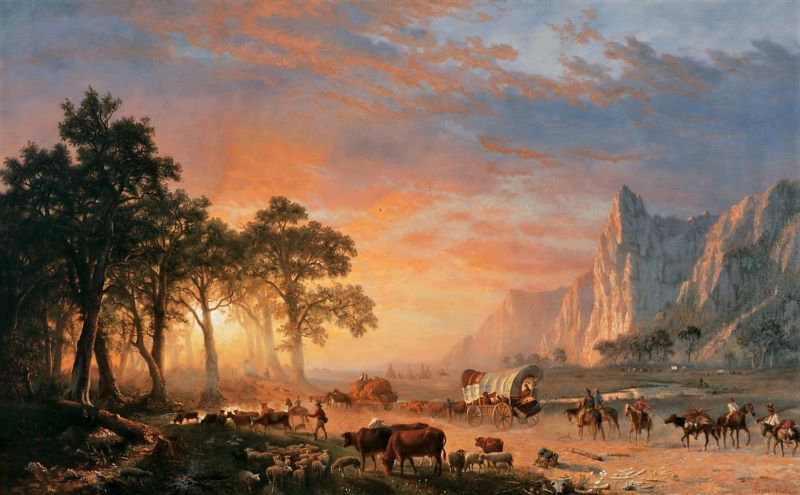
The featured image is Emigrants Crossing the Plains, or alternatively called The Oregon Trail, (1869) by Albert Bierstadt (1830–1902) and is the public domain. It has been brightened slightly for clarity and appears here courtesy of Wikimedia Commons.





Sir,
You reference George Washington in passing but you completely miss the bigger picture of the total cadre of men in that era – The Founding Fathers. Washington, Jefferson, Adams, Franklin, Madison, Hamilton & others. Have you not noticed that they created “the City on a Hill” that the Pilgrims longed for? You will search in vain for greater heroes than they.
Hello Mr. Zelch,
Thank you very much for your comment. I admit I could have articulated my point clearer in the article. I do not in any way deny the heroism of Washington or any of the founding fathers. They are indeed great men. The distinction I wish to draw is between the historical hero and the mythological hero. I am using the word “mythology” here in a more elevated sense than it is popularly understood–that is, as mythopoetic revelation of truth. This sense is to the best of my knowledge how Lewis, Tolkien, and George McDonald understood myth. The value the Founding Fathers brought to America was indispensable and I do not intend to nullify their contribution to American history. The difference between the founding fathers and King Arthur is that Arthur may or may not have been real. It is his fabled quality which enables him to operate as an artistic and literary symbol in English literature. The founding fathers can operate as a symbol as well, but not in the same way as Arthur. It is the mythological hero, not the historical hero, which I find lacking in American literature. However, I am certainly still on the search for a figure who can match these qualities.
Mr. Dokupil,
Thank you for the beautiful article. On an individual (or local) level, what is the practical next step to “run after the train”? Read Flannery O’Connor?
Thanks,
Hello Andrew,
You pose a very good question and personally I am not entirely sure of the answer. I charge myself with the common intellectual crime of pointing out problems without offering clear solutions. Reading O’Connor would certainly be a good start. I suppose the next logical step (although substantially more difficult) would be creating a mythology of our own. It would, in some sense, be an artificial mythology, because historically mythologies are not typically created by an individual artist who has the conscious intention to create a mythology. However, we know that was exactly what Tolkien set out to do (with significant success too) although it is up for debate whether the heart of his message was lost on the wave of popular culture. However, few of us can match the creative genius of Tolkien. Therefore on the practical level I think the best thing to do is to educate ourselves to the qualities of mythology and allow it to influence our ways of interpreting the world. I have always liked the title of this journal: “the imaginative Conservative.” Being an imaginative conservative is certainly a good philosophy for living one’s life.
Leatherstocking would be my choice
Yes, I think James Fenmore Cooper’s work should certainly be acknowledged, although I am not familiar with him as I hope to be.
I agree. Deerslayer/Hawkeye is the “demigod,” as it were, of the American cultural mythos. He lives in the frontier. He is a white man, but being brought up by the Native Americans gives him a sort of mixed heritage. Cooper’s novels, along with the Hiawatha poem by Longfellow, constitute the best example of an American Mythology.
Perhaps our “Logres” is being forged right now in the crucible of our present dilemmas. Or, just as Arthur had a Round Table of Noble Knights, perhaps the USA “Logres” is a composite of our specific regionalisms whether they be in the form of legends, factual history, or fiction–each one, in itself a knight capable of good or less than good deeds, much like Gawain, Lancelot, or Kay. Should we search through them to understand a workable and, at the same time, diverse totality much like a Medieval Cathedral? McSorley’s Bar, Johnny Appleseed, Bent’s Fort, the Huntington and Broad Top Railroad, etc., etc., etc….—how can they be all brought together? What contribution can be made in good faith by everyone who has a stake, everyone who will put aside his own personal axe to grind? It is all part of the same epic.
The author states: “As a kid, I struggled to understand why books like The Chronicles of Narnia, The Wind in the Willows, and Peter Pan were so much more meaningful to me than Tom Sawyer and Huckleberry Finn.” There is truth in this observation, but I would say that the poignant meaningfulness of the former three can be matched for me in the prologue to Longfellow’s TALES OF THE WAYSIDE INN as well as in the pages of that noble attempt at the Great American Novel, Ross Lockridges’s RAINTREE COUNTY: “The clock on the Court House Tower on page five of the RAINTREE COUNTY ATLAS is always fixed at nine o’clock, and it is summer and the days are long.”
Hello Mr. McCormick,
I greatly appreciate your thoughts on this article. I also appreciate your mention of architecture: “Should we search through them to understand a workable and, at the same time, diverse totality much like a Medieval Cathedral?” I believe Mr. Russel Kirk’s article on “The Architecture of Boredom” sheds light on the relationship between architecture and meaning in society. I think a shift in architecture in our society could be just as valuable as a shift in literature. Literature, music, and architecture all contribute to a society’s (or nation’s) sense of meaning.
“McSorley’s Bar, Johnny Appleseed, Bent’s Fort, the Huntington and Broad Top Railroad, etc., etc., etc….—how can they be all brought together?” I might have something to say to this effect if I understand your question properly. In researching this article I came across a symbol in American literature which interested me immensely: the symbol of the train. It’s very common in country music, and especially so in singers like Bob Dylan and Johnny Cash. My question was: what does the train signify? Is it an attempt to integrate the “myth of the immigrant” with the idea that we are “all part of the same epic”? I think that could be a viable interpretation.
I have not yet read Longfellow of Lockridge, but I’ve heard positive things about Longfellow and I thank you for giving me a lead on them. I will definitely make note of those works.
Dear Mr. Dokupil:
I greatly appreciate your gracious reply to my comments. And, that you took the time to reply to all the commentators on your article. I just wanted to add (if you permit my rambling which, if nothing else, will provide other leads for you to follow up, if you so desire) that your comment about trains sparked my imagination. “Blue Water Line” by The Brothers Four and “The Orange Blossom Express” are the country music songs that I know about trains, as well as, I suppose, “The City of New Orleans” by Arlo Guthrie, though my knowledge of country music is limited. I wonder if it is because railroads are fading in this country that they have become all the more easily a point of departure for a connection with the past with a nostalgic hope for the present. I believe it was B. A. Botkin who edited a book of Railroad Folklore though I have never come across it in a used book store. Certainly we have our railroad folk heroes like Casey Jones and John Henry (both subjects of songs and biographies). Then there is the epic of the transcontinental railroad. Also, geography in the USA can be associated with the railroad in places as diverse and faraway as the Raton Pass (over which the Santa Fe trail went, long before the Southern Pacific) and the Horseshoe bend in central Pennsylvania near Huntingdon, Pennsylvania. On the Long Island Railroad two old turntables still survive, in Greenport and Port Washington, at least the last time I looked. In literature, the famous New Yorker writer, Wolcott Gibbs, wrote several stories about with an LIRR yard setting. And as far as New York is concerned, let us not forget the old Myrtle Avenue elevated line, closed in 1969, that had the last wooden cars and the Third Avenue El which is a minor character in the film noir, “The Dark Corner”. For Boston subways, there is “Charlie of the MTA”. Railroads can also have a darker side as readers of Frank Norris’s novel, THE OCTOPUS will know, or anyone familiar with the history of the Pullman Strike. Hobos road the rails, not just immigrants, looking for work and/or “The Big Rock Candy Mountain”–this is examined in a movie from the 1970’s called “The Emperor of the North” with Lee Marvin, Ernest Borgnine, and Keith Carradine. I could even say that the railroad has a symbolic role at the end of the aforementioned RAINTREE COUNTY. Of course, I have gone on too long, but I wanted to share these thoughts with you and other readers for their interest.
Yes, I think there is much to be said about “The Orange Blossom Express” and especially of the “Wabash Cannonball.” The Wabash Cannonball is interesting because it is a fictional train sprung purely from folklore and cannot be traced back to any one particular author. As one of the legends goes, the brother of Paul Bunyan constructed a 700 car train and a railroad called the “Ireland, Jerusalem, Australian & Southern Michigan line.” What is really interesting is the folktale’s intentionally hyperbolic playfulness with time. The I.J.A. & S.M. line ran on a schedule of “36 hour days” and “9 day weeks”; when it reached a “dead stop” it was still going “65 miles an hour” and was known to arrive at its destination an hour before its departure. One day it went so fast that it melted the rails and flew straight into the stars, and, in the traditional way of ending a folk legend: “some say it is still traveling.” (I am going off the authority of American ethnomusicologist Alan Lomax.) The folktale bears striking relation to T.S. Eliot’s poetic construction of the train in “Four Quartets”: “Fare forward, travelers! not escaping the past into different lives, or into any future; you are not the same people who left the station or who will arrive at any terminus…you shall not think ‘the past is finished’ or ‘the future is before us’…” I would venture to say that perhaps this is what Eliot meant with his idea of the “objective correlative,” which he defined as “a set of objects, a situation, [or] a chain of events which shall be the formula of that particular emotion.”
But as you said, trains are not always a positive symbol, such as in the examples you mentioned and also in Hawthorne’s short story “The Artist of the Beautiful.” This may run somewhat contrary to Eliot’s idea of the objective correlative, but folklore is commonly subject to many different interpretations and it seems that Eliot’s intention probably had more to do with the way symbols, objects, and images function within one particular work rather than the whole canon of literature as a whole.
Thank you again for your comments and for the many works you mentioned, many of which are new to me and I am very interested in researching them further.
Thank you, that was very interesting. Your essay got me thinking on what the immigrant narrative could encompass. I imagine that for some it can be a fable of new beginnings, of valuing doing over being, of choice, of freedom, of liberty from past oppressors. For others, the immigrant narrative may be a fable of a half-way house, when it is not choice, but banishment or slavery that brought you there. Either way, the narrative encompasses hope and belief in the strength and wisdom and perseverance of the individual, and is very strongly linked with the idea of ‘place and time’ in particular the move from ‘old place’, with an old narrative to the ‘new place’, with a new narrative, at a particular point in history. Establishing the story of a new narrative necessitates sacrifice. The immigrant per definition emigrates, leaves his home behind, never to return. This creates a tension within the psyche. A paradox is created. The history and the ghost of ‘Logres’-past still linger, the old narrative is still a recognisable narrative, but it sits uncomfortable with the necessity to create a new emigrant/immigrant story. When one of the roots of the new culture is “leaving the old-home never to return” (whether by choice or not), it is psychologically necessary to find a way, within the new narrative, to ‘divorce’ the old place and its’ narrative and find peace with that divorce. Such peace may be achieved through continued examination and engaging with what was left behind. However, more often it happens through an ignoring of that past or, as is becoming more and more popular, a complete rejection of the past. In addition, the new immigrant/emigrant narrative will be busily occupied with a race for the creation of a new sense of space and belonging, a race against the clock. Naturally what is thus arrived at will feel a bit “thinner”, less grounded, more hurried, less layered, maybe less forgiving too? Maybe the American Logres is the quest to find peace within this paradox and to find the elusive grounding and the home-coming it desperately craves?
Hello Marjan,
This is very helpful to me. Yes, I think finding “peace within the paradox” may certainly be one of the qualities of the American Logres.
You write, “Such peace may be achieved through continued examination and engaging with what was left behind. However, more often it happens through an ignoring of that past or, as is becoming more and more popular, a complete rejection of the past. ” I heartily agree. It is a personal issue for me as well. When I came to this realization I myself began investing in a detailed investigation of my own heritage. My mother was a Chinese immigrant from Malaysia and my father was raised in Texas as a second-generation immigrant of the Czech Republic. Both of their histories shaped the way I understand the world in significant and largely unconscious ways. Taking the time to uncover one’s personal past is, I think, a very important task for anyone born in America.
I suspect our Logres appeared in 1865 in Lincoln’s Second Inaugural, “With malice toward none, with charity for all” and again in 1945. You see it in “12 Angry Men,” “Mr. Smith Goes to Washington,” and even “It’s A Wonderful Life.” You see it in the Miranda right to remain silent, especially now when silence is equated with violence. The Fifth Amendment. Didn’t all these proceed from our Logres?
Dear Mr. Dell,
This is a remarkable insight and, I think you hit the nail right on the head, gave an answer to the speculation raised in the essay. Your historic and cultural references add weight to your proposal. I especially admire your remarks about our Fifth Amendment Right. It never occurred to me that is another of our Rights under attack until you brought it to my attention, Thank you very much. You gave me a lot of food for thought.
Thank you, Raymond Dokupil, for that excellent read. Allow me to suggest that the mythos of America is that of the eternal return; constant rebirth or renewal. Our love affair with the “hardboiled detective” capable of one last moment of clarity and good action, or the worn out cowboy finding the courage to face down the killers at the train station, or the washed up replicant killer learning to feel sympathy for his enemy at the moment of his death, all speak of the possibility of renewal even of the deadest cause or soul. I think this may account for why as Americans we cling so heartily to the image of the underdog, the down and out boxer, the loser who learns to make it good, the libidinous girl who finds herself while walking through the desert – Americans seem to be fascinated with the idea that we can recover and do it right. Perhaps this is also the appeal of the American form of science fiction, both critical of our own potential for destruction and hopeful in our search for new worlds and new civilization where we can go boldly where no man has gone before.
Adventurer: George Washington, Daniel Boone, Lewis and Clark, Andrew Jackson, David Crockett, Kit Carson, Buffalo Bill, Anne Oakley, Wyatt Earp, Bat Masterson, Teddy Roosevelt, Black Jack Pershing, General Patton, General Macarthur, President Grant, President Eisenhower, J.F.K., R.F.K., Sgt York, Audie Murphy etc
I love that you have brought this up.
It is a question that I myself have struggled with.
What is the American Logres?
I have often focused on the early ideal, the gentleman farmer, the free, agrarian, intellectual of the late 1700/ early 1800s. North,or South doesn’t matter, but what else?
Is it perhaps rooted in our indigenous background?
I have even endeavored to create a language just for us, so that we are no longer “colonists ” a kind of Sanskrit of the West. It is a pursuit that may well take the rest of my life.
Perhaps we may yet find our center, our soul, what I refer to in this language as “Eyirtath”, the center,or point of origin.
Thank you for the article, Mr. Dokupil. I believe that every thinking person in the U.S. has their own “Logre,” and that those people who don’t think but merely act out of hunger, thirst, greed, sexual desire, revenge, or a warped craving to see others suffer lack any “Logre” to influence them. After reading the article, my first thought of an American “Logre” was Longfellow’s “Hiawatha”, and as others in this correspondence have also suggested it, I think it’s a good candidate but for one problem–most modern Americans have never read it, and in all likelihood, have never read ANYTHING by Longfellow. My mother could recite the entire Hiawatha poem–she had to learn it in high school. I would like to also suggest that Longfellow’s “Evangeline” is another candidate for a “Logre,” and indeed, a very “Catholic” Logre,” as the heroine, Evangeline, was separated from her husband on their wedding day and so the marriage was never consummated. (My daugher is named “Evangeline”–I decided on this name for a girl back when I was in middle school and read the poem–how many middle schoolers today read Longfellow?). I would also suggest that the works of H.P. Lovecraft comprise an “anti-Logre” or “evil mythos”–most of his stories revolve around the Old Ones vs. the Dark Ones,.” who populate not only the U.S., but the entire universe. Of course, Mark Twain’s Tom Sawyer and Huck Finn need to be included in that list of “Logre” candidates, especially Huck Finn who defends “Jim” the slave who was willing to risk his life for Huck. And how about Ray Bradbury, the Illinois writer who gave us Dandelion Wine, the story of a boy and his adventures in real and fantasy lands? And Robert Frost, another Illinoisian, who gave us The Road Less Travelled–indeed, I think that for many Americans, there is a “Logre” of untraveled roads that we plan to someday travel, be they actual road trips, or journeys of self-improvement, or giving up all our possessions and lifestyle in order to help those less fortunate (this is a common desire for many of us, and I think that many movie stars and other celebrities enjoy the opportunity to finally live their “Logre” and do something “big” and “good.”) I think that for many of us women, the “Logres” that we are constantly carrying with us became part of our lives when we were young and reading the stories of the Ingalls and Wilder families written by Laura Ingalls Wilder and Rose Wilder Lane–these women spent their lives looking for “the Land of the Big Red Apple”-Laura found it in Missouri, and Rose found it in De Smet, South Dakota after roaming the world looking for it. Finally, I suggest that for many older (mature) Americans, the American “Logre” exists in children’s fiction by authors like Elizabath Enright, L Frank Baum, Johnny Gruelle, Mildred D. Taylor, etc. who told stories about individuals and families who learned the virtues of family–the Melendys, the Gales, the dolls and stuffed animals, the Logans. I fear that many American children and teens today don’t read books like these, but instead, are developing a “Logre” based on video games, many of which are created by non-Americans. But perhaps the heroic quests in games like “Kingdom Hearts” will become their “Logres” In conclusion, I think that the American “Logre” is as varied as its people, and that is perhaps why we have difficulty find it. Maybe that would be a good book. But sadly, most kids don’t read books anymore, so the author had better make it a movie or a game.
Thank you for the article for I needed to hear what you said. I have been working on a story for three years about a Christ-haunted farmer from the Palouse region of Eastern Washington and you have inspired me to keep going!
This is such a fascinating article; thank you. I have always loved British literature above American, and this may be why. (I am a retired professor of English with specialities in composition and Victorian literature.) Hawthorne and O’Connor are two of my favorite American authors, and perhaps it is that Romantic/mythical flavor that so attracts me. Are you very familiar with Eudora Welty’s work? In _Robber Bridegroom_ she weaves many fairy and folk tales together in a way that suggests a wonderfully mythic underpinning to Southern life. Maybe this is what we need more of?
Chesterton said something like “America is the only nation founded on an ideal” in his “What I saw in America” essays. That ideal is something shaped predominantly by Enlightenment philosophical commitments and a Zeitgeist emphasizing a strange blend of optimism toward reason and human ingenuity and cynicism about humanity’s tendency to suck. Neither supposition makes possible a common life, a common language, a common vision (i.e. the very things it means to be a people). No “Logres” is possible in an invented land with invented convictions, where every citizen is invited to invent or reinvent himself according to the desires that seem at least momentarily to matter most to a transient sense of belonging. America is the reductio ad absurdum of Nations—proof that to redefine a People by loose ideological conviction is to redefine what it means to be a community or a person altogether (which is perhaps why both have now largely degenerated into private preference and abstract political categories). America is a brand, a label, a chimera, not a country, and no matter how long we dwell here, we are renters of a land we can never own because it only exists in our minds. God have mercy.
Maybe this definition came true during the Cold War when America was universalized to fight the universalism of Communism, but this was not the case among the majority of people before the Cold War (there are always exceptions and nothing is ever totally pure). Chesterton was great but he wasn’t omniscient. The United States was a collection of rooted particulars, which is why there were tensions between the Northern localities, the Southern localities and the Western localities from the beginning. And the ideas that, with those localities, helped create the American ideal were predominantly the Bible, English common law and history, the Roman Republic, ancient Athens and Sparta; tangible things the preceded the seventeenth century.
Tanith Lee has written a fantasy book set in an imaginary city. capital of a great nation, called Paradys, and another set in a city built around canals in a lagoon called Venus.
I have pondered for some time the idea of writing a fantasy set in a gigantic city on the edge of a gigantic continent, a city inhabited by people who have come from all parts of the world to build a new life:
People who pine for their homeland, even though their parents fled form it because its soil was thin and unproductive, and it was ruled by cruel oppressors who made their hunger even worse by selfish policies.
People who remember their old lives in a country even vaster than their new land, ruled by a monstrous despot, yet they can’t help but remember their old home fondly.
People who were driven from their country an age ago, whose grandparents’ grandparents never saw their homeland, but who still preserve the language which their ancestors spoke, and are comforted by the knowledge that their ancient homeland has been promised to them by a power to great and terrible that their faith in it is completely unquestioned. They KNOW their land will be returned to them, Someday.
All of these people share the largest city in the world, and they agree it is also the greatest city in the world, in the greatest country in the world. They take pride in all of the city’s wonders as things which belong to them, personally, from the lovely little park at the north end to the majestic copper colossus on an islet just beyond the south end.
For all its faults, New York City is undeniably a part of our Logres.
What a fantastic article, and an articulation of what I and many others perhaps subconsciously, intuitively feel about this One Nation. I long for a Logres to fight for, to dedicate a life serving and chasing. I yearn for a universal good that elevates my own personal struggles into a grand narrative, a moral arc of righteousness. And I think this yearning is shared among humans throughout history, but in this modern era of America, lacks a tangible Myth-story to latch onto and grow out of.
But I think it’s the very search for a Logres— the quest for the Grail— that IS our American Logres. From the beginning, our Founding Fathers (old and different enough to be near mythological in the minds of most Americans) were our Knights of Arthur, and the goodness they pursued was that of enlightenment principles of humanism and freedom from the nebulous evil of tyranny. From the start, we’ve had a moral dichotomy that set the landscape for the Romantic adventures of American history.
Our code of honor is Freedom. Freedom is our Logres, specifically BECAUSE it is a nebulous and impossible to define concept. Freedom is an ideal and not an end state, and therefore it is the singular banner under which the spirit of the American populace can be stirred into action. It is our “still point of a turning world”. Heck, we even have a mythological demigod in Captain America who bears the flag on his armor and fights for an *incredibly* ill defined idea of goodness and freedom.
And like Logres, we have fought very real battles over conflicts in places that have almost nothing to do with the daily life experience of being American. We held the world in a nuclear vicegrip, but found to this day that it is justified because of the evil behind the iron curtain that American strength is holding at bay. During the war on terror (again, extremely ill defined mythological battle against generalized evil, under the name of Terrorism) we sought to bring the light of freedom to lands oppressed in the darkness of terror and tyrannical regimes. We went to war for this Romantic ideal, and when we couldn’t find a tidy conclusion to that narrative, shifted into a pragmatic realism which addressed the conflict better, but then lost the entire raison de etre for being there.
And on the scale of the everyday man, the idea of a government overstepping its boundaries, the very image of evil tyranny threatening to extinguish the light of freedom, is *the* rallying cry for both sides of our political battleground. It’s no wonder politics is so heated, so desperately urgent, so *perilous* all the time.
It’s because it’s our mythos, our haunting, our Logres. It’s the story of the soul of our nation, the story of good versus evil. It’s Freedom.
After all, this is the Land of the Free.