
I know how it is. Our shopping isn’t done yet, either. That’s why we all need some ideas. Here are some good ones: books you’ve seen, not on TV, but—even better—on TIC.
 Admit it—you forgot to give somebody a gift and are scrambling. In “A Hans and Franz Christmas Book List,” I offered a selection of volumes that will be reviewed shortly in this magazine. But given the lateness of the hour and the delicacy of the situation, you may not want to gamble on books about which you have only read a mere paragraph from your scribe. You want something of substance that has been fully vetted. Well, we write about a great many books at this site. So here are a few ideas for gifts that you can read about more fully in some of the full reviews I’ve written earlier this year.
For Kids—and Moms. If you’ve never read the marvelous artist and writer Hilda van Stockum, take a look at her wonderful work. For younger children, there is her famous A Day on Skates, but for kids ten-and-up (and, really, my eight-year-old enjoyed listening to it, too), her very exciting story of the Verhagen family and their part in the Dutch resistance to the Nazis during World War II is a treasure. The Winged Watchman has everything a kid could want: disguises, a boy’s secret help of a downed fighter pilot, a much-loved dog, a Jewish child hidden from the Nazis, and much, much more. The “more” I wrote about in my essay has to do with its attention not only to the chases and intrigue but also to the reality of life in a house with kids. This story, I said, and will say again, is truly a mother’s tale as much as one for the kids.
For Kids, Hoosiers, History Buffs, and—ahem! Politicians. My hometown of Bremen, Indiana, has two claims to fame. Less important, but fascinating to me, is the fact that the then-heaviest man in the world, Robert Earl Hughes (1,071 pounds) died while on tour with an amusement company in Bremen in 1958. The more important claim is that two-time Indiana governor and Secretary of Health and Human Services Dr. Otis R. Bowen had his medical career in and launched his universally respected political career from my hometown. My fourth grade Indiana history teacher, Sheila Reed, told his story with lots of love, wonderful details, and many pictures in Otis R. Bowen; Farm Boy to Governor: A Life. The book is designed for kids, but anybody who loves history or Indiana will enjoy this tale of a truly great man who was also good. And politicians who have become jaded about America or their own task ought to read it whether they love it or not.
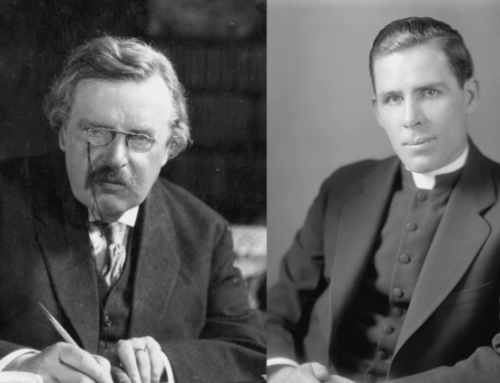
For Adults Who Want to Become Like This Child. A saying on Notre Dame’s campus during the 1940s was that only two people cared about your soul: the campus chaplain, who wanted to know if it were dirty or clean, and legendary literature professor Frank O’Malley, who wanted to know if it were alive or dead. O’Malley’s quest to bring souls alive matched one of the authors who was on many a syllabus in his classes: G. K. Chesterton. In Manalive, GKC brings a holy fool named Innocent Smith into the lives of a group of young people living together in a London boarding house. Though their sins seem few, their souls seem dead or dying. Innocent teaches them in this rollicking mystery story how his own soul came to life—and how theirs can, too.
For Pilgrims in this Life. Like his fictional character Innocent Smith, Chesterton’s friend Hilaire Belloc was constantly scourging his soul and setting off on trips hither and yon that he might discover adventure and his true home. In his most famous travel book, The Path to Rome, Belloc provides a cultural, historical, linguistic, comedic, and spiritual account of his 750-mile trip from Toul, France, to Rome clad in a linen suit. If you like books that can go from the ridiculous to the sublime and back again—or even combine them—Belloc is your man and this is your book. My favorite part about it is that the headers at the top of the pages give a line indicating what you’ll find on the page, making it easy to go back and re-read your favorite parts.
For Those Who Like Mocking the Devil and Praising the Good. Fr. Paul Mankowski, S. J., was a remarkable figure. A blue-collar boy who studied ancient languages and thought at Chicago, became a Jesuit priest, and earned a doctorate at Harvard, he was then made persona non grata and banned from writing in his own name by his own order for exposing corruption and deceit. Like Terry Malloy in Elia Kazan’s film On the Waterfront, Mankowski “coulda been a contender” in the academic heavyweight category—or even the literary one. And yet he wasn’t bitter, living his priestly life and writing brilliant essays when he could until his untimely 2020 death at the age of 62. In Jesuit at Large, George Weigel collects of some of the best of these essays from over thirty years. Mankowski’s essays, covering the absurdities in religion, the academy, and society, sparkle with the kind of razor-sharp wit, spiritual wisdom, and insight that characterize those of Evelyn Waugh. Though he was religiously and professionally an odd man out, that outsider quality likely both honed the objectivity of his eye and also gave him a sympathy even for those whom he satirized and critiqued.
For Teachers and Students. The great battles over Western Civilization, particularly those in education, could be at least a bit more interesting if its attackers and its defenders had a better sense of its growth and development. In the Habiger Institute’s The Heart of Culture: A Brief History of Western Education, we see the clash and combination of many strands of knowledge and practice, beginning with the original and essential components: Greek philosophical culture and Jewish religion. This volume helps students get the broad strokes of educational history in a brief but vivid 130 pages, making it possible for those in the fights to see that the choice is not between dynamic progressivism and a staid traditionalism. Instead, it is really between a staid and self-defeating narrowness and the thrilling amalgamation of truths from all over that is the characteristic of western education.
For Those Who Wish to Think Globally and Act Nationally. Many Americans have come, rightly, to be ashamed of how certain aspects of American policy have been destructive for countries around the world. In Obianuju Ekeocha’s Target Africa, readers can see how our progressive politicians have combined with NGOs, corporations, and foreign governments to bring the failed and destructive culture of death and sterility to a continent brimming with life. Ekeocha, a scientist and pro-life activist, lays out how these groups sell abortion, contraception, and even sterilization in the name of “human rights” and “health.” They get willing accomplices in corrupt African politicians who are perfectly willing to be administrators in a new, ideological colonialism that is just as deceptive and destructive as the old. Readers who are interested in making sure that western governments are considering their impact on developing countries will be informed by this book about what exactly to look for.
I know how it is. Our shopping isn’t done yet, either. That’s why we all need some ideas. Here are some good ones: books you’ve seen, not on TV, but—even better—on TIC.
The Imaginative Conservative applies the principle of appreciation to the discussion of culture and politics—we approach dialogue with magnanimity rather than with mere civility. Will you help us remain a refreshing oasis in the increasingly contentious arena of modern discourse? Please consider donating now.
The featured image is courtesy of Pixabay.




Leave A Comment