
It is no mean feat to bring together the thought of Thucydides and Tocqueville when discussing the topic of equality, a concept seemingly so ancient and timeless. In her new book, Eva Brann has crafted a bridge beyond these revered sources onto the banks of newer, gleaned insights; it is a bridge that invites the reader to evaluate preconceived ideas, substituting haste and expediency with proper measure and the will to be bound to truth.
Most of these acted from a passionate desire for their neighbor’s possessions…but there were also those who attacked the wealthy not for their own gain, but primarily out of a zeal for equality…[1]
But the pleasures of equality are self-proffered; each of the petty incidents of life seems to occasion them, and in order to taste them, nothing is required but to live.[2]
I might even say that this is the gravity of thinking, its ponderousness — that, insofar as it is free, it seeks bondage — seeks to be bound by truth’s necessity.[3]
 Over two thousand years separate the political thought of Thucydides and Alexander de Tocqueville. The Athenian general Thucydides was perhaps the greatest of antiquity’s historians, most notable for charting down for posterity the verities of human nature, especially when visible during times of strife. Tocqueville the French aristocrat studied the vast potential and nuanced complexities of the nascent United States of America, keenly delineating which of these would enable the young nation to separate itself, for better or worse, from older European counterparts and paradigms.
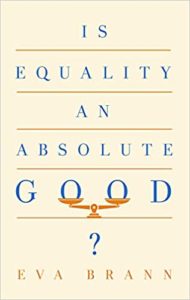
These two great minds come together in the latest book by Eva T. H. Brann, longtime Tutor, and Dean, of St. John’s College in Annapolis, Maryland. Where Ms. Brann’s writing distinguishes itself is not only in bringing together such thinkers on a timeless, yet inescapably contemporary question, but in gleaning rich and original insight from it as well. The question itself is no mean one, succinctly worded in the book’s title, Is Equality An Absolute Good?[4]
One may assume from the first quotation above, drawn via an account of a series of events in the Greek polis of Corcyra (modern day Corfu) during the Peloponnesian War, that Thucydides would posit a regrettably somber response. Under the protection of an Athenian naval contingent, the democrats of Corcyra clashed with the city’s oligarchs. Gaining the upper hand in this clash, the egalitarian democrats proceeded to enact vengeance on their rivals. The violence and strife bordered, and perhaps exceeded, the profane. Oligarchs were condemned to death by the temple of Hera, and in desperation, committed suicide rather than suffer the rendered judgment of the democrats. No space was sacred.
What is notable about this is which group within the democrats—those who championed equality—were deemed most responsible for the most heinous atrocities by the author. As the first quotation above states, it was not those who were possessed by greed, but rather those emboldened by zeal for equality that spurred the gravest atrocities. If, as modern political history would maintain, equality is held as a positive quality, if not an outright virtue, how could it lead to barbarism?
Ms. Brann’s writing provides valuable insight into this conundrum. She brings forth, in the long tradition of Annapolitan Socratic inquiry, two questions: one of quality, another of disposition. “Then what might be the attraction of equality as its own end? Is there an egalitarian temperament?”[5] After first positing that there may be moments when an ennobling ethos permeates the comparative act of rendering matters equal, a more problematic human tendency, or aboriginal disposition, arises. “It is a squint-eyed peering, not for the sake of looking at, taking in, others, but of holding them off for inspection, so as to perform an assessment.”[6] This, Mrs. Brann points out, is envy.
Envy, one of humankind’s oldest vices, can be etymologically traced to a Latin verb. “Envy derived from the Latin verb invidere, ‘to look into, to examine closely’ — invidiously.”[7] The adverb at the end of the definition is key here. There may be differing variations of looking, ranging from the surprised perspective of a 17th century scientist discovering what biological intricacies lay at the bottom of a microscope’s lens, to the ardent gazing of an enamored couple. The particular act of looking, however, which is bound to envy is one that looks, and evaluates. “It is not, however, so much frank aggression as ambushing animosity. It is the egalitarian vice, less the sociable desire to establish equality than the sour wish to eliminate inequality.”[8] This tells much about human nature, and something unique about the nature of equality as an absolute good.
Thucydides asserts that those who committed the worst atrocities in Corcyra were possessed by a zeal for equality. Could it be that they cared less about establishing equality per se, and instead more about eliminating inequality? The nature of Peloponnesian War political persecution does not speak much of establishing equality. By a violent purge, the democrats of Corcyra are establishing they are not equal to the oligarchs they are persecuting. In addition, if equality was a gift or boon, why must it come after the seeming sacrifice of rivals? It may then be inferred what is actually being done by Corcyra’s democrats is leveling society, an act parallel to eliminating inequality. This grants the levelers a moral tinge, if not an actual moral imperative. Inequality is assumed to be an evil which requires elimination, instead of equality being considered a good which necessitates promulgation. Now, with a posited evil, there comes the possibility of drastic actions excused by the presence of such evil. So, though establishing equality may not extend to a call for political violence, the elimination of it may render the path, roundabout as it may be, more smoothly paved.
This leaves the reader with a bit of an intellectual dilemma. Does equality seemingly not possess enough of a moral imperative to motivate as much as the compulsion to eliminate inequality? What is positive about the establishment of equality?
The quotation from Tocqueville above at the top of this essay comes from a paragraph in an essay taking the measure of liberty and equality. The French diplomat took note in his travels of these two ideals being of great importance to this newest, and most promising of 19th-century nation-states. He wrote that liberty at times offered profound blessings on certain citizens. In contrast, equality proffered smaller doses of blessings, but did so regularly to all men. Interestingly, and corresponding to liberty’s less constant bestowing of greater blessings, it was something which was purchased at the costly price of deliberate effort and sacrifice. No such sacrifices curiously were required for equality. As the quote above establishes, nothing more than living was needed to enjoy the gifts of equality which were self-given. What is the nature of these self-given benefits?
Here, Ms. Brann expounds. “Equality is surely, strictly speaking, a mere relation, and that must, I imagine, affect its terms, people.”[9] Of note in this statement is the defining of equality as a relation. This points to its requiring more than one person to flesh out fully a sense of meaning. As Ms. Brann writes, a person can possess a positive quality, or gift, such as having an advanced aptitude for music. Though one could say this is relational as well—as person A may be more talented than person B—this does not take away from person A being quite adept at playing Schubert’s Ständchen on the piano. This gift, by itself, stands out, without the need of an outside comparison. Ensuingly, without person B, it is most difficult for person A to claim to be equal.
 It would seem then that equality is not equal to being gifted, whether in music or art. As Ms. Brann next elucidates, “Being equal has no concrete positive consequences. Its good begins and ends when you have what everyone else has, which, for purposes of equal assignment has to be more or less of the same sort: de-qualified, and instead, quantified.”[10] Following from this, equality’s good comes about when person A, who is a musical prodigy, has what person B, someone who is not a musical prodigy, or everyone else possesses. But, what exactly is that which is possessed, something equally assigned and quantified? If what is possessed is de-qualified, as Ms. Brann writes, then person A’s musical talent matters less as said talent would be a quality which separated A from B and everyone else. Yet, what is possessed in this scenario, though de-qualified, is also quantified. Each person, A, B, and the rest, is measured and evaluated not on the basis of qualities which by definition separate them as individuals, but by an assigned quantitative value. Where then would this assigned value, which would appear to level the differences among these individuals by de-qualification, and hence through this leveling promote uniformity instead of qualified individuation, emanate from? Who, or what is performing the assignation of quantified value?
The attempted quantification of human beings does have precedents in the last century. Ms. Brann was a survivor of the horrors imposed by the Nazis in Germany during the 1930. She escaped on one of the last ships bearing Jewish refugees from Portugal to the United States. Members of her own family were not as fortunate. She, among others, would bear witness to the heavy price and consequences of attempting and failing at this endeavor, the “measuring” of individual human beings. “Since minds can be captured but not assessed, leaders have had recourse to totalitarian socialization; movements with pre-composed mantras, organized protests against offenses not experienced by participants, rallies with speeches at once inciting and benumbing.”[11]
Could there be then, some unique boon to equality, if viewing it as an absolute good, something good in itself, is growing seemingly and increasingly tenuous to apprehend? Ms. Brann does raise one possibility early on in the book. This manifestation of equality, instead of leveling by lowering, produces its opposite. “There is an elevating equalization in the face of greatness, Sub specie aeternitatis, ‘under the aspect of eternity,’ we are all too diminutive to differ in stature. The noble response is reverence…”[12] This is an intriguing possibility. It would appear that equality is evident with the presence of something (note, not someone, or another human being), detached, and in a manner elevated, above those involved. She established this as having great relevance to teaching. “This equality-under-greatness has a very desirable pedagogic consequence…put a work of greatness before a class or a reading group, and the members can converse with each other without the inhibiting presumption of expert mastery or special experience.”[13] This manner of learning is of course the bread and butter of the Great Books Program at St. John’s College in Annapolis, where Ms. Brann has taught for more than six decades. The present author graduated from the same program and can thus attest to its maieutic capacity to bring out the potential in a student’s thought, with respect and reverence for the books’ studied as integral.
What other practice may make manifest the positive potential of equality? Most relevant here is something, like the learning method at St. John’s College, that adheres to the third and last quotation from Ms. Brann at the top of this essay. It is an odd thing: for thinking to be free, it must seek to be bound by truth. Equality may be beneficially found when the will, like the mind, also desires to hold fast to something truthful. Fortunately, this comes with the best of American civic involvement. “Come election day, I walk to the polling place — a curiously composite being for the hour: at once a decision-maker, a being with a faculty of choice and execution, my will. And I am, as well, a unit, walking to add myself as a number to numbers.”[14] Being composite validates a person’s qualitative worth, that which separates people from each other. The part of a composite being that chooses, the will, then elects to add, not to be added, to others whose votes, quantitatively amount to the same value. The result is elevating. “So for that civic holyday, the sense of felt equality is not degrading but proud…. Not so the equalizing equality; it debases dignity by its vices, envy and resentment, and it depresses enterprise by its discouragement of disparity.”[15] Ultimately, equality may be found in choosing to incorporate the qualitative and quantitative values of a human being, to join and be counted among others, but also to remain respectful in the reverence of truth, an individual.
It is no mean feat to bring together the thought of Thucydides and Tocqueville when discussing a concept seemingly so ancient and timeless. It is altogether an act of serious erudition to bridge beyond these revered sources onto the banks of newer, gleaned insights. Ms. Brann has crafted such a bridge—one which invites the reader carefully to evaluate preconceived ideas, substituting haste and expediency with proper measure and the will to be bound to truth.
The Imaginative Conservative applies the principle of appreciation to the discussion of culture and politics—we approach dialogue with magnanimity rather than with mere civility. Will you help us remain a refreshing oasis in the increasingly contentious arena of modern discourse? Please consider donating now.
[1] Thucydides, On Justice, Power, and Human Nature: Selections from the History of the Peloponnesian War (P. Woodruff, Trans.). Indianapolis, IN: Hackett Publishing Company (1993) 93.
[2] https://xroads.virginia.edu/~Hyper/DETOC/ch2_01.htm
[3] Eva Brann, Is Equality An Absolute Good?, (Philadelphia, Paul Dry Books, 2022) 71.
[4] Eva Brann, Is Equality An Absolute Good?, (Philadelphia, Paul Dry Books, 2022).
[5] Brann, Is Equality An Absolute Good?, 37.
[6] Brann, Is Equality An Absolute Good?, 37.
[7] Brann, Is Equality An Absolute Good?, 38.
[8] Brann, Is Equality An Absolute Good, 38.
[9] Brann, Is Equality An Absolute Good, 46.
[10] Brann, Is Equality An Absolute Good, 47.
[11] Eva Brann, Is Equality An Absolute Good?, 65-66.
[12] Eva Brann, Is Equality An Absolute Good?, 36.
[13] Eva Brann, Is Equality An Absolute Good?, 36.
[14] Eva Brann, Is Equality An Absolute Good?, 77.
[15] Eva Brann, Is Equality An Absolute Good?, 78.
The featured image is courtesy of Pixabay.






Equality is bunk. Worse than that, it is sin. It is the child of envy and it grows into adulthood only through force. It is the bastard grandchild of pride, which is the only sin, and the child knows the parent.
With his usual prescience, Alexis de Tocqueville argued that “the more equal men are, the more insatiable will be their longing for equality.” He prophesized that “Americans will never get the equality they long for. . . . [it] ever retreats before them without getting quite out of sight, and as it retreats it beckons them on to pursue.” For us Americans, equality is like the green light at the end of Daisy’s dock in The Great Gatsby, forever receding from us, yet always visible.
And once the enemy has twisted the aspects of inequality into the sin of their enemy, they can proceed with destroying them and then they are justified in whatever punishment they mete out. But one needs to make sure that the audience is properly prepared for the appropriate definition .