
One of the most frustrating things about the Civil War is simply trying to understand its many causes. As long as historians exist, there will be a multitudinous cacophony of answers to this perplexing question. I’ve been wrestling with these questions for nearly a quarter of a century. Let me offer several causes.
 I’ve had the great and grand pleasure of teaching H303, Sectionalism and the Civil War, since 1999 at Hillsdale College. The course ostensibly covers the years 1848 through 1877—that is, the Treaty of Guadalupe Hidalgo through Reconstruction. For better or worse, however, I also reach back to 1776 (the Declaration), 1787 (the debates over slavery in the Constitution), 1820 (the Missouri Compromise), 1822 (Denmark Vesey’s rebellion), 1832 (Nat Turner’s rebellion and the Nullification Crisis), 1836 (the Texas Revolution), and 1846 (The Mexican War). Phew, a lot to cover, especially where there is still 1848 through 1877 to cover!
Founded in 1844 by radical abolitionists, Hillsdale College sent more than five hundred soldiers to the Union army, many of them serving in the famed 2nd, 4th, and 24th Michigan regiments. As you enter our campus, you’re welcomed by a statue of a Civil War soldier, a bowing Abraham Lincoln, and a mighty Frederick Douglass. The town’s Protestant cemetery, Oak Grove, just north of campus, inters more than three hundred Civil War veterans as well as such early Republican party luminaries as Ransom Dunn, a professor of history as well as a doctor of divinity. In fact, I can see Dunn’s tombstone from my driveway. It’s all rather inspiring and intimate.
One of the most frustrating things about the Civil War is simply trying to understand its many causes. As long as historians exist, there will be a multitudinous cacophony of answers to this perplexing question. I’ve been wrestling with these questions for nearly a quarter of a century. Let me offer several causes.
First, and fundamental to the war, was the issue of slavery. Yet, to what degree? When the Union waged war on the South, it did not, immediately, do so because of slavery. Yet, as Abraham Lincoln put it, slavery was SOMEHOW the cause of the war. To quote the sixteenth president at length:
One eighth of the whole population were colored slaves, not distributed generally over the Union, but localized in the Southern part of it. These slaves constituted a peculiar and powerful interest. All knew that this interest was, somehow, the cause of the war. To strengthen, perpetuate, and extend this interest was the object for which the insurgents would rend the Union, even by war; while the government claimed no right to do more than to restrict the territorial enlargement of it. Neither party expected for the war, the magnitude, or the duration, which it has already attained. Neither anticipated that the cause of the conflict might cease with, or even before, the conflict itself should cease. Each looked for an easier triumph, and a result less fundamental and astounding. Both read the same Bible, and pray to the same God; and each invokes His aid against the other. It may seem strange that any men should dare to ask a just God’s assistance in wringing their bread from the sweat of other men’s faces; but let us judge not that we be not judged. The prayers of both could not be answered; that of neither has been answered fully. The Almighty has his own purposes. “Woe unto the world because of offences! for it must needs be that offences come; but woe to that man by whom the offence cometh!” If we shall suppose that American Slavery is one of those offences which, in the providence of God, must needs come, but which, having continued through His appointed time, He now wills to remove, and that He gives to both North and South, this terrible war, as the woe due to those by whom the offence came, shall we discern therein any departure from those divine attributes which the believers in a Living God always ascribe to Him? Fondly do we hope–fervently do we pray–that this mighty scourge of war may speedily pass away. Yet, if God wills that it continue, until all the wealth piled by the bond-man’s two hundred and fifty years of unrequited toil shall be sunk, and until every drop of blood drawn with the lash, shall be paid by another drawn with the sword, as was said three thousand years ago, so still it must be said “the judgments of the Lord, are true and righteous altogether.”
Second, though, and perhaps equally important, was the vying of northern and southern visions of nationalism and the purpose of the nation-state. While this involved, understandably, the issue of slavery, it also dealt with agrarianism, industrialization, state’s rights, and national authority. One of the strangest myths of the Civil War is that the South favored state’s rights and the North opposed them, desiring only centralization. It was the South, after all, that wanted a federal police force (Slave Commissioners) and the North which passed Personal Liberty Laws, denying federal use of state property or personnel in the capturing of black Americans. This is not to suggest that the North somehow only favored state’s rights. When it came to the waging of the Civil War itself, both the North (the Yankee Leviathan) and the South (Confederate War Socialism) used the mechanism of the nation-state to achieve their objectives.
It must also be noted, that each section, the North and the South, held a deep republican streak as well. The Northerners felt their republicanism to be more Greek (think of Lincoln’s very Periclean Gettysburg Address), and the Southerners thought of their republicanism as far more Roman (imagine John C. Calhoun as a modern Cato the Elder).
Third, the North and South were also waging a cultural war. The North “was established by witch-burning Puritans, by cruel persecuting fanatics, who implanted in the North the standard of Torquemada, and breathed in the nostrils of their newly-born colonies all the ferocity, bloodthirstiness, and rapid intolerance of the Inquisition,” a South Carolinian stated, shortly after the bombardment of Robert Anderson’s band of Union men at Fort Sumter. Confusing its own bigotry with Christianity, Puritanism had birthed “impurity of mind among men” and “unchastity in women,” the South Carolinian continued, conspiratorially. Evil, corrupt, and dark, Northerners might very well “know how to read and write, but they don’t know how to think, and they are the easy victims of the wretched imposters on all the ‘ologies and ‘isms who swarm over the region.”
Ex-president Franklin Pierce, a northern Doughface, expressed this fear most articulately, claiming that Lincoln was merely the culmination of twelve years of northern abuse. “By letters, by speeches, in private conversation, I have uttered for more than twelve years words of warning against the heresies which have swept over the North and culminated in the enactment of laws which are directly in the teeth of the clear provisions of the Constitution, in eleven states,” Pierce wrote from New Hampshire.
But when you ask me to interpose, then comes this paralyzing fact that if I were in their [Southerners’] places, after so many years of unrelenting agression [sic], I should probably be doing what they are doing. It is not the election of Mr. Lincoln, per se, which has caused this emphatic movement at the South. That election in beyond all doubt Constitutional, but the people of the Southern States look beyond it to see, if they can, what it implies. They see the great and powerful state of Massachusetts electing by 35,000 majority a man who justified the armed invasion of Virginia last year; and they believe that the people of Massachusetts are acting deliberately. They see Mr. Lincoln elected and they take his election as an endorsement of his opinion that we cannot go on as we are, but must in the end be all free or all slave states. Foolish, absurd and groundless as this view is and will always stand, the South takes his election as an endorsement of resistance to the law for the return of fugitives from service of 1851, and of the other heresy broadly promulgated by him and Mr. Seward, referred to above, of an ‘irrepressible conflict.’
Pierce never sent the letter, but he assured his imaginary reader that though he was a Union man, he also argued that “If our fathers were mistaken when they formed the Constitution, if time has proved it, the sooner we are apart the better.”
Finally, fourth, the Civil War was a religious struggle, deeply rooted in the colonial conflict of Puritan New England and Anglican Virginia. One southern theologian, James Henley Thornwell, described the two sides in almost Manichean terms:
The parties in this conflict are not merely abolitionists and slave-holders—they are atheists, socialists, communists, red republicans, Jacobins on the one side and the friends of order and regulated freedom on the other. In one word, the world is the battleground, Christianity and atheism the combatants, and the progress of humanity is at stake.
Indeed, this was an intensely religious conflict. Some scholars, such as Richard Rollins, have argued that the Army of Northern Virginia was the most religious army since Cromwell’s army of Roundheads in the English Civil War or any of the armies of the eight Crusades. Robert E. Lee, too, saw the struggle as a deeply religious one. Of course, Lincoln and Jefferson Davis did, too.
It’s going to be a bewilderingly wonderful semester, full of intense investigation and tragic nobility…
The Imaginative Conservative applies the principle of appreciation to the discussion of culture and politics—we approach dialogue with magnanimity rather than with mere civility. Will you help us remain a refreshing oasis in the increasingly contentious arena of modern discourse? Please consider donating now.
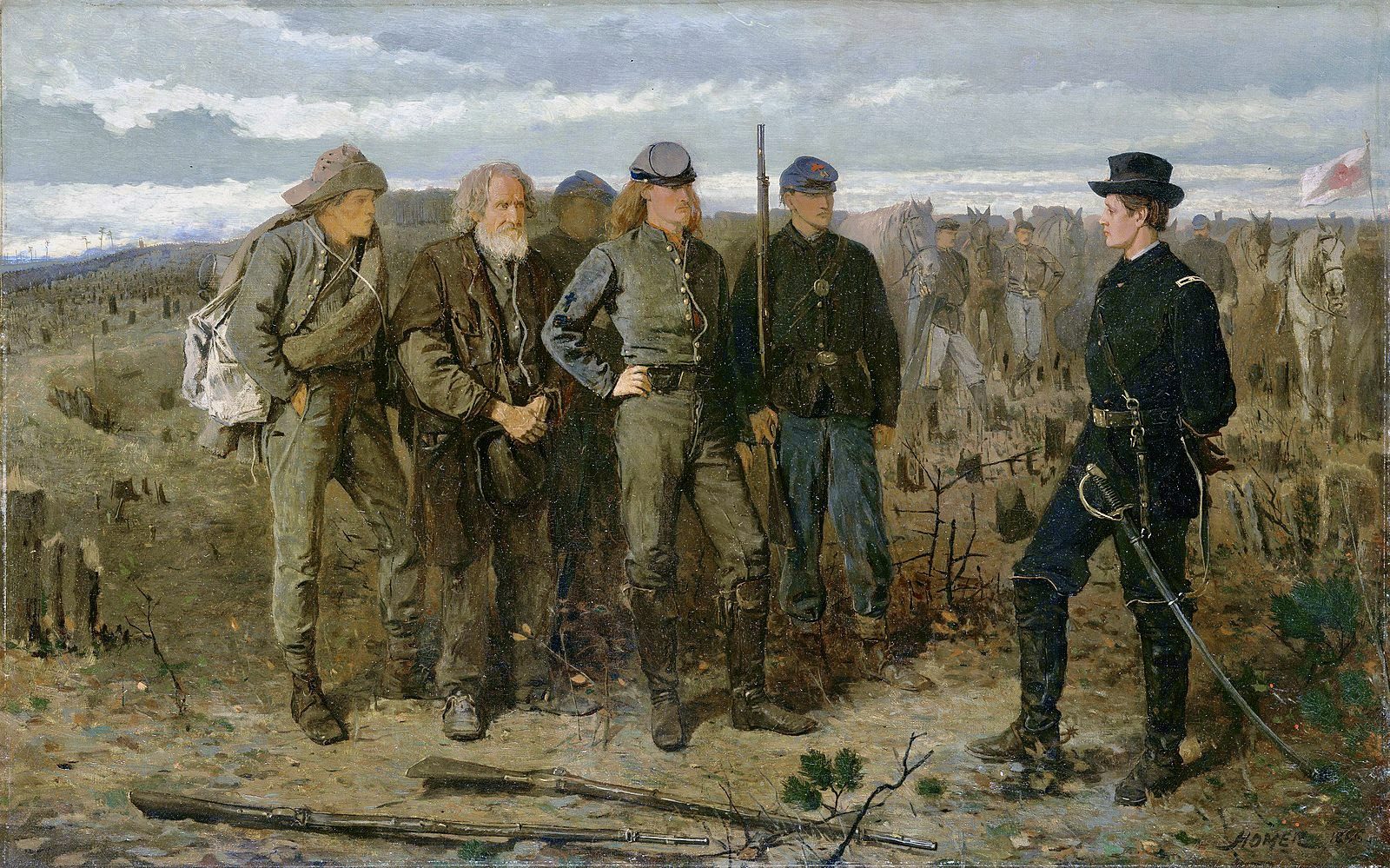
The featured image is “Prisoners from the Front” (1866) by Winslow Homer, and is in the public domain, courtesy of Wikimedia Commons.




Read the bills of seccession and take them at their word slavery was the primary case. Several southern states had filed federal lawsuits against New York to prevent from invoking it right to declare slaves free upon entering New York. Those summers were hot and not able to bring their property with them they begged for federal relief.
The author does a fine job of twisting the facts to the point a pretzel would be envious. Yes, the Union originally fought to preserve the union, not to end slavery.
However, there is no Civil War without secession and no secession without slavery.
The southern states clearly lay out their reason for secession in their Articles of Secession; slavery, or more to the point, their desire to protect its demise from what they saw as a northern agenda to end it. All other arguments by southerners stem from the division the practice of slavery caused between north and south.
The Republican Party was founded in about 1856 when Fremont ran and lost. However, secession has already been growing since the Nullification Crisis over tariffs. The 1860 Republican platform does not support abolition but did call for protective tariffs. Lincoln went out of his way to say the war was not about slavery. This only changed when he could not win the war.
I really enjoyed how you laid this out, I think as a society our need to reduce everything to a black and white, us vs. them, story blinds us to a complicated past. The people involved in the Civil War were that, people trying to figure out what to do in response to a complex set of questions and because most of them were well read they seemed to very much understand the historical implications, or potential implications, of what they were doing.
Wow! I would love to take your course. I’d also like to hear your take on the causes of the Great War. Thanks!
Always insightful, Bradley! Thanks,
You might start by calling the war by its proper title. It was not a civil war. The South had no desire to rule the north, it wanted to be free of it. It should be called the War Between the States. The set of encyclopedias we had as a child in 1954 (WorldBook) had this conflict under that name in the W volume.
British Empire started the civil war in one more attempt to regain the colonies.
They backed the South to divide and conquer. Similar to what the USA does to other countries.
Having grown up looking out my window at Fort Sumter, it is no surprise that my never-owned-slaves ancestors and I find your writings useful, albeit not necessarily compelling. Lincoln wanted war and he got it: good for Him, great God that he is. Less so for the 2 million or so. people who died for his war. He loved the slaves so much that his decisions caused death and destruction for them a well.
How do I sign up for your course online?
If you don’t follow the money, you haven’t much idea of why any war erupts. Pierpont Morgan supported the war as a young man til he visited Washington DC, around 1863 on business. He was taken back from what he experienced. From then on he understood it was money, money, money.
You will always get outliers who come along with moral reasons for a war, especially a war among populations of the same, central country if one segment begins to feel morally superior to another part. We are a great country and a great people … and we reman human. Acquisition is in our bloodlines. Welcome to Earth.
There may be an even more important cause.
My understanding is that the North passed laws, because of their greater political numbers in Congress, that economically hurt the South. Specifically tariffs that hurt Southern trade and helped Northern manufacturing. My understanding is that the South paid a disproportionately higher amount per person of all the Federal taxes. When people use Force to take from others, the others get angry, especially if the others have to pay a greater share. These others are fighting for their own freedom, however twisted or not twisted that may be. But they are fighting for themselves. This is government taking from its own citizens.
I discount the slavery issue. Sure it is important. But does it seem logical that a million ‘white’ guys would fight and give up their lives to free a bunch of ‘black’ guys. You might fight for your own freedoms to the point of dying, but how likely is it that a million guys died fighting for others interests?
I’m glad the millions who fought in WWII didn’t share your viewpoint. Sometimes there is actually a greater good to fight for.
Lincoln’s “greater good” was keeping the Union together. He makes that clear in his response to Horace Greeley’s letter to Mr. Lincoln regarding emancipation for the slaves. Lincoln states his main objective is to “preserve the Union”, whether slaves are freed or not. Lincoln even used the threat of the Emancipation Proclamation to bring the Confederate States back into the Union. Remember the Emancipation Proclamation only freed slaves in Confederate held territories.
“ I discount the slavery issue.”
Of course you do, because it is indefensible.
But it still was the decisive, preeminent cause of the Civil War, all your discounting notwithstanding.
There is no serious debate possible on that score…
Fantastic article. It seems the forces that populated that era have not changed, only “morphed” from then till now. What is at the root of it?
I’m curious how much you think the British influenced the war? They were trading with the South and seemed to be pitting the South against the North. Thank you.
Good piece to invoke thought.
I would however remind everyone that cares about words and their meanings it was not a civil war. Civil war is two parties wrestling over the centralized power, in this instance, one wanted to take their ball and bat and go home and the other thought beating him to a bloody pulp was the answer.
I read that you are inspired by a cemetery you can see from your driveway. We Southerners were also inspired by statues and graves of our people. Most are gone now.
Yes, many statues are gone! Social media and big pocketed organizations broadcasting their agendas to change our culture. As a North Carolinian who has pictures of three of their grandfathers in grey uniforms, I see Heritage and not hate as many big media outlets with activists agendas have tried to brand and color public opinion. It has become a world heavily polarized by the smart phones in our pockets. Unfortunate. Or when we see headlines on our devices that we can see are placed there to create more division than unity based on some groups agenda for power or gain. Hopefully, there are voices of reason out there. I have to believe there are. Good article. I enjoy reading the Hillsdale college materials. Thanks!