
The story of the Indian Wars for the American West in Peter Cozzens’s “The Earth Is Weeping” contains the tragic patterns of all human history. This history, like all real history, lives once we awaken memory and see the real contours of what lies before us.
 One of the compensations for long hours in the car, as many have discovered, is listening to books. Formerly known as “books on tape,” they are now more likely “books on phone” connecting by Bluetooth to the car’s sound system. This past week, after classes ended at Wyoming Catholic College and my family set out on Thanksgiving travels, we listened to The Earth Is Weeping by Peter Cozzens. Subtitled “The Epic Story of the Indian Wars for the American West,” Mr. Cozzens’ book is an even-handed account of both sides in this long and ultimately heartrending struggle.
The more we listened, the more my wife (a student of political philosophy, especially of political foundings) saw in the story the tragic patterns of all human history, certainly not just in this country. Her students in sophomore Humanities had just read about the rise of Rome and its incessant wars, first with its near neighbors and eventually with almost everyone in the known world. As with the Romans, the movement of settlers into the American West obviously involved the displacement of the previous inhabitants by whatever means offered themselves. Naturally, the displaced people felt the injustice (often overtly corrupt) and reacted violently; in turn, their violent depredations—accounts of the savagery are truly stunning—called for equally savage reprisals.
So it has always been, and not just in America. One-sided though the wars became and inevitable though the outcome now seems, Mr. Cozzens makes it clear that white settlers from the East were by no means disrupting long-established cultures. The various tribes they encountered were often at war with each other and unified against the settlers only with extreme reluctance and constant infighting. Those like the Comanches in Texas who controlled large areas did so because they had brutalized and driven off the previous inhabitants. They understood conquest, and they were eventually defeated by the U.S. Army, most of whose officers had recently led troops against the South in the American Civil War. In fact, the strategy of total war that won the West was developed in that earlier conflict. Gens. William Tecumseh Sherman and Philip Sheridan, in charge of suppressing the Indians—“exterminating” them if necessary, as they sometimes put it—had earned their high positions by waging a similarly efficacious destructive war (Charles Royster’s term) on the civilian population of the South.
For my part, I was most struck by the similarity between the Indians of the Great Plains and the main characters of the classics from the ancient world in the curriculum at Wyoming Catholic College. The great figures—Red Cloud, Cochise, Quanah Parker, Sitting Bull, Crazy Horse—bear with them much of the same heroic aura as Achilleus, Agamemnon, Nestor, or Hektor. They came out of the same kinds of cultures, in which courage was everything and boys were brought up almost from infancy learning the arts of war. Military experts who saw the American Indians fight said that they were the finest soldiers in the world. Unlike many poorly trained cavalrymen of the U.S. Army, for example, who had never fired a shot from horseback, Comanches or Lakotas could ride bareback at full speed, hang unseen off the opposite side of the horse, and shoot with deadly accuracy, early on in these wars with bows and arrows and later with rifles. They made a game of war in the ritual of “counting coups” (which requires too long an explanation). The only rivals to the American Indians as horsemen might have been the famous Numidians of North Africa, who made the decisive difference in Hannibal’s defeat of the Romans at Cannae as well as Scipio’s much later defeat of Hannibal at Zama.
The peculiarity of Crazy Horse, who rejected the usual Lakota marks of honor and status but was universally recognized as the greatest warrior, attracts classical comparisons, and his almost mystical standing has earned him a monument on the heroic scale. Sitting Bull, also a Lakota, combined great skill as a warrior with the sagacity of Nestor and a distinctively prophetic power like that of Kalchas or Teiresias in the heroic poems. According to Mr. Cozzens’ well-documented account, Sitting Bull dreamed of a great victory of the united tribes over the U.S. Army and shared his vision in the weeks before the crushing victory over Gen. Custer at Little Bighorn in late June of 1876. The “medicine” or power of the gods that rests on certain warriors, the efficacy of rituals and potently symbolic things, the sense of what is destined—all these characterize the ancients at the beginning of the Western tradition as much as they do the now-conquered tribes of the American West.
Descendants of these ancient virtues share the sidewalks of Lander. This history, like all real history, lives once we awaken memory and see the real contours of what lies before us. Some of these things, I knew before, but I look now with different eyes at Fort Washakie, the only U.S. fort named for an Indian—the great Shoshone Chief Washakie. The Wind River Reservation is a few miles away; quite a few of our students at Wyoming Catholic College have helped with catechism classes at St. Stephens Indian Mission over the past several years. Faculty and friends have mentioned Black Elk of the Lakota tribe before, but I look now with keener interest at the canonization process begun for him in 2017.
Republished with gracious permission from Wyoming Catholic College‘s weekly newsletter.
This essay first appeared here in December 2020.
The Imaginative Conservative applies the principle of appreciation to the discussion of culture and politics—we approach dialogue with magnanimity rather than with mere civility. Will you help us remain a refreshing oasis in the increasingly contentious arena of modern discourse? Please consider donating now.
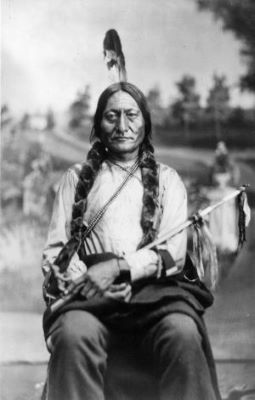
The featured image is a three-quarter-length portrait of Sitting Bull, seated, facing front, holding calumet (1881), and is in the public domain, courtesy of Wikimedia Commons.





The soldiers realized quickly, they could not carry enough food and water, for horses and men, to chase Indians cross country.
Geronimo and 150 Apaches held off an army of 5000, in the mountains near Flagstaff Arizona.
The new strategy became to starve out all Natives in the western US, by killing all the Buffalo.
Herds as big as 50 square miles migrated from South to North and back, annually.
Otherwise, the Army did not have a chance for conquest. Impossible logistics.
As my Dad used to say “Do you know how a much a horse eats, and drinks?”
An unfortunate generalization: “The new strategy became to starve out all Natives in the western US, by killing all the Buffalo.” The tribes west of the Rockies had never had buffalo to hunt, at least not for many centuries.
Thanks for bringing the Cozzens book to our attention. I’ll look for it. Meanwhile the review
notes, “the movement of settlers into the American West obviously involved the displacement of the previous inhabitants by whatever means offered themselves.”
An alternative existed but was in its infancy, a system well started in Europe–registered property ownership. The tribes, like the Europeans, for centuries if not millennia, used force to acquire territory. Once the nomadic Sioux (Lakota, Dakota) got horses, they became conquerors. Large Mandan earth lodge villages along with their inhabitants were destroyed by the Sioux who now claim it as “sacred land.” (Witness claims during the Dakota Pipeline protests.)
The Puritans and Pilgrims of New England at least started by negotiating land rights with the tribes and recording agreements and sales. Slowly but surely this system spread and became fairer and more enforceable. Creating a marketable land rights system with enforcement mechanisms could have and sometimes did save both settlers and Indians from determining rights by warfare. Can we name a tribe that has an off reservation casino or ranch without a registered deed or lease?
Crazy Horse holds a lot of traits in common with Tecumseh, of the Ohio valley region. Tecumseh’s story is the backstory in Allan W. Echert’s fascinating historical narrative, “The Frontiersman” (1967). A common characteristic of North American native tribes was the general tradition that if one was not a member of my tribe, that person was non-human and could be treated however I wished. This belief was why captives would endeavor to be adopted into the tribe so as to recover their humanity.
The extermination of the buffalo must be connected (most fundamentally0 the the introduction of the horse by Europeans. The Comanches, for instance, were great horsemen and would allegedly kill buffalo just for the tongue, which they prized most. Animal conservation was not a common value among Native Americans.