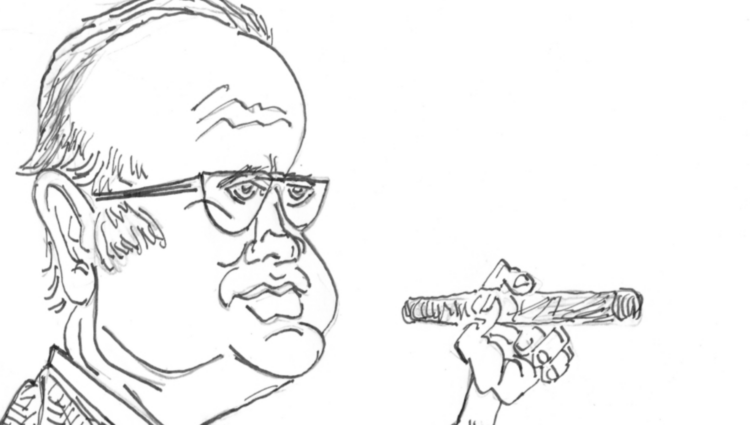
Original Intentions: On the Making and Ratification of the Constitution

By |2020-06-22T16:20:45-05:00January 20th, 2013|Categories: American Founding, American Republic, Books, Constitution, Kevin Gutzman, M. E. Bradford|Tags: |

Driven by an imperative to remind Americans of what they once knew, and to do so before the opportunity passed, M.E. Bradford possessed a reactionary vision; he yearned for a return to America’s birthright, the Constitution of 1787. Original Intentions: On the Making and Ratification of the United States Constitution, by M. E. Bradford; foreword [...]
The Living Edmund Burke

By |2019-12-17T19:48:37-06:00January 12th, 2013|Categories: Conservatism, Edmund Burke, RAK, Russell Kirk|Tags: |

Getting up in recent months an anthology of conservative writing, The Portable Conservative Reader, I had reason to reread much of Burke. More than ever before, I was impressed with how relevant Burke’s thoughts - and, indeed, Burke’s actions - remain to our present discontents. (It is with some reluctance I employ that word “relevant,” [...]

Socrates Today

By |2021-04-13T11:24:23-05:00January 2nd, 2013|Categories: Classics, Plato, Socrates, Wisdom|Tags: |

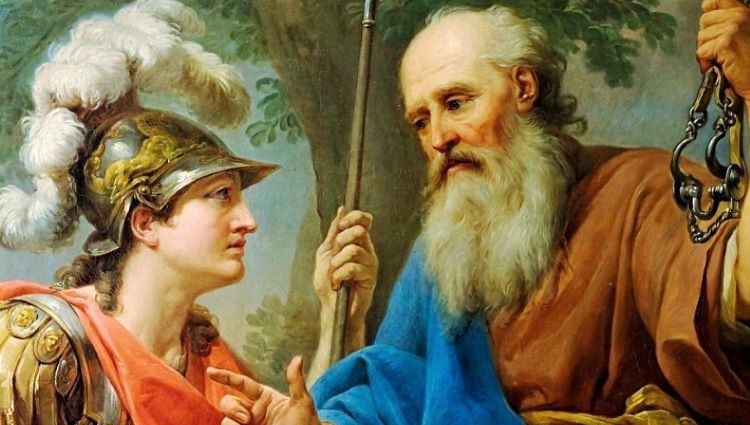
Socrates, who lived from 470 to 399 B.C., is separated from us by nearly two and one half millennia. This means that he had not in common with our progressive age the automobile, the aeroplane, the television, the computer, the telephone (whether cellular or regular), video games, virtual reality, etc. Can we, then, “relate” to [...]

The Swords of Imagination: Russell Kirk’s Battle With Modernity

By |2014-03-10T17:56:12-05:00December 31st, 2012|Categories: Books, Gleaves Whitney, Imagination, Jean-Jacques Rousseau, Modernity, Russell Kirk|Tags: |

“Imagination rules the world,” Russell Kirk used to say.[1] He meant that imagination is a force that molds the clay of our sentiments and understanding.[2] It is not chiefly through calculations, formulas, and syllogisms, but by means of images, myths, and stories that we comprehend our relation to God, to nature, to others, and to the self. [...]

The Legacy of C. S. Lewis

By |2016-02-12T15:28:33-06:00December 26th, 2012|Categories: C.S. Lewis, Christianity, Literature, Permanent Things|Tags: , |

On Friday, November 22, 1963, at about the same time as President John F. Kennedy prepared to enter the black limousine that would take him through downtown Dallas to his violent death, another life was coming to a far less dramatic close across the Atlantic in England. It was late afternoon in the village of [...]

The Future of Conservatism

By |2014-01-21T12:38:12-06:00December 17th, 2012|Categories: Conservatism, George W. Carey, Politics|Tags: |

A survey of the present American political scene provides, I believe, the background and point of departure for examining more permanent and basic aspects of American institutions and politics that pose enormous obstacles to the realization of principles long associated with traditional conservatism. More specifically the eclipse (some might say the disappearance) of traditional conservatism [...]

The Transcendent in Tolkien

By |2019-01-03T18:11:24-06:00December 14th, 2012|Categories: Bradley J. Birzer, Christianity, J.R.R. Tolkien, Russell Kirk|Tags: , |

J. R. R. Tolkien ’s Sanctifying Myth: Understanding Middle-Earth by Bradley J. Birzer Much has been written of J.R.R. Tolkien’s accomplishment during the past half century, with critics struggling to understand the powerful grip exercised by the English fantasist’s writings upon readers. Some Tolkien-focused criticism has been enlightening, much has been repetitive, and a small [...]

The Quintessential Founder: John Witherspoon

By |2020-06-22T16:50:27-05:00November 29th, 2012|Categories: American Founding, American Republic, Gerald Russello, John Witherspoon|Tags: |

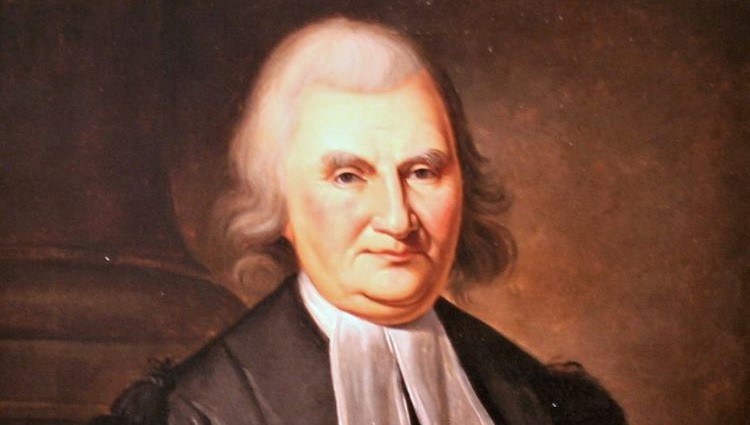
Who remembers John Witherspoon? Although he was one of the most influential Americans of the eighteenth century, Witherspoon has been overlooked by subsequent generations of historian. John Witherspoon and the Founding of the American Republic, by Jeffry H. Morrison (220 pages, University of Notre Dame Press, 2003) Who now remembers John Witherspoon? Despite his many [...]

The Sharpening of the Conservative Mind

By |2013-12-24T10:17:43-06:00November 16th, 2012|Categories: Alexis de Tocqueville, Books, Bruce Frohnen, Conservatism, Edmund Burke|Tags: , |

Virtue and the Promise of Conservatism: The Legacy of Burke & Tocqueville, by Bruce Frohnen In his role as a professor of English literature, Thomas Howard sometimes gives his class a list of the following words: majesty, magnanimity, valor, courtesy, grace, chastity, virginity, nobility, splendor, ceremony, taboo, mystery, purity. The reaction he gets is quite [...]

Russell Kirk as a Political Theorist

By |2022-07-12T07:59:24-05:00November 1st, 2012|Categories: Christianity, Conservatism, Jean-Jacques Rousseau, Moral Imagination, Politics, Russell Kirk|Tags: |

Ultimately in Russell Kirk’s thinking one is confronted with the fundamental differences between the pridefulness of secularism and the transcendent, enduring, and sacrificial love of the biblical view. This accounts for his powerful dissent on any proposition that conservatism and libertarianism are theoretically compatible. Born on October 19, 1918, in Plymouth, Michigan, the son of [...]

A Potent Imperium: American Empire

By |2014-01-05T22:42:47-06:00October 19th, 2012|Categories: Books, Conservatism, History|Tags: |

American Empire: The Realities and Consequences of U.S. Diplomacy, by Andrew J. Bacevich, Cambridge, Mass.: Harvard University Press, 2002. xiii+300 pp. Andrew Bacevich’s American Empire is a first-rate book: important, interesting, and well-written. It stands outside mainstream writing on international relations as a result of its grasp of practicalities, and Bacevich’s preference for rigorous analysis [...]

The Jamestown Project: The Start of Something Big

By |2026-05-08T13:42:06-05:00October 1st, 2012|Categories: American Republic, Books, Bruce Frohnen, Jamestown|Tags: |

Over the course of the seventeenth and eighteenth centuries, Virginia would become something other than what most Americans tend to think of in relation to localist democracy. But Jamestown, after much painful experimentation, had established the kinds of local institutions, beliefs, and practices that colonizers recognized as the prerequisites to successful settlement and that we [...]

Civilization without Religion?

By |2018-10-16T20:25:01-05:00September 24th, 2012|Categories: Civilization, Culture, Moral Imagination, RAK, Religion, Russell Kirk|Tags: |

Watch ye, stand fast in the faith, quit you like men, be strong. -1 Corinthians 16:13 Sobering voices tell us nowadays that the civilization in which we participate is not long for this world. Many countries have fallen under the domination of squalid oligarchs; other lands are reduced to anarchy. “Cultural revolution,” rejecting our patrimony [...]

Conservatism, Centralization, and Constitutional Federalism

By |2016-11-28T18:51:56-06:00September 17th, 2012|Categories: American Founding, Constitution, Featured, Federalist Papers, George W. Carey, Supreme Court|Tags: |

My purpose is to set forth and explore the ramifications of two different conceptions or paradigms of American federalism whose roots can be traced to The Federalist essays of both Hamilton and Madison. Certain conclusions flow from this analysis that, in my judgment, are important to the conservative approach and thinking about centralization. Perhaps the [...]

Go to Top