
Becoming educated is a process of becoming intellectually free so as to be capable of thinking for oneself, engaging in ongoing learning and inquiry, and achieving inner freedom. St. John’s College believes that the life of the mind is crucial to full human flourishing.
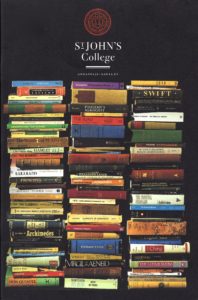 Loyal readers of The Imaginative Conservative have been given many opportunities to read essays describing the incredible liberal learning experience offered by St. John’s College (Annapolis & Santa Fe campuses). Additionally, we have published many essays by tutors from St. John’s including Eva Brann, Chris Nelson, and Peter Kalkavage. Below is a brief overview of the St. John’s Program of learning. St. John’s offers online sessions for those interested in earning the Master of Arts in Liberal Arts degree or the Master of Arts in Eastern Classics. I have benefited greatly from completing the St. John’s MALA program and I highly recommend it for our readers’ consideration.
St. John’s College: Pedagogy & Opportunity*
Great books express most originally and most deeply the ideas that have shaped civilization. These books are both timeless and timely; they illuminate the persisting questions of human existence that bear directly on the problems we face today. Although they span many subjects, these books transcend genres. Plato’s Republic, for example, is both a profound work of philosophy and a brilliant literary work. Euclid’s Elements is a mathematical text with deep philosophical implications. Emily Dickinson’s poems are both great literature and a way of looking into the deepest philosophical, theological, and experiential questions. These authors change our minds, move our hearts, and touch our spirits.
At St. John’s College, every class has fewer than 20 students, and every class begins with a question—a question formulated to foster a genuine investigation into the meaning of a text, not to elicit a ready-made answer. Where that discussion may travel during the class is unpredictable. It all depends on the moment-to-moment dynamism of human conversation in an encounter with a text of inexhaustible richness. The classroom experience is an adventure—and the graduate students a genuine intellectual community.
Becoming educated is a process of becoming intellectually free so as to be capable of thinking for oneself, engaging in ongoing learning and inquiry, and achieving inner freedom. Our students are professionals enhancing their careers, academics seeking a rigorous immersion in interdisciplinary thought, and adults interested in investigating the roots of current issues through thoughtful inquiry and conversation. At St. John’s, we believe that the life of the mind is crucial to full human flourishing.
Students are assisted in their understanding of the great books by faculty members that are referred to as “tutors” rather than “professors.” The title “tutor” is used to signify that our faculty’s chief role is not to profess or lecture in their area of expertise, but to guide the students through the program of study. The tutors guide discussions by asking questions, supplying helpful examples, and encouraging students to explore the implications of their statements. During class, a tutor spends a great deal of time actively listening as students work through the difficulties of a particular text. Tutors raise issues or objections along the way but always encourage the students to find answers for themselves.
There are regular written assignments in addition to reading and discussion. Students who wish to undertake a more extensive piece of written work may submit a proposal to write a Master’s Essay. Upon completion, the essay is read by a committee of three tutors, who also conduct a public oral examination of the student.
The St. John’s College Graduate Institute welcomes applications for admission from individuals with a bachelor’s degree; no particular field or major is required. There is no application fee. Financial aid is available, as are special scholarship opportunities for educators.
*The program description is from the St. John’s College GI website.




Leave A Comment