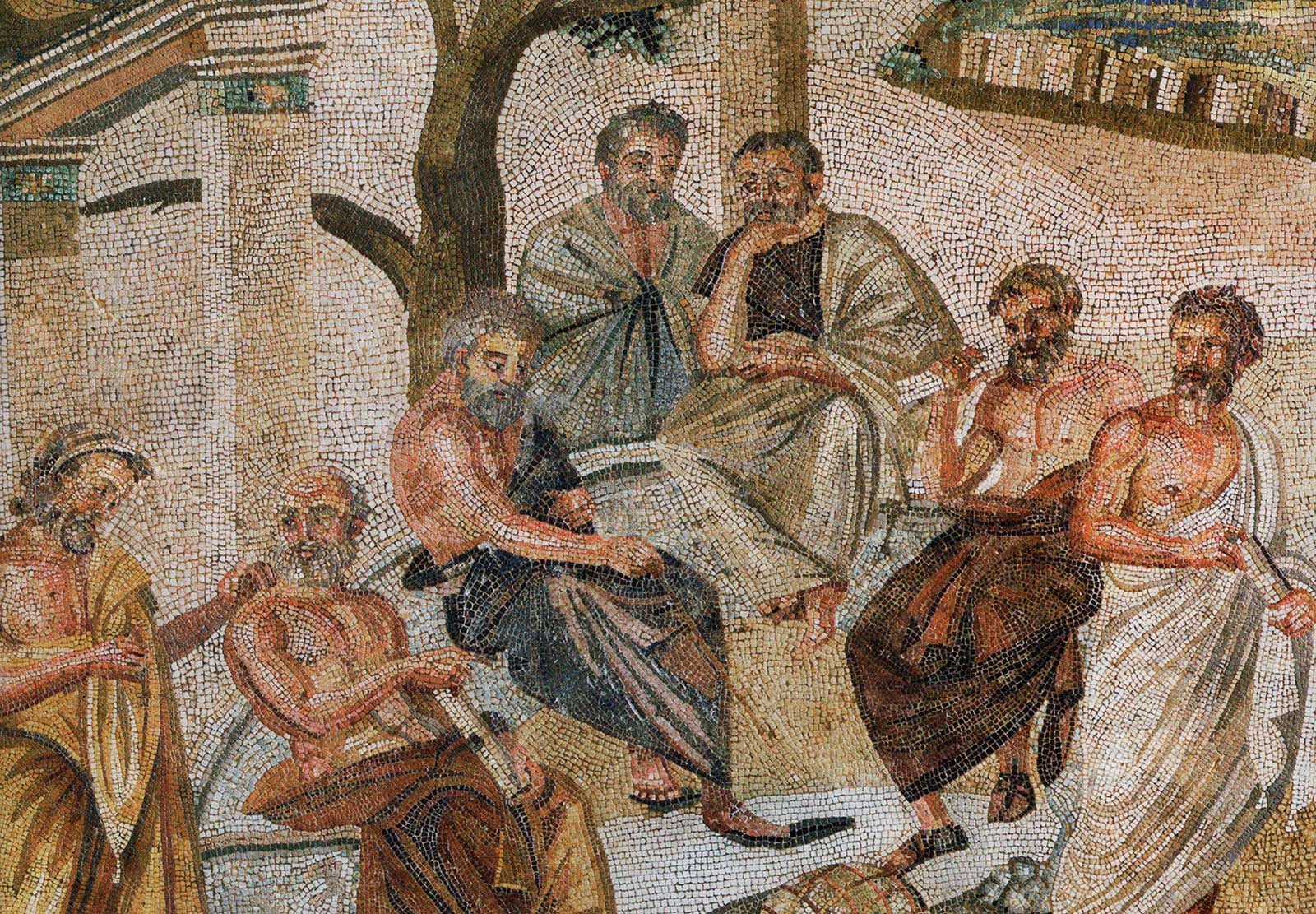
The Musings of a Professor

By |2023-05-21T11:30:49-05:00September 29th, 2016|Categories: E.B., Eva Brann, Featured, Language, Liberal Learning, Senior Contributors, St. John's College|

For the first time in nearly a decade I again have the great pleasure of teaching a freshman language tutorial. I am myself a believer in the "spirit" of a tutorial, because I am convinced that what happens in class for well or ill is nothing beyond the accumulated effect of the goodness or deficiency [...]

How Should We Read a Book?

By |2023-05-21T11:30:50-05:00August 17th, 2016|Categories: E.B., Eva Brann, Quotation, Senior Contributors, St. John's College|

Peter Kalkavage's The Logic of Desire presents an exemplary attitude for a reader to adopt toward a book. To use a fancy term, it embodies a “hermeneutic,” a principle of interpretation. The most respectful such hermeneutic rule I know is the so-called “principle of charity:” give the text a chance to make maximum sense. Mr. [...]

Graduation Day: Do You Want to Change the World?

By |2023-05-21T11:30:51-05:00June 28th, 2016|Categories: E.B., Eva Brann, Featured, Liberal Learning, Senior Contributors, St. John's College|

Parents and Relatives, Fellow Tutors and Mr. President, Board Members and, above all, Santa Fe Seniors and Graduate Institute students! Some of you will remember that radio-telephone distress signal of old: “Mayday, Mayday.” It had, alas, nothing to do with the “merry month of May.” Our seniors, who have all learned a lot of French, [...]

Myth, Sacred Story & Epic: Imagination and Making Fictions

By |2023-05-21T11:30:52-05:00June 7th, 2016|Categories: E.B., Eva Brann, Featured, Homer, Iliad, Imagination, Literature, Myth, Odyssey, Senior Contributors, Sophocles, St. John's College|

A Reflection on Three Questions Concerning the Re-telling of Sacred Stories and of Myths (An Academically Disreputable Inquiry) Questions: Are there canonical sources—gold-standards—for myths, and how would we recognize them? Should our re-visioning of sacred persons and mythical people stay true to the standard version? Should there be myth-dilations? […]

Socrates on Age and the Progress of Study

By |2023-05-21T11:30:52-05:00May 23rd, 2016|Categories: Aristotle, E.B., Education, Eva Brann, Philosophy, Plato, Senior Contributors, Socrates, St. John's College, The Music of the Republic series by Eva Brann|

1c-d. The activity of this higher logos, dialectic itself, is beyond Glaucon’s present reach and no part of the preliminary survey. To set out on the dialectical road would be to see “no longer an image… but the true itself” (533a3); the “most serious matters” are withheld from Glaucon, and so from any mere reader [...]

Socrates on Mathematics and Being

By |2023-05-21T11:30:54-05:00May 16th, 2016|Categories: E.B., Education, Eva Brann, Plato, Senior Contributors, Socrates, St. John's College, The Music of the Republic series by Eva Brann|

1a. After the cave image Socrates considers with Glaucon the actual education of the philosophers. He begins significantly: "Would you like now to see in what way such men will come to be born [in the city] and how one will lead them up into the light, just as some [e.g., Heracles[40]] are said to have [...]

Socrates on Education in the Cave

By |2023-05-21T11:30:55-05:00May 9th, 2016|Categories: E.B., Eva Brann, Music, Plato, Senior Contributors, St. John's College, The Music of the Republic series by Eva Brann|

The cave image deals with the actual habitation of human nature, that is, of the embodied soul, and with the painful steps and stations of its slow ascent. 1. Book VII begins with this invitation to Glaucon: “Now, after this, liken our nature, as far as education and the lack of education is concerned, to [...]

Socrates on Proportions, Dialectic, & the Image of the Good

By |2023-05-21T11:30:56-05:00May 2nd, 2016|Categories: E.B., Eva Brann, Featured, Great Books, Plato, Senior Contributors, Socrates, St. John's College, The Music of the Republic series by Eva Brann, Truth|

4a. Let us return to the invitation to reflection that is extended to Glaucon by the sectioning of the realms “as if” they were a line; he must wonder why, as has been said, the Republic has no dialectical treatment either of the Good or of the eide under it. This missing logos is, however, absent [...]

Socrates on the Offspring of the Good

By |2023-05-21T11:30:57-05:00April 25th, 2016|Categories: E.B., Eva Brann, Featured, Plato, Senior Contributors, Socrates, St. John's College, The Music of the Republic series by Eva Brann, Truth|

  1. Socrates yields to Glaucon. He will speak, though not of the Good itself but rather of its “offspring,” which is most like it (506e). Socrates reminds Glaucon of the “oft-told” story of the one and the many (cf. 476). Those many good and beautiful things are seen but not known, while the thing [...]

Socrates on Opinion, the Philosopher, & the Good

By |2023-05-21T11:30:58-05:00April 18th, 2016|Categories: Classics, E.B., Eva Brann, Featured, Plato, Senior Contributors, Socrates, St. John's College, The Music of the Republic series by Eva Brann, Truth|

A. 1. Glaucon’s introduction to philosophy will itself have a prelude. He will discover for himself the meaning of “opinion,” doxa.  Opinion in its various meanings determines the musical key of the different parts of the dialogue by its absence or presence. The outer ring of logoi is explicitly spoken in a signature appropriate to the [...]

Socrates on Music and Poetry

By |2023-05-21T11:30:59-05:00April 11th, 2016|Categories: E.B., Eva Brann, Featured, Great Books, Liberal Learning, Myth, Senior Contributors, Socrates, St. John's College, The Music of the Republic series by Eva Brann|

1a. We shall now show that, like Heracles, Socrates uses music to “civilize” his young guardian. He uses not the traditional music of the poets but his own restoration of true music; he shows how to apply seriously Damon’s thesis that a change in the character of a city’s music produces a change in the [...]

Socrates on Democracy and the Just City

By |2023-05-21T11:31:00-05:00April 4th, 2016|Categories: E.B., Eva Brann, Featured, Liberal Learning, Myth, Senior Contributors, Socrates, St. John's College, The Music of the Republic series by Eva Brann|

A. 1. Socrates is about to go on with the investigation of the unjust cities when he is again restrained, as once before on his way up to Athens (327), by a conspiracy of Polemarchus and Adeimantus (499). After some whispering, a vote is taken and the decree that has been passed is announced by Thrasymachus [...]

The Imaginative Conservatism of Education

By |2023-05-21T11:31:01-05:00March 30th, 2016|Categories: E.B., Education, Eva Brann, Featured, Imagination, Quotation, Senior Contributors, St. John's College|

My first and last care is not politics (a late-learned duty) but education (an abiding passion). Education seems to me inherently conservative, being the transmission, and thus the saving, of a tradition’s treasures of fiction and thought…. But education is also inherently imaginative, because from pre-school to graduate school, it consists, or should consist, primarily [...]

Socrates on the Founding & Degeneration of Cities

By |2023-05-21T11:31:02-05:00March 28th, 2016|Categories: E.B., Eva Brann, Featured, Great Books, Justice, Myth, Senior Contributors, Socrates, St. John's College, The Music of the Republic series by Eva Brann|

A. 1-2. We come now to the arguments, the logoi, that form the broad middle ring encircling the center. Just as the question concerning the connection of justice to happiness is answered by bringing to light the human soul in its mythical shape, so the soul itself, that is, its formal “constitution,” is discovered by [...]

Go to Top