Remembering Alexis de Tocqueville

By |2021-04-15T17:03:50-05:00March 15th, 2015|Categories: Alexis de Tocqueville, Equality|Tags: |

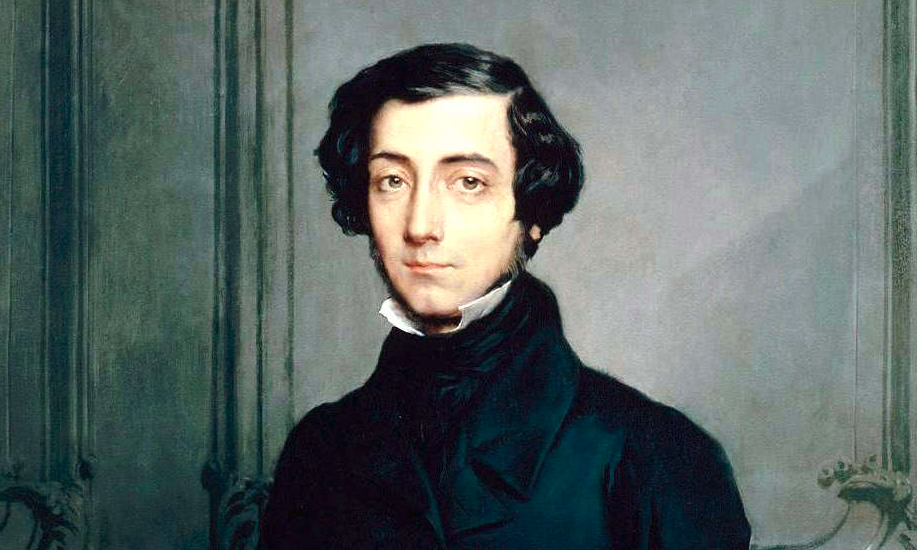
By identifying and attempting to ameliorate democracy’s paradoxical excesses toward conformity and individualism, Alexis de Tocqueville sought to make democracy safe for liberty and to promote an ennobled, rather than a debased, form of equality. Among conservatives and liberals alike, the French aristocrat Alexis de Tocqueville is perhaps the most often quoted political theorist of [...]
Plato’s Pious Prophecy of Modern Man in The Euthyphro

By |2019-09-12T13:52:54-05:00March 12th, 2015|Categories: Alexis de Tocqueville, C.S. Lewis, Christianity, Classics, G.K. Chesterton, Modernity, Plato, Richard Weaver|

Modernism is an ancient phenomenon. If prostitution is the world’s oldest profession, then modernism is the world’s oldest heresy. Modernism’s essential features were already understood long before the era of modernity. Plato reveals them in his dialogue The Euthyphro. The character of Euthyphro is a prototype of modern man. In the dialogue Euthyphro is prosecuting [...]

America’s Democratic State

By |2016-08-03T10:36:37-05:00January 12th, 2015|Categories: Alexis de Tocqueville, Books, Christendom, Democracy in America|

I had remarked during my stay in the United States, that a democratic state of society, similar to that of the Americans, might offer singular facilities for the establishment of despotism; and I perceived, upon my return to Europe, how much use had already been made by most of our rulers, of the notions, the [...]

Applying the Tocquevillian Lens to Contraception

By |2016-07-06T15:02:36-05:00January 2nd, 2015|Categories: Alexis de Tocqueville, Democracy, Family|

The recent high-profile controversies touched off by the HHS Mandate have elicited excellent debate regarding the meaning, importance, and application of the American idea of religious liberty. They have not, however, elicited any substantial debate regarding the rational grounds for opposing the use of contraception in itself. In the numerous conversations I have had on [...]

Typical Tocquevillian Advice

By |2015-05-19T23:13:34-05:00December 28th, 2014|Categories: Alexis de Tocqueville, Aristotle, Classics, Education, Liberal Learning, Peter A. Lawler, Plato|

So I just finished reading the most recent contributions to Postmodern Conservative. The quality is high, and the depth and breadth of insight is real. And I wish I could say something to show I am anywhere near their pay grade when it comes to classical or contemporary events. I agree with Peter Spiliakos that [...]

Cancel the Midterm Elections?

By |2014-11-04T08:58:55-06:00November 4th, 2014|Categories: Bruce Frohnen, Conservatism, Democracy in America, Liberalism, Republicans|

Like all actual conservatives, I look on any increase in the powers of the Republican Party as an opportunity for disappointment. Its leaders would rather run a permanent minority than serve as part of a majority actually returning power to the states and the people. Better to be ruled by Democrats, “our” leaders believe, so [...]

Less Puritanical Than Ever

By |2014-09-22T17:11:28-05:00September 22nd, 2014|Categories: Alexis de Tocqueville, Culture, Peter A. Lawler|

Marilynne Robinson Thanks to Carl Eric Scott for calling attention to the strengths and weaknesses of the moral, political, scientific, and theological views of Marilynne Robinson (perhaps our best living novelist) by highlighting Paul Seaton’s balanced and smart review of her latest book of essays. Ms. Robinson’s thought really is neo-Puritanical. Mr. Seaton and Mr. Scott, knowing, as they do, [...]

Democracy, Greed, and the Perils of Equality

By |2014-09-20T17:06:06-05:00September 20th, 2014|Categories: Alexis de Tocqueville, American Republic, Democracy in America|

If there are two things that one is likely to hear from college faculty today, they are that 1. Students are too careerist, and 2. We need a more democratic society. They worry about the growing utilitarian cast of education in general, as well as the remnants of hierarchy, authority, paternalism, and inequality in today’s [...]

Why Liberalism Means Empire

By |2022-07-16T07:12:48-05:00August 9th, 2014|Categories: Christendom, Conservatism, Democracy in America, Liberalism, War|Tags: , |

Liberal democracy is unnatural. It is a product of power and security, not innate human sociability. It is peculiar rather than universal, accidental rather than teleologically preordained. And Americans have been shaped by its framework throughout their history. History ended on October 14, 1806. That was the day of the Battle of Jena, the turning [...]

Progress in the Face of Crisis

By |2017-09-05T23:05:56-05:00July 14th, 2014|Categories: Alexis de Tocqueville, Books, Civilization, Mark Malvasi, Progressivism|

While recuperating from a knee and shoulder injury, I used my forced idleness to read two very different English writers: the eighteenth-century historian Edward Gibbon and the twentieth-century mystery novelist John Buchan. Despite the gravity of his magisterial Decline and Fall of the Roman Empire, Mr. Gibbon, it turns out, shared at least one assumption [...]

Are Americans Too Busy?

By |2022-05-28T11:09:55-05:00May 30th, 2014|Categories: Alexis de Tocqueville, Happiness, Peter A. Lawler|

From a certain view, the most probing question Alexis de Tocqueville had to answer in Democracy in America is “Why are the Americans so restless in the midst of prosperity?” Why can’t they just stop and enjoy all their good fortune? Why are those workaholics almost running away from leisure? Why do those pursuers of [...]

When a Group of Marylanders Changed the World in 1774

By |2020-06-01T18:08:03-05:00January 22nd, 2014|Categories: Alexis de Tocqueville, American Founding, American Republic, Bradley J. Birzer, Constitution|

In response to the Boston Tea Party, Parliament passed five of what the Americans called the “Intolerable Acts.” A group of disgruntled Marylanders reacted by forming the Annapolis Convention, which sought ways to “best secure American liberty” and which sparked resistance to British “tyranny” throughout the colonies. On January 19, 1774, the news of the [...]

Tocqueville on Keeping Our Countercultural Churches

By |2019-04-16T16:26:53-05:00January 16th, 2014|Categories: Alexis de Tocqueville, Christianity, Peter A. Lawler, Religion|Tags: |

To begin with a simple point, one basic insight of Tocqueville is that things are always getting better and worse. Thus, it is hardly surprising that Tocqueville could be used to defend the advantages of religious establishment. He, more generally, is unrivaled in arousing a kind of selective nostalgia that helps us remember the advantages [...]

Whither Self-Governance?

By |2016-06-28T12:32:23-05:00January 2nd, 2014|Categories: Alexis de Tocqueville, Democracy, Economics, Government, Politics|

The financial crisis and lingering economic malaise have resulted in an extended debate as to the proper sphere of markets and government in society. Unsurprisingly, a large number of social critics have ignored the degree of government intervention that existed in financial markets on the eve of the crisis, falsely caricaturing the financial panic as [...]

Go to Top