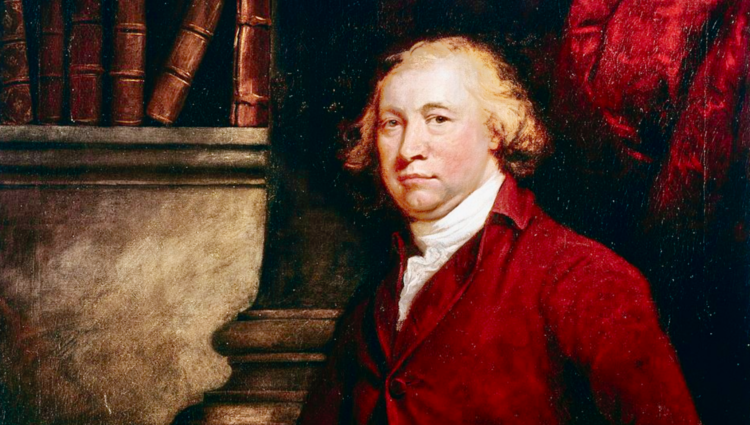
Edmund Burke & the English Revolution

By |2023-08-15T18:01:08-05:00August 15th, 2023|Categories: Community, Conservatism, Edmund Burke, Revolution, Timeless Essays|Tags: , |

In his “Reflections,” Edmund Burke constructs a powerful myth of English history, defending the consolidated results of the English Revolution of the seventeenth century. In his poem “Blood and the Moon,” Yeats writes of “haughtier-headed Burke that proved the state a tree.” Edmund Burke would have relished the line, having proved nothing of the sort. [...]

Is Conservatism at the Mercy of Hollow Men?

By |2023-08-02T18:30:33-05:00August 2nd, 2023|Categories: Conservatism, Featured, George A. Panichas, Timeless Essays|Tags: |

A conservatism at the mercy of hollow men is inconceivable, and yet cruelly possible, which ultimately makes it necessary to protect and to conserve the soil of conservative thought and consciousness. That the canons of conservatism must beg to be defended against present-day pretenders who mask their ambitions and antinomies under the rubric of conservatism [...]

Samuel Johnson as Hero

By |2023-07-30T21:55:06-05:00July 30th, 2023|Categories: Featured, Poetry, Timeless Essays|Tags: , , |

Samuel Johnson’s ultimately victorious sanity derived from a set of axioms that he had derived from his reading in literature, philosophy, history, and theology—having to do with human limitation, self-discipline, the inevitability of the vanity of human wishes, and the psychological power of prayer. Samuel Johnson’s achievement is so impressive that we tend to forget [...]

Ben Jonson’s “To Penshurst” & the Good Society

By |2023-07-25T17:03:52-05:00July 25th, 2023|Categories: Community, Conservatism, Culture, Order, Permanent Things, Poetry, Timeless Essays|Tags: , |

Ben Jonson’s “To Penshurst” has received very little attention, no doubt because of the well known circumstance that Jonson himself is more honored than read. Yet “To Penshurst” is a memorable poem, and perhaps a great one. Civilization is memory. –Hugh Kenner I cannot do my duty as a true modern, by cursing everybody who [...]

John Dryden: The Politics of Style

By |2023-07-18T14:17:32-05:00July 18th, 2023|Categories: Art, Conservatism, Culture, Order, Poetry, T.S. Eliot, Timeless Essays|Tags: , |

John Dryden was, for the most part, a man of quiet temperament; yet he presided over a literary revolution. As a poet and critic he destroyed the principal seventeenth-century literary modes and created the style and the methods that would characterize the eighteenth. The rise in John Dryden’s reputation, commencing a generation or so ago, [...]

Solzhenitsyn, Russell Kirk, & the Moral Imagination

By |2023-06-07T18:16:45-05:00June 7th, 2023|Categories: Aleksandr Solzhenitsyn, Featured, Ideology, Moral Imagination, Russell Kirk, Timeless Essays|Tags: |

Alexander Solzhenitsyn illuminates the distinctive character of our age by bringing to bear a religiously grounded moral vision, and he filters this vision through his literary imagination. In the summer of 2003, I had to vacate my college office. With limited file-cabinet space at home, I had to lighten my files drastically. Reading and skimming [...]

Christopher Dawson & the History We Are Not Told

By |2023-05-25T12:19:06-05:00May 24th, 2023|Categories: Aleksandr Solzhenitsyn, Catholicism, Christendom, Christian Humanism, Christianity, Christopher Dawson, Culture, Featured, History, Timeless Essays|Tags: , |

Christopher Dawson radically revises our sense of the continuity of Western culture. For the ordinary educated consciousness, what happened in Western Europe after the collapse of the Roman order tends to be a blank page labelled “the dark ages.” But as Dawson makes clear, there were heroic continuities, an enormous effort on the part of [...]

Was Nathaniel Hawthorne a Conservative?

By |2023-05-18T18:02:44-05:00May 18th, 2023|Categories: Conservatism, Featured, Russell Kirk, The Conservative Mind|Tags: |

Nathaniel Hawthorne’s chief accomplishment was his ability to impress “the idea of sin upon a nation which would like to forget it.” By reminding Americans of the power and influence of original sin, Hawthorne maintained that real reform must be first and foremost moral reform, and such reform is not possible until one had remembered [...]

The Great Books: Enemies of Wisdom?

By |2023-06-11T10:32:45-05:00May 1st, 2023|Categories: Education, Great Books, Philosophy, Timeless Essays|Tags: |

Great Books fanaticism ignores the audience and in so doing reveals its parochialism, its innocence towards history. We no longer live in a book-dominated culture; to treat our students as though we did is to violate their very psychic structure. Today we enter a new kind of Middle Ages, but Great Books people still absent-mindedly [...]

The Things That Are Caesar’s: Romano Guardini

By |2023-07-29T21:36:59-05:00March 8th, 2023|Categories: Books, Christianity, Communio, George A. Panichas, Religion, Romano Guardini, Timeless Essays|Tags: |

Romano Guardini reminds us, above all, to render “to Caesar the things that are Caesar’s, and to God, the things that are God’s.” His writings help us to recognize the spiritual necessity of not being slaves of the things of the world. His testimony thus pleads with us to disentangle ourselves from the enemies of [...]

The Popular Roots of Conservatism

By |2022-11-24T18:21:34-06:00November 24th, 2022|Categories: Conservatism, Featured, George W. Carey, Politics, Timeless Essays|Tags: |

American conservatism is rooted in what it understands to be the principles which guided our Founders; principles which, in turn, it sees as rooted in the better part of Western civilization, though adapted to the peculiarities of the American condition. The chief difficulty in assessing the state of contemporary American conservatism is arriving at some [...]

Moral & Political Foundations of the American Founding

By |2022-11-03T16:53:27-05:00November 3rd, 2022|Categories: American Founding, American Republic, Books, Donald Lutz, Featured, George W. Carey, Timeless Essays|Tags: |

The overemphasis on the writings of the politically prominent has resulted in a distorted picture of the political thought of the American Founding. American Political Writing During the Founding Era: 1760-1805, compiled by Charles S. Hyneman and Donald S. Lutz. These beautifully produced volumes represent the most ambitious effort to date to remedy a significant [...]

The Extended Republic Theory of James Madison

By |2022-10-10T16:16:11-05:00October 10th, 2022|Categories: American Founding, American Republic, Featured, Federalist Papers, George W. Carey, James Madison, Timeless Essays|Tags: |

Certainly, James Madison cannot be faulted for not having seen the true dimensions of the problems associated with factions. Perhaps more clearly than other theorists who preceded him, he saw its root causes. Yet, he can be faulted for not having urged upon his audience the observance of that morality necessary for the perpetuation of [...]

The Moral Center & America’s Future: James Bryce’s “American Commonwealth”

By |2022-10-04T14:31:09-05:00October 4th, 2022|Categories: Alexis de Tocqueville, American Republic, Featured, George W. Carey, James Bryce, Timeless Essays|Tags: |

James Bryce’s relatively optimistic view of America’s future relies on the tacit premise that its people will retain the moral center, inherited largely from their English forebears. His work, then, is valuable, if only to remind us of that heritage. It is also foreboding in suggesting that without this moral center troubled times await the [...]

Go to Top