The Constitutional Intrigue of West Virginia Statehood

By |2020-01-18T20:59:39-06:00May 21st, 2019|Categories: American Republic, Constitution, Government, History, Politics|

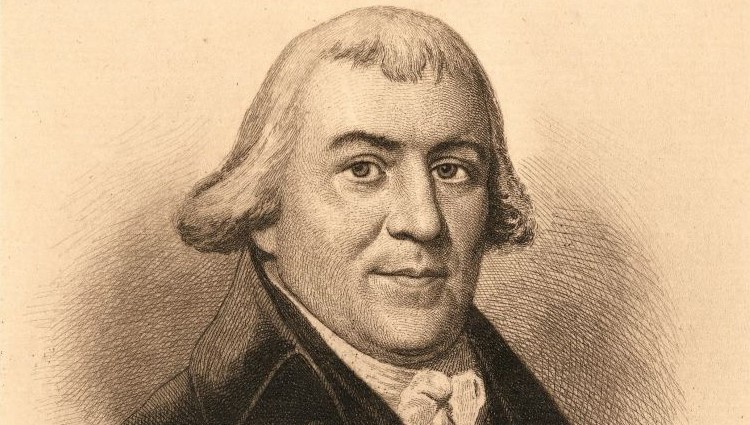
Admitted in June 20, 1863 by ratifying the U.S. Constitution, West Virginia became the thirty-fifth state. It is known as “The Mountain State” with the West Virginia State Constitution in current use adopted in 1872. The story of how West Virginia became a state is an amazing story, full of constitutional intrigue and sleight-of-hand worthy [...]

Orestes Brownson’s New England and the Unwritten Constitution

By |2020-07-19T11:19:04-05:00May 19th, 2019|Categories: American Republic, Civil Society, Constitution, Culture, History, Political Philosophy, Politics, Timeless Essays|

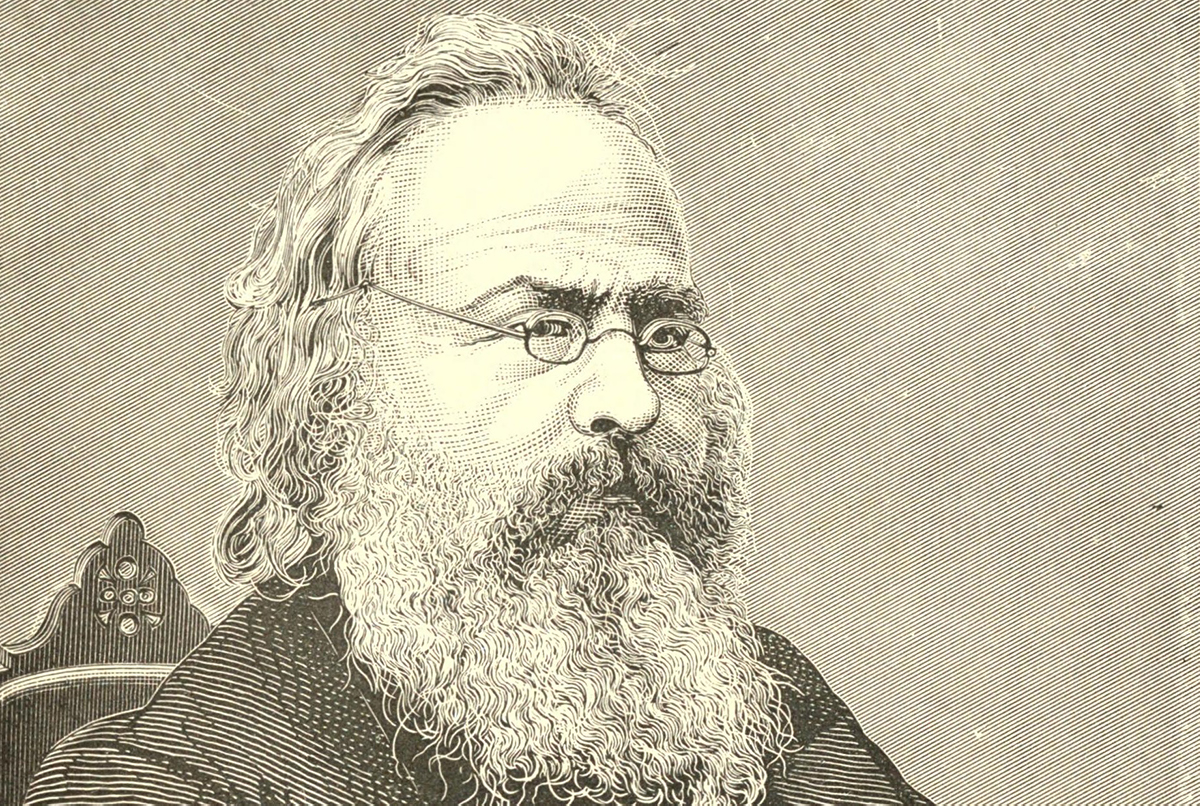
Orestes Brownson so esteemed New England people, customs, and institutions that they dominated his writings and fit at the heart of his political ideas. The danger of majoritarian tyranny hangs over republics. The dilemma of constituting a virtuous republic while also restricting interests, sects, and factions’ use of unchecked political power possessed eighteenth century American [...]

Maryland’s 1867 State Constitution, Among the Oldest in Use Today

By |2021-04-22T18:35:02-05:00April 10th, 2019|Categories: American Founding, Constitution, History|

Maryland has one of the oldest state constitutions in use today, as well as one of the longest Declarations of Rights. As such, it provides both the historian and constitutional scholar much to occupy their time. A detailed study of the rights of Maryland’s citizens will be time well spent. Maryland is the seventh state [...]

The Libertarian Constitutional Fantasy

By |2021-02-23T17:14:30-06:00December 4th, 2018|Categories: Conservatism, Constitution, Libertarianism|

The libertarian theory of constitutional law is clever and undoubtedly well-intentioned, but it is unsound from an originalist standpoint. It is historically untenable. It requires doctrinal leaps of Olympic caliber. Instead of increasing individual liberty, it would destroy the republican form of government by concentrating power in one branch of government. Debates regarding the role [...]

The Supreme Court: Usurping the Legislative and Taxing Power

By |2019-06-25T17:07:11-05:00November 18th, 2018|Categories: American Republic, Constitution, Supreme Court Precedent Series, Thomas R. Ascik|

“Precedence,” as well as following or overturning precedents, is not limited to what is decided in new cases. It is also concerns the adherence to established principles of judicial jurisprudence. Without both kinds of precedence, there is no limit to the power of the judiciary... In the last installment of this survey of the judicial principle [...]

The First Shots of the Civil War: “The Star of the West”

By |2022-01-07T23:31:05-06:00November 13th, 2018|Categories: American Republic, Bradley Birzer Fort Sumter Series, Bradley J. Birzer, Civil War, Constitution, History, Senior Contributors, War|

The Union soldiers defending Forts Sumter and Moultrie in Charleston Harbor had come to believe that their honor, as well as the honor of the Constitution and the federal government, was at stake. Shortly after dawn, around 6 am, on January 9, 1861, Captain Abner Doubleday spotted a steamer preparing to enter Charleston Harbor by [...]

The Other Founders: The Legacy of Anti-Federalism

By |2019-10-16T13:18:43-05:00November 1st, 2018|Categories: American Founding, American Republic, Books, Constitution, Democracy, Featured, Federalism, John Taylor of Caroline|

To a very great extent, it was the Anti-Federalists, through their rhetoric and writings, who kept alive the spirit of localism and salvaged the great ideal of limited government inherited from the Revolution... The Other Founders: Anti-Federalism and the Dissenting Tradition in America, 1788-1828 by Saul Cornell (University of North Carolina Press, 1999) The Anti-Federalists who [...]

The Cornerstone of Conservatism

By |2019-05-07T14:40:38-05:00August 19th, 2018|Categories: American Republic, Christianity, Conservatism, Constitution, Government, Liberalism, Liberty, Politics|

Conservatism is a formal understanding of man. By understanding, I mean a verifiable truth, and by formal, I refer to a distinguishable methodology which permeated the celebrated thoughts of classical antiquity and scholastic medievalism. Conversely, Liberalism is an ideology for man. This is not to say that Conservatism is without its own prescriptions, but only [...]

The Americanization of James Iredell

By |2021-04-23T14:42:35-05:00August 3rd, 2018|Categories: American Founding, American Republic, Constitution, M. E. Bradford, Politics|

James Iredell’s careful apologia for the American cause—a teaching which he developed in a series of essays and public letters written from 1773-1778—clearly contains a foreshadowing of what he thought should be in a constitution for the United States. James Iredell was born at Lewes, Sussex County, England. He was the eldest of the five [...]

Constitutional Drift & the Challenge of Self-Governance

By |2018-07-29T23:08:08-05:00July 29th, 2018|Categories: Conservatism, Constitution, Federalist, Government, Liberty, Politics, Timeless Essays|

Self-governance requires that those in positions of authority emphasize the importance of treating the Constitution as a "living document," in that phrase’s best sense—not as a surrender to expediency, but as a recognition that no nation can govern itself that fails to meet the responsibility of perpetually renewing the Constitution by living its constitution... Today’s [...]

Can the President Pardon Himself?

By |2021-04-22T18:53:56-05:00July 1st, 2018|Categories: American Founding, American Republic, Constitution, Government, Presidency, Sean Busick|

It used to be a fundamental article of faith among American conservatives that the Constitution can only be understood in the context of the Founders’ original intentions. So, is it reasonable to believe that the Founders intended a president to have the power to pardon himself? The Constitution gives the president “Power to grant Reprieves [...]

Roger Sherman and the Puritan Founding of America

By |2021-04-26T16:25:16-05:00May 1st, 2018|Categories: American Founding, American Republic, Books, Bradley J. Birzer, Constitution, History|

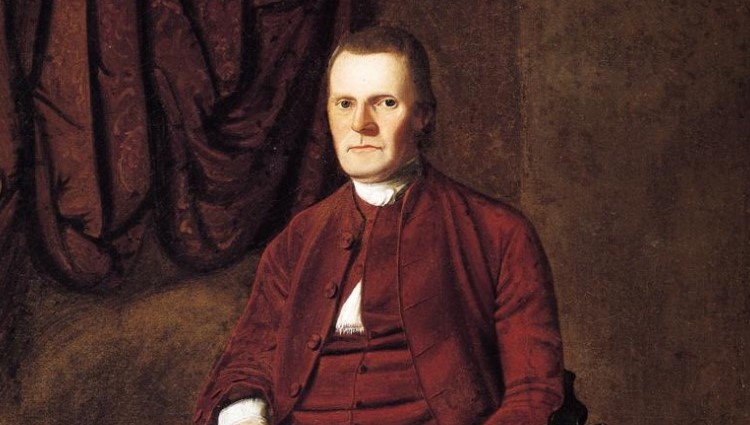
If James Madison offered the American republic a five-course meal of epicurean excellence, Roger Sherman was the short-order fry cook in the nearest greasy spoon, a block or two away from Independence Square. The Collected Works of Roger Sherman ed. Mark David Hall (840 pages, Liberty Fund, 2016) “Sherman’s air is the reverse of grace; there [...]

On Compromise

By |2023-05-21T11:30:27-05:00April 23rd, 2018|Categories: Character, Constitution, E.B., Eva Brann, Federalist, History, Philosophy, Senior Contributors, St. John's College|

What is interesting is the ultimate human predicament, when serious principles, serious commitments are at odds, and there is no apparent way to compose them in sight, except for giving something up, or giving in—that will be a surrender of self. Why are we in these predicaments to begin with? I am not a great [...]

Go to Top