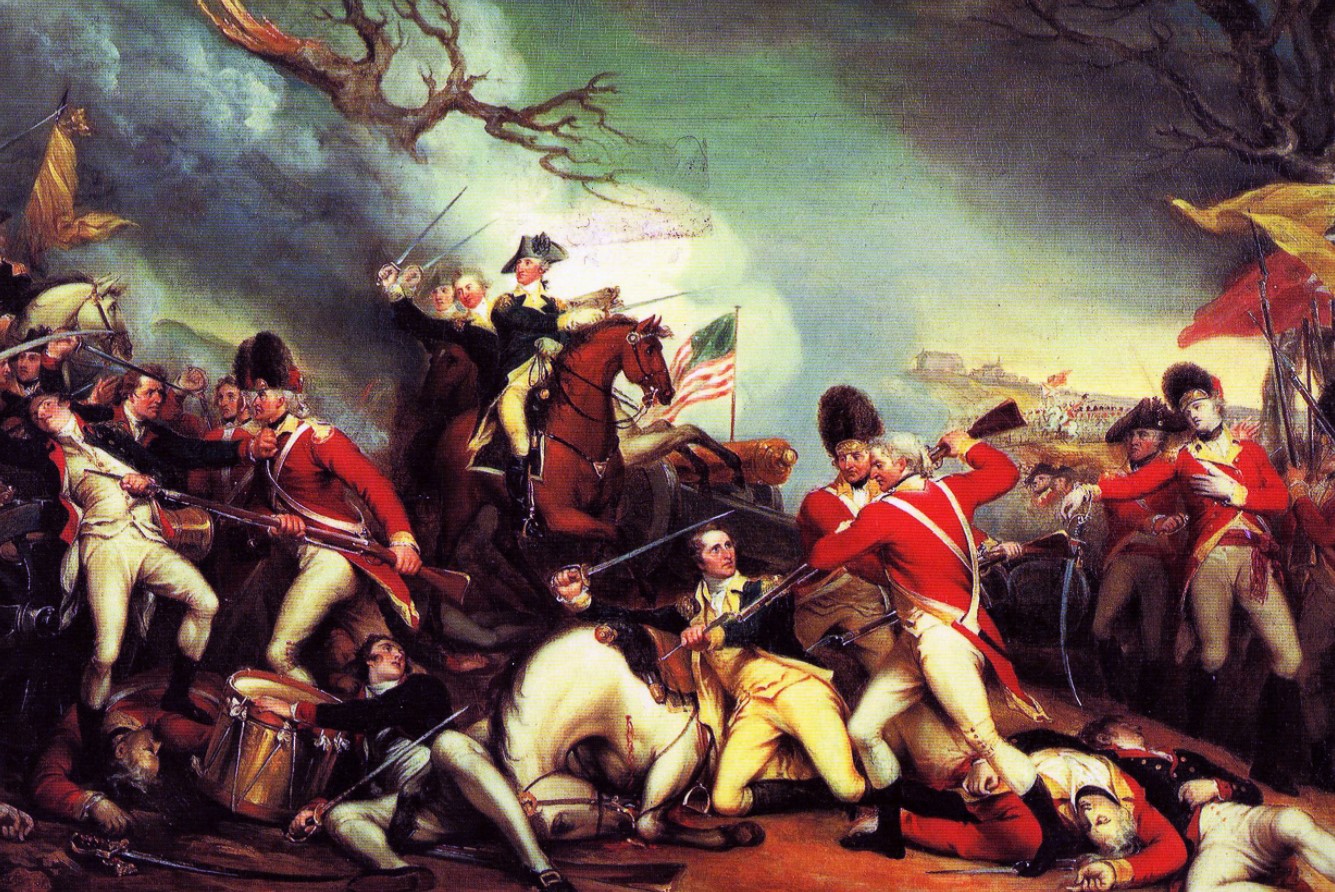
Hesiod’s “Works and Days”

By |2019-10-16T15:48:45-05:00January 19th, 2014|Categories: Books, Classics, Greek Epic Poetry, Labor/Work, Poetry, Steven Jonathan Rummelsburg|Tags: |

The centuries ebb and flow on a cosmic tide between faithfulness and depravity as men commit their lives to a seemingly infinite range of virtuous and vicious acts. Though man tears himself away from the face of God in pursuit of idols, God never abandons His creation. The glorious age of the Ancient Greek pagans has [...]

Barnacles: Liberal Education and the Art of Coming Unstuck

By |2021-05-21T15:12:08-05:00January 18th, 2014|Categories: Christopher B. Nelson, Imagination, Liberal Learning, St. John's College|

Barnacles do not often occupy the thoughts of landlubbers. Most people can go for weeks without thinking about them. It had been at least that long for me when I found in my files John Gardner’s marvelous 1990 address called “Personal Renewal.” Gardner begins his speech with an arresting quotation from an article he had [...]

Kindred Spirits and the Art of Friendship

By |2018-05-30T12:04:51-05:00January 18th, 2014|Categories: Books, Julie Baldwin|

Looking for Anne of Green Gables: the Story of L.M. Montgomery and Her Literary Classic by Irene Gammel “You’re young, and I’m old, but our souls are about the same age, I reckon. We both belong to the race that knows Joseph, as Cornelia Bryant would say.” “‘The race that knows Joseph?’” puzzled Anne. “Yes. [...]

G.K. Chesterton and Modernity

By |2022-05-28T22:43:19-05:00January 17th, 2014|Categories: Books, Christendom, Christianity, Communio, Culture, Featured, G.K. Chesterton, Modernity, Morality, Stratford Caldecott|

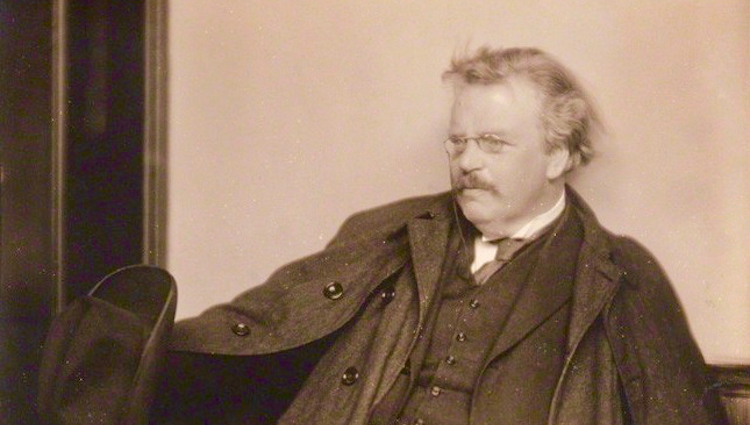
Chesterton recognized that heart and hearth, work and worth, are all of a piece. Human flourishing is found in families, human wholeness in holiness. Civilization depends on faith—faith both in the transcendent horizon that many call God, but also faith in reason, and in the ability of human intelligence to grasp objective truth. by [...]

Tocqueville on Keeping Our Countercultural Churches

By |2019-04-16T16:26:53-05:00January 16th, 2014|Categories: Alexis de Tocqueville, Christianity, Peter A. Lawler, Religion|Tags: |

To begin with a simple point, one basic insight of Tocqueville is that things are always getting better and worse. Thus, it is hardly surprising that Tocqueville could be used to defend the advantages of religious establishment. He, more generally, is unrivaled in arousing a kind of selective nostalgia that helps us remember the advantages [...]

Duck Dynasty and the Dangerous Truth

By |2014-01-15T16:41:08-06:00January 15th, 2014|Categories: Christianity, Culture, Morality, Steven Jonathan Rummelsburg|

The crescendo of voices clamoring for disordered public ethics is a din rising to hellish decibels. We are witnessing a massive misuse of American law by “rights and entitlement ideologues” licentiously torqueing the trajectory of this country’s course towards an irrevocable downward spiral. Morally disordered organizations like GLAAD and 100 more besides, are springing up [...]

My Year in Reading: 2013

By |2014-01-14T17:07:42-06:00January 15th, 2014|Categories: Books, Sean Busick|

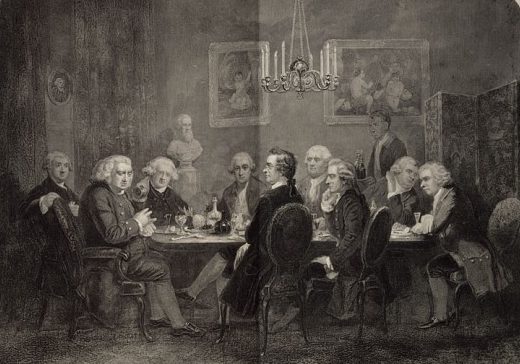
“Is there, my Books, a charm which ye have not, No!—When with you, the world is all forgot.” —William Gilmore Simms, “Sonnet—To My Books,” 1823 The beginning of a new year provides me with an opportunity to outline a personal reading plan for the coming year and to reflect upon the books I read last [...]

Mr. Dickinson or Professor Middlekauff?

By |2021-07-03T17:27:43-05:00January 14th, 2014|Categories: Books, Bradley J. Birzer, John Dickinson|

Though I’m only about 200 pages into Robert Middlekauff’s massive 1982 history of the American founding, The Glorious Cause, I’m willing to take a chance and label it not just a “good book” but a “great book.” Middlekauff not only possesses sheer mastery over the era—as though he lived in it—but he’s never afraid to [...]

Modern America Through Burke’s Eyes

By |2019-07-02T17:06:33-05:00January 14th, 2014|Categories: American Founding, Conservatism, Culture, Edmund Burke, Jean-Jacques Rousseau|

As those serious about influencing the nation on both sides of the aisle understand, winning in politics first requires winning the culture. Doing so necessitates both a keen eye for recognizing cultural trends and the creative foresight to envision how best to guide a culture back to true principles by which a people can safely [...]

Progress and Progressives: Moving Beyond Antique Optimism

By |2015-05-19T23:10:16-05:00January 13th, 2014|Categories: Classics, Plato, Progressivism|Tags: |

To the classical philosophers, history was cyclical. J.B. Bury observed that thought in ancient Greece was dominated by the idea of cycles, and that time was itself the enemy of man to the degree it eroded the value of the corporeal world. Marcus Aurelius wrote that the rational human mind “stretches forth into the infinitude [...]

The War of the Wells: Bellocian Bellicosity vs. Chestertonian Charity

By |2016-02-12T15:28:15-06:00January 13th, 2014|Categories: Books, Christianity, G.K. Chesterton, Hilaire Belloc, Joseph Pearce|

Much of G. K. Chesterton’s work is an engagement with relativism and modernism in their multifarious manifestations. Nowhere is this more evident than in The Everlasting Man, arguably his most important book. It was no mere coincidence that Chesterton’s book should appear in 1925, the same year that H.G. Wells’s Outline of History was first [...]

Building the Conservative Mind

By |2021-05-10T19:25:43-05:00January 12th, 2014|Categories: Audio/Video, Russell Kirk, The Conservative Mind|

In this lecture, Dr. Christopher Hammons of Houston Baptist University addresses the way in which The Conservative Mind traces “a long train of conservative intellectuals contribute to the progress of the human condition despite” the liberalism of the intellectuals of the modern academy. As Kirk explains, conservatives hold “that a people’s core values and beliefs are [...]

Go to Top