The Suicide of a Civilization

By |2020-12-09T15:59:46-06:00December 9th, 2020|Categories: Christianity, Civilization, Culture, Death|

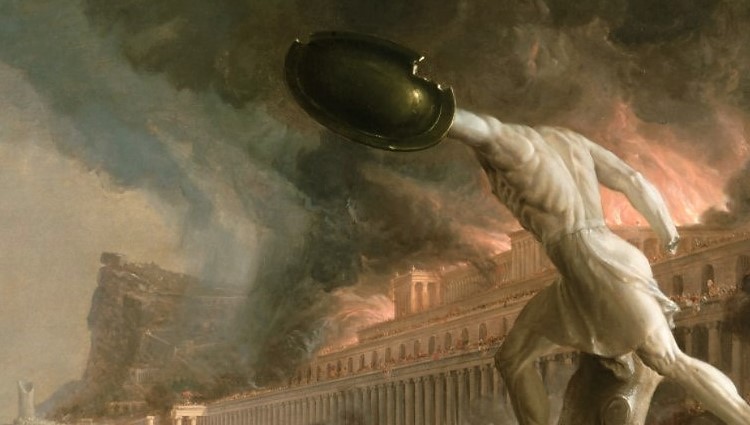
Suppose an anthropologist were asked, apart from the sound and fury of current politics, what were the signs of a dying culture, or a culture committing suicide? What might he respond, as following from human nature and from the terms of the question itself? What might he notice in our own? Such a culture would [...]

Neighborhoods: A Forgotten School of Family & Social Flourishing

By |2020-12-02T15:48:40-06:00December 2nd, 2020|Categories: Civil Society, Civilization, Community, Family|

The neighbourhood can give one a greater sense of a geographic and social whole. It can serve as a bridge between the home and the larger society. The limited control we have over who our neighbours are reflects the normal conditions of a large society. How well do you know your neighbours? How much does [...]

Prayer, Beauty, and Civilization

By |2025-01-04T10:20:04-06:00November 21st, 2020|Categories: Art, Beauty, Books, Christianity, Civilization, Culture, Imagination, Michael De Sapio, Prayer, Senior Contributors|

In our zeal to articulate how Christianity has shaped civilization, we are apt to neglect the specific role of prayer. The good, the true, and the beautiful fostered by our civilization have been initiated and sustained by prayer. If one does not pray, what measure of human cultivation is one missing? Art and Prayer: The [...]

Satyagraha: Gandhi’s Civil Disobedience and Nonviolent Resistance

By |2021-08-28T09:30:17-05:00October 22nd, 2020|Categories: Civilization, Eastern Thought, Freedom, Politics, Rights|

In each country represented by adherents to truth or devotees of satyagraha—Gandhi’s concept of civil disobedience—their nonviolent efforts helped achieve seismic change and movement toward justice, all without resort to war. Their influence, and that of satyagraha, continues to cascade and ripple across the world incalculably. “I’m more convinced than ever before that nonviolence is [...]

Burke’s First Letter on a Regicide Peace

By |2020-10-15T09:55:34-05:00October 8th, 2020|Categories: Bradley J. Birzer, Civilization, Edmund Burke, Government, History, Politics, Revolution, Senior Contributors|

As Edmund Burke observed, real community begins with the free and natural choice to associate at the most personal, familial, and local level, with each community growing from the ground up. By misunderstanding this, the French Revolutionaries seceded not just from Christendom, but from the laws of nature. In the final years of his life, [...]

Pietas and Fallen Cities: America and Vergil’s “Aeneid”

By |2020-09-28T00:48:46-05:00September 27th, 2020|Categories: Aeneid, American Republic, Civilization, Culture, Great Books, Religion, Virgil, Virtue|

Authentic righteousness for a nation of natives, settlers, immigrants, and refugees requires the same whether for America or Vergil’s Rome: pietas. This is devotion to family, community, country, and deity. One so devoted does not fear the sublimation of the self in the fulfillment of these duties, for it is in the pursuit of these [...]

Nock and Nisbet on Society and State

By |2020-09-04T15:20:28-05:00September 4th, 2020|Categories: Bradley J. Birzer, Civilization, Community, Culture, Robert Nisbet, Senior Contributors, Social Institutions|

As Albert Jay Nock argued in the 1930s, and Robert Nisbet in the 1960s, the state plays a zero-sum game: It desires to assume all power over society, even to the point of taking the place of the Church as the glue that holds all together, and thus it renders society obsolete in the long [...]

The Good Man’s Crusade: The Frog Is Getting Hot

By |2020-08-24T16:56:47-05:00August 24th, 2020|Categories: Civil Society, Civilization|

There are cultural battles that cannot be taken for granted without seriously risking freedom. The left clearly feels comfortable with conflict. Their campaign slogan is always the same: Change, no matter what. It reminds me of those shampoo brands that present a "new formula" and stop making the old one just as you had gotten [...]

Can “Community Groups” Replace the Police?

By |2020-08-20T15:32:09-05:00August 23rd, 2020|Categories: Civilization, Community, Government, John Horvat, Modernity, Politics|

Because the classic idea of a community that once existed in America has been swallowed up by the present culture, to demand “community-driven” solutions to remedy police problems is an empty—and dangerous—proposition. The defund-the-police movement clearly defines its goal. Its activists believe police officers are agents of violence inside the community. Their solution is to [...]

The “Leatherstocking Tales” and the American Frontier

By |2020-08-21T14:20:39-05:00August 21st, 2020|Categories: American Republic, American West, Bradley J. Birzer, Civilization, History, Literature, Republicans, Senior Contributors|

James Fenimore Cooper’s depiction of the frontier, as expressed in the “Leatherstocking Tales,” transcends race and sex. The frontier can make anyone a true American—noble, liberty-loving, and virtuous. Ultimately, “Americanness” is individual and cultural; it is based on virtue and merit. 1822-1827: Republicanism and the American Frontier With his third novel, The Pioneers, James Fenimore [...]

Michael Oakeshott on the Tensions Between Political Theory and Practice

By |2020-08-19T13:42:20-05:00August 19th, 2020|Categories: Civilization, History, Liberal Arts, Michael Oakeshott, Political Philosophy, Politics|

Political theory sets out to consider the kind of knowledge involved in political activity and the appropriate form of education that will continue to inculcate this knowledge and the value in sustaining such knowledge to society. Political theory may not be so theoretical, after all. Within political theory, there is a pressure to operate in [...]

Another Lockdown? For the Sake of Our Health, No!

By |2020-08-18T17:02:55-05:00August 18th, 2020|Categories: American Republic, Civilization, Community, Coronavirus, David Deavel, Economics, Senior Contributors|

The idea that a second lockdown, more severe than the first and on a national basis, would not cause more damage than it prevents is sheer fantasy. COVID poses health risks to a particular portion of the population. Lockdowns pose a risk to everybody—both economically and physically. Many people have talked about the death of [...]

Go to Top