Teaching in an Age of Ideology

By |2015-05-19T23:10:18-05:00December 22nd, 2012|Categories: Classics, Education, Ideology, Socrates|Tags: |

What does it mean to teach in an age of ideology? At first glance, especially for conservatives, the answer appears to be obvious: to advocate for conservative ideas and principles against the prevailing ideologies of relativism, feminism, multiculturalism, and other “politically correct” dogmas that dominate the institutions of American higher education today. Alternatively, if you [...]
Aristotle and Economic Prudence

By |2019-12-19T12:30:07-06:00December 20th, 2012|Categories: Aristotle, Classics, Economic History, Economics, Featured, Mark Malvasi, Political Economy|

In Aristotle's view, “true wealth” was finite, restricted to those articles “useful to the association of the polis or the household,” and thus necessary to sustain “the good life.” The exchange of commodities for money with the aim of making a profit was an artificial, and potentially destructive, enterprise. Trade, Aristotle declared, should be mutually beneficial, [...]

The Sting of the Torpedo Fish

By |2022-09-29T11:20:23-05:00October 24th, 2012|Categories: Christopher B. Nelson, Classics, Liberal Learning, Meno, Socrates, St. John's College, Virtue|

Can you tell me, Socrates, whether virtue can be taught? [to continue] Or if not teachable, is it acquired by practice, or if neither, whether men possess it by nature or in some other way?” So begins Plato’s dialogue, Meno, opening as abruptly upon the reader as my remarks have upon you this afternoon. You [...]

Happiness: Aristotle and the American Founding

By |2022-02-22T17:58:47-06:00September 18th, 2012|Categories: American Founding, Aristotle, Bradley J. Birzer, Classics, Ethics, George Washington|Tags: |

  The Question: What has the Ethics to do with the Declaration? As the subtitle indicates, we are to examine whether or not Aristotle spoke to the founding generation. Sadly, I must be rather blunt: Aristotle had almost no direct influence on the Founding or the founding generation. And, when he did speak to them, [...]

Music of the Republic

By |2021-05-24T11:44:38-05:00September 13th, 2012|Categories: Christopher B. Nelson, Classics, Liberal Learning, Music, Socrates, St. John's College|

There comes a time in every year when I find myself saying to a friend or a prospective student that this is a very musical College [Ed., Convocation, St. John’s College, 2011]. After 20 years of speaking this way, I thought I should ask myself just what I mean by this statement, and so I will [...]

Politics and the Imagination

By |2023-05-21T11:32:11-05:00July 25th, 2012|Categories: Classics, E.B., Eva Brann, Imagination, Jean-Jacques Rousseau, Plato, Politics, Senior Contributors, St. John's College|

The topic “Politics and the Imagination” is at once larger and more restricted than “Politics and the Arts,” the theme of this Tocqueville Forum. It is more restricted because I mean to exclude the practical problem of the relation between the arts and public life. Indeed, by politics I mean here not the working processes [...]

Plato Yes, Radical Environmentalism No

By |2015-05-19T23:10:19-05:00July 23rd, 2012|Categories: Books, Classics, Environmentalism, Lee Cheek, Plato|

Eco-Republic:What the Ancients Can Teach Us about Ethics, Virtue, and Sustainable Living by Melissa Lane In this provocative and accessible reflection on the potential contributions of Platonic political thought to the resolution of contemporary environmental problems, Lane (Princeton) attempts to craft “an intuitive and imaginative model inspired by the ancients” (p. 6).  As a work in [...]

Welcome to Colonus: The Theban Plays of Sophocles

By |2023-05-21T11:32:13-05:00June 28th, 2012|Categories: Antigone, Books, Classics, E.B., Eva Brann, Senior Contributors, Sophocles, St. John's College|

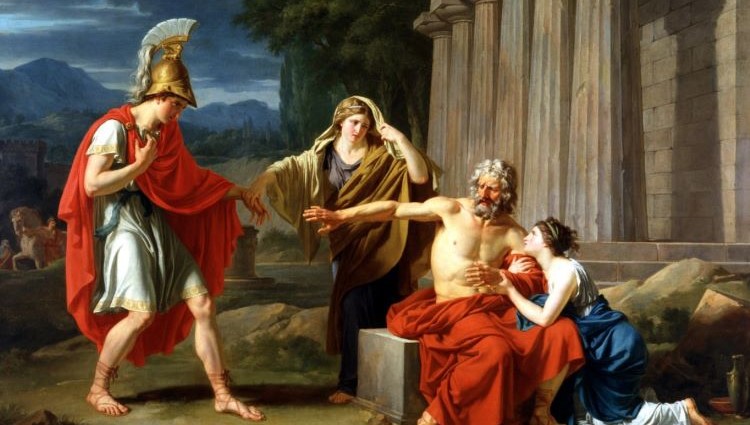
Sophocles: The Theban Plays, translated by David R. Slavitt This is the most stripped-down version of the three Theban plays of Sophocles that I have read. As I write, I am surrounded by more than 15 translations retrieved from my shelves and the college library. David Slavitt’s book is by far the shortest and the [...]

Plato’s Republic: Impossible Polity

By |2023-05-21T11:32:15-05:00June 8th, 2012|Categories: Books, Classics, E.B., Eva Brann, Plato, Senior Contributors, St. John's College, Wisdom|

Plato’s Republic: A Study, by Stanley Rosen Plato’s Republic, Stanley Rosen says at the beginning of his book, is “both excessively familiar and inexhaustibly mysterious.” Thus it invites ever more interpretations, not, I think, by reason of any willful indeterminacy or woolly grandeur on Plato’s part, but because a false sense of knowing the work [...]

Homer and the Power of Men That Have Chests

By |2021-05-24T12:12:35-05:00June 2nd, 2012|Categories: Christopher B. Nelson, Classics, Featured, Homer, Liberal Learning, St. John's College|

One of the many things I love about this college [Ed., Convocation address to St. John’s College] is that everyone must begin with Homer—and not only Homer, but the Iliad. It’s not just that this happens to have been my favorite book for most of my life. It is a collection of things, all of which have [...]

A Poem for Men: The Iliad by Homer

By |2021-02-15T15:42:25-06:00April 18th, 2012|Categories: Classics, Featured, Greek Epic Poetry, Homer, Iliad, Literature|Tags: |

The Iliad by Homer, translated by Herbert Jordan (Norman, OK: University of Oklahoma Press, 2008) It is noteworthy that when the freedman Livius Andronicus (c. 250 B.C.) gave the Romans their first translation of Homer it was the Odyssey, not the Iliad he chose to render in the old Saturnian verse: Virum mihi Camena, insece versutum, [...]

The Tragedy of Democracy Without Authority: A Reflection on Maritain and Thucydides

By |2018-08-19T21:25:25-05:00April 11th, 2012|Categories: Classics, Democracy, Jean-Jacques Rousseau, Politics, Thucydides|Tags: , |

Scrupulous fear of the gods is the very thing which keeps the Roman Commonwealth together. To such an extraordinary height is this carried among them, both in private and public business, that nothing could exceed it. –Histories, Polybius Infirmity doth still neglect all office Whereto our health is bound; we are not ourselves When nature, [...]

The Socratic Philosopher and the American Individual

By |2017-08-03T13:49:32-05:00March 6th, 2012|Categories: Books, Classics, Jean-Jacques Rousseau, Liberal Learning, Peter A. Lawler, Socrates|Tags: , |

Today, Allan Bloom’s unlikely 1987 bestseller The Closing of the American Mind is in some ways truer and more moving than ever. I have just taught the book in a class (one that began by reading Tocqueville) filled mostly with very smart yet still overachieving Evangelical students. They eagerly embraced the book as evidence of [...]

On Classical Studies: Eric Voegelin

By |2015-04-29T07:52:18-05:00February 10th, 2012|Categories: Classical Education, Classics, Eric Voegelin, Liberal Learning|Tags: |

Eric Voegelin A reflection on classical studies, their purpose and prospects, will properly start from Wolf’s definition of classic philology as the study of man’s nature as it has become manifest in the Greeks.[1] The conception sounds strangely anachronistic today, because it has been overtaken by the two closely related processes of the [...]

Go to Top