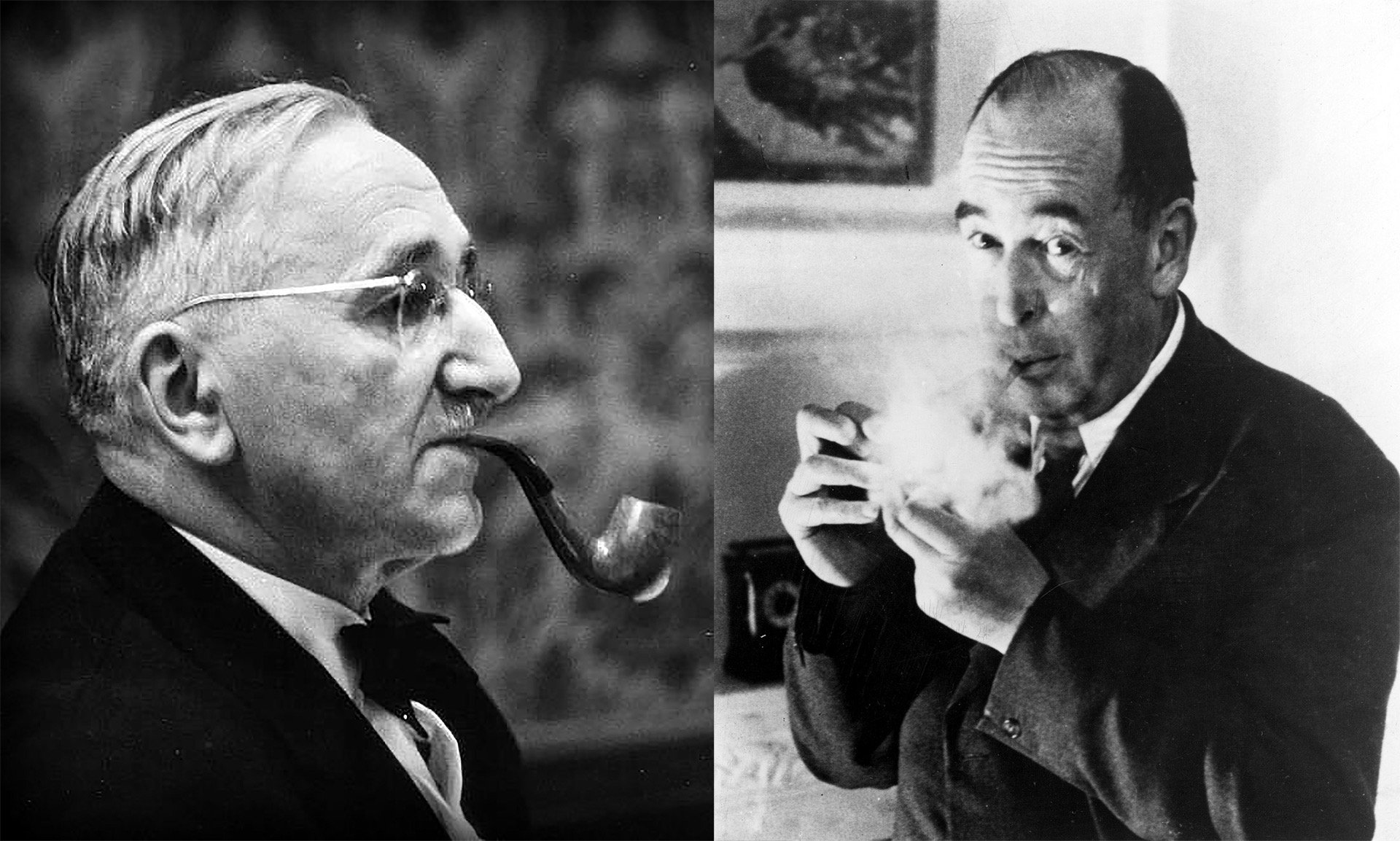
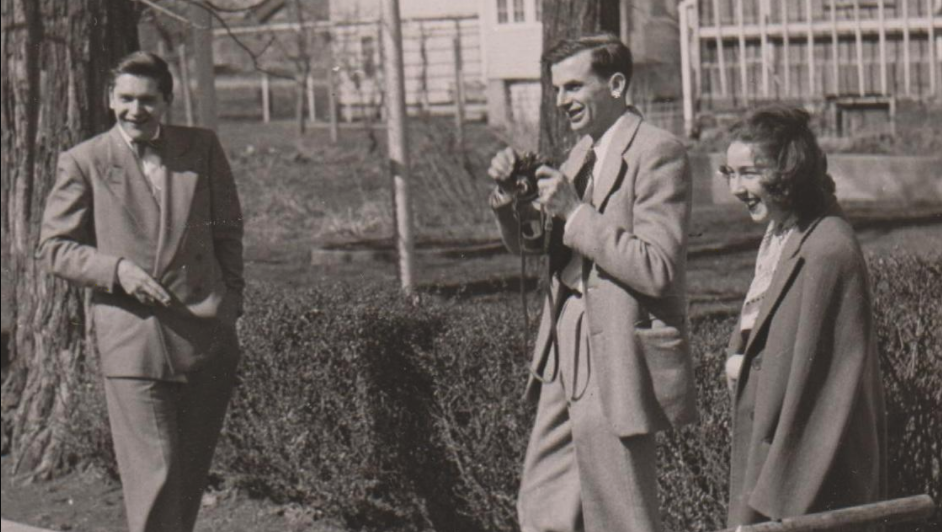
Eric Voegelin (January 2, 1901 – January 19, 1985) was born in Germany and lived there until he fled to the United States with his wife during the Nazi invasion. He spent much of his career at Louisiana State University, the University of Munich, and the Hoover Institution at Stanford University. He wrote many books including Science, Politics, and Gnosticism (1968), The Science of New Politics (1952) and his great 5 volume work entitled Order and History.
Eric Voegelin: A Scattering of Brilliant Ideas

By |2026-08-10T10:02:46-05:00August 7th, 2026|Categories: Bradley J. Birzer, Christianity, Eric Voegelin, Modernity, Philosophy, Senior Contributors|

For Eric Voegelin, all modern ideologies—left or right—were simply Gnostic attempts to order a disordered world according to ritual and knowledge. This essay concludes my three-essay series on Eric Voegelin (1901-1985). In the first essay, I discussed Voegelin’s own influence on my intellectual development over the past 37 years. I also, rightly or wrongly, questioned [...]

Eric Voegelin and the Price of Progress

By |2026-08-02T07:11:00-05:00July 31st, 2026|Categories: Bradley J. Birzer, Civilization, Eric Voegelin, History, Nature of Man, Progressivism, Senior Contributors|

Eric Voegelin stressed that progress falsely demands the sacrifice both of man and God. With history and progress as false gods, the man who would attempt to derail or thwart history is the sinner and may thus, justifiably, be removed, even if by bloody force. In my previous essay, I considered the ways in which [...]

Eric Voegelin and the Case of Character

By |2026-07-25T09:26:13-05:00July 24th, 2026|Categories: Bradley J. Birzer, Conservatism, Eric Voegelin, Russell Kirk, Senior Contributors, Western Civilization|

In his personal letters, Eric Voegelin not only mocked Russell Kirk and conservatism, but he also freely admitted that he cynically accepted funding from conservative sources, even though he had no sympathy with conservatism. And yet he was a genius, one of the single finest thinkers of the 20th century, and perhaps the single finest [...]

Eric Voegelin, Leo Strauss, & American Conservatism

By |2024-06-26T19:34:16-05:00June 26th, 2024|Categories: Conservatism, Eric Voegelin, Featured, Leo Strauss, Timeless Essays|

Conservatives are people who defend certain traditional goods, because they know they’re worth defending. Political philosophy, by contrast, is animated by concerns quite different from political battles or external goods. It’s fundamentally a quest for insight, not influence. Eric Voegelin and Leo Strauss were essentially philosophers, not conservatives. For more than fifty years, American conservatives [...]

Hamlet in the Metaxy

By |2023-07-18T17:18:33-05:00January 24th, 2023|Categories: Eric Voegelin, Literature, Philosophy, Plato, William Shakespeare|

We must decide and act, but because this process occurs in the metaxy—the experience of being itself, the experience of a tension between the poles of time and eternity—we, like Hamlet, find ourselves, more often than not, in highly equivocal circumstances. For both William Desmond and Eric Voegelin Plato’s concept of the metaxu or metaxy [...]

What Happened to Excellence?

By |2023-08-02T08:20:20-05:00September 18th, 2022|Categories: Character, Culture, Eric Voegelin, Essential, Featured, George A. Panichas, Great Books, Irving Babbitt, Modernity, Timeless Essays, Virtue|

Excellence predicates aspiration and transcendence, a quest for a higher qual­ity of attainment and, in effect, going beyond the moment. Excellence, which can be defined as the state of excelling and of surpassing merit, is now increasingly one of the lost words of the English language. And increasingly the special qualities that this word de­notes [...]

A Bridge to Somewhere: Willmoore Kendall’s Teaching on Democracy

By |2023-08-04T09:29:51-05:00April 7th, 2022|Categories: American Republic, Democracy, Eric Voegelin, History, Leo Strauss, Willmoore Kendall|

Complex and perceptive, Willmoore Kendall's ideas remain relevant as the most important intellectual defense of the American people’s right to rule itself rather than to submit to the tyranny of experts. He is the man who engineered the foundation, structure, and superstructure of a bridge to democracy with his own formidable intellect and tremendous erudition. [...]

Eric Voegelin, Conservative?

By |2020-03-20T12:25:49-05:00March 20th, 2020|Categories: Bradley J. Birzer, Conservatism, Eric Voegelin, Political Philosophy, Senior Contributors|

Whatever his criticisms of liberalism, progressivism, and socialism, Eric Voegelin shunned the word and the concept of “conservatism,” claiming that his ideas could never be harnessed by any political movement. When the definitive history of non-leftist movements of the twentieth century is finally written, Austro-American philosopher, Eric Voegelin (1901-1985) will loom large. Arrested by the [...]

Measuring the Influence of Russell Kirk & Other Conservative Authors

By |2021-08-01T17:26:59-05:00May 12th, 2019|Categories: Christopher Dawson, Conservatism, Culture, Eric Voegelin, Irving Babbitt, Robert Nisbet, Russell Kirk|

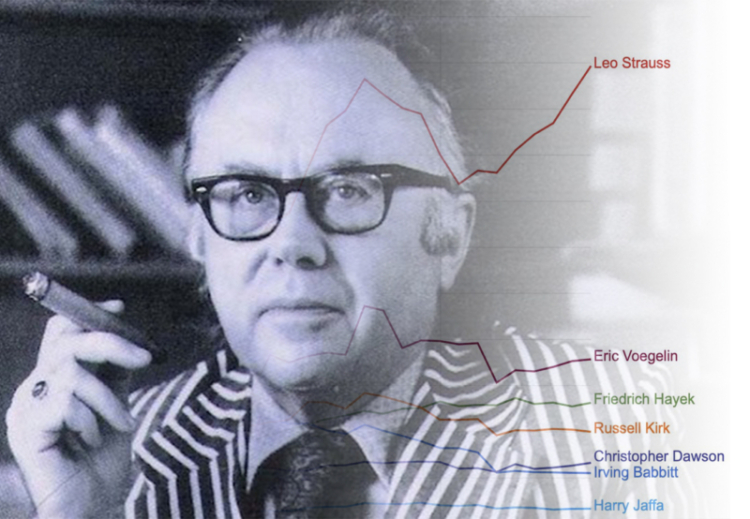
By using Google’s Ngram Viewer, we find that Russell Kirk’s reputation hit its highpoint in 1964, and then began a painful decline that remained unabated until his death in 1994. What does Ngram tell us about other conservative authors, like Robert Nisbet, Leo Strauss, Eric Voegelin, and Christopher Dawson? While I would never consider myself [...]

Understanding Voegelin’s Critique of Locke

By |2019-11-21T19:44:32-06:00November 30th, 2018|Categories: American Republic, Books, Democracy, Eric Voegelin, John Locke, Philosophy, Political Philosophy|

No matter how conservative intellectuals try, they just do not seem able to escape John Locke. Jonah Goldberg’s well-received Suicide of the West proudly called America’s Declaration of Independence “echoes of” the great English Enlightenment philosopher John Locke, saying U.S. history was “more Locke than anything Locke imagined.”  He inspired “a government but not a state”: a government with power [...]

René Girard’s Challenge to Fusionism

By |2023-11-25T12:46:50-06:00May 23rd, 2018|Categories: Civilization, Conservatism, Culture, Eric Voegelin, Politics, Rene Girard, Western Civilization|

At a minimum, a restoration of conservative thought requires paying attention to primitive history and to what it might tell us about the things that fusionism has long assumed are most important about tradition—as well as what this new knowledge reveals about the viability of freedom…   Modern American conservatism rose in the 1950s under [...]

Intelligent Piety: The Christian Humanism of Flannery O’Connor

By |2022-08-02T12:17:20-05:00February 21st, 2018|Categories: Books, Bradley J. Birzer, Catholicism, Christian Humanism, Christianity, Eric Voegelin, Featured, Flannery O'Connor, Romano Guardini, Russell Kirk|

Not only was Flannery O’Connor one of the most important Christian Humanists of the twentieth century, but she also well understood what made Christian Humanism what it was. While it might very well be conservative, it was always imaginative, allowing one to imagine what must be conserved. The Presence of Grace by Flannery O’Connor (192 pages, [...]

The Elements of Leadership: Might, Measure, & Meaning

By |2019-06-06T12:18:22-05:00January 17th, 2018|Categories: Eric Voegelin, Featured, Leadership, Political Philosophy|Tags: |

Not only is a leader an agent of force and something of a philosopher, but he must also be a kind of corporate prophet… The philosopher Eric Voegelin labored for many years in relative obscurity until his death in 1985. Even now his disciples are drawn largely from conservative academe, which is so marginal as [...]

A Thinker You Should Know: Eric Voegelin

By |2017-12-27T10:34:20-06:00December 27th, 2017|Categories: Conservatism, Eric Voegelin, History, Philosophy, Western Tradition|

Eric Voegelin’s philosophical framework attempted to break down the ideological barriers to the search for order and the recovery of transcendent consciousness… Eric Voegelin’s work is not well known outside a relatively small group of academics and their students. Yet within this domain Voegelin’s influence is impressive. His work has inspired a growing secondary literature and [...]

Go to Top