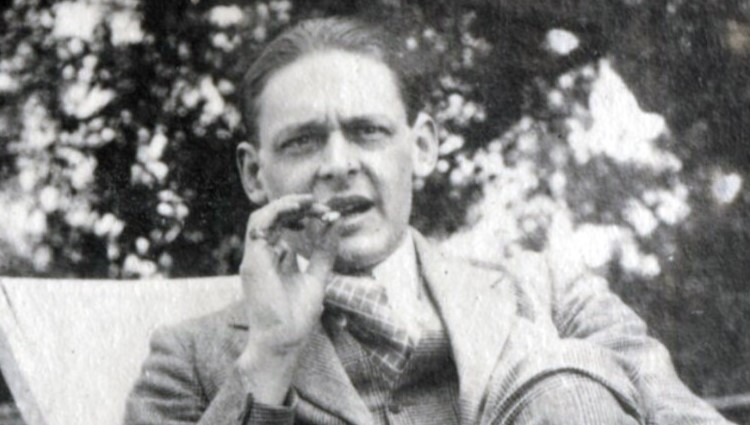
Thomas Stearns Eliot (26 September 1888 – 4 January 1965) was an essayist, publisher, playwright, literary and social critic and “one of the twentieth century’s major poets.” Born in St. Louis, Missouri in the United States, he moved to the United Kingdom in 1914 and was naturalised as a British subject in 1927.
Listening to “Dry Salvages”

By |2019-12-10T09:25:30-06:00September 27th, 2019|Categories: Culture, Dwight Longenecker, Four Quartets Series, Literature, Poetry, Senior Contributors, T.S. Eliot|

In “Dry Salvages,” T.S. Eliot moves into a new confidence and clarity. The arcane symbolism begins to evaporate. The artificial voices are silenced and we are at last face to face with the poet himself, and a new level of emotional interaction is experienced. We sense a new vulnerability and with the new honesty comes [...]
Listening to “East Coker”

By |2019-08-31T20:59:12-05:00August 31st, 2019|Categories: Culture, Dwight Longenecker, Four Quartets Series, Literature, Poetry, Senior Contributors, T.S. Eliot|

T.S. Eliot’s “East Coker” relies more explicitly on personal references than his earlier work. It is as if the mask has fallen. The poet is humbler and more vulnerable. The poem expands his meditation into a wider consideration of time and eternity, destiny and desire. In the introduction to this five part series I proposed [...]

Listening to “Burnt Norton”

By |2019-08-24T23:50:26-05:00August 24th, 2019|Categories: Beauty, Culture, Dwight Longenecker, Four Quartets Series, Literature, Poetry, Senior Contributors, T.S. Eliot|

T.S. Eliot’s visit to the garden at Burnt Norton, and his musings with Emily Hale about a love and life together that never happened, lead to a broader contemplation on the nature of time, free will, and human choice, culminating in the first poem of the "Four Quartets." I’m using the word “listening” in this [...]

Listening to “Four Quartets”

By |2019-08-17T16:18:15-05:00August 17th, 2019|Categories: Beauty, Culture, Dwight Longenecker, Four Quartets Series, Literature, Mystery, Poetry, Senior Contributors, T.S. Eliot|

T.S. Eliot’s “Four Quartets” is highly personal, uniquely-fashioned religious poetry. This wordless realm into which Eliot takes us is the region of dreams, the numinous, the collective unconscious. He wishes us to plunge into the experience instead of simply pondering the meaning. I first read T.S. Eliot’s Four Quartets as an undergraduate and was surprised [...]

A Letter to the Seniors

By |2019-05-07T21:33:50-05:00May 7th, 2019|Categories: Character, Culture, Glenn Arbery, Senior Contributors, T.S. Eliot, Tradition, Virtue, Wyoming Catholic College|

T.S. Eliot reaches into the unsaid, perhaps even into the ultimately unsayable, in a way that makes new possibilities present for those of his own time. Eliot comes out of the great tradition, the long conversation of the West, which is now your own earned inheritance as well. What will you do with it? Early [...]

Eliot and Irons

By |2019-12-10T11:51:26-06:00March 15th, 2019|Categories: Culture, Dwight Longenecker, Imagination, Literature, Poetry, T.S. Eliot|

Hearing T.S. Eliot's poems read brings us back to the haunting beauty of the words themselves, and hearing the words unlocks Eliot’s powerful imagery, just as he would have wanted. Jeremy Irons' classic rendition empowers this strange transaction, and through the words we are taken beyond the words to the realm of the Word. Those [...]

T.S. Eliot’s “The Fire Sermon”: Of Memory & Salvation

By |2019-08-08T11:17:24-05:00January 13th, 2019|Categories: Conservatism, Great Books, Modernity, Poetry, T.S. Eliot, Timeless Essays|

T.S. Eliot reminds us that the answers to our soul’s depravity are all around us, in our collective culture—the books we read, the places we inhabit, the music we listen to—but also that culture can only survive if we remember it and keep it alive... Today’s offering in our Timeless Essay series affords our readers [...]

T.S. Eliot’s Magical Journey

By |2022-01-06T12:31:18-06:00January 5th, 2019|Categories: Books, Character, Christianity, Dwight Longenecker, Literature, Poetry, Senior Contributors, T.S. Eliot|

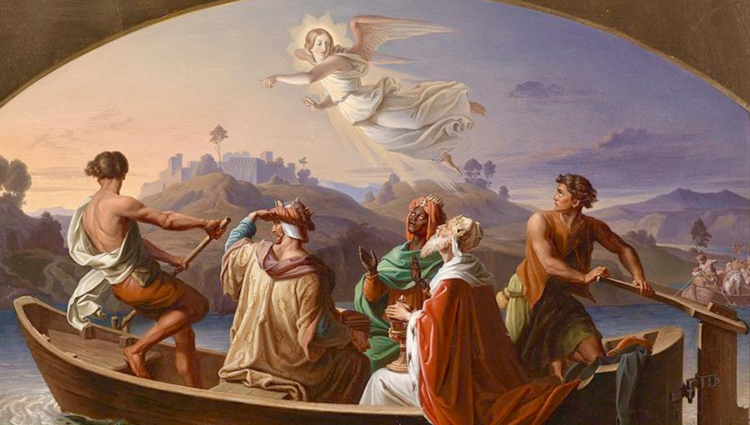
Through T.S. Eliot’s use of symbolism in “The Journey of the Magi” there is a call to a world beyond words—just as the mystics of historic Christianity beckoned to Eliot from the beginning of his journey. In the summer of 1927, just after his baptism into the (Anglo) Catholic faith, T.S. Eliot wrote “The Journey [...]

Lewis, Letters, and Love

By |2021-04-23T12:29:21-05:00September 5th, 2018|Categories: Bradley J. Birzer, C.S. Lewis, Christian Humanism, Love, Paul Elmer More, T.S. Eliot|

Real, actual letters are a gift, an insight into our best and our worst selves. Unlike the present world of the ephemeral email and hatchet posts on social media, letters of the pre-internet era could be gorgeous works of art. In them, the writer shares just a bit of his soul, preserving it for time, [...]

How T.S. Eliot Predicted the Coming of Male Millennials

By |2019-05-08T22:58:57-05:00August 9th, 2018|Categories: Character, Love, Marriage, Poetry, T.S. Eliot|

T.S. Eliot’s poem, “The Love Song of J. Alfred Prufrock,” shows that men do not need more pleasurable escapes or more time, but loving friends and an introduction to reality. They need to listen to human voices instead of the illusive mermaids out in the ocean. And they need to do this before the shock [...]

T.S. Eliot’s “Dry Salvages” & the Christian Philosophy of A.E. Taylor

By |2021-04-23T16:33:50-05:00July 27th, 2018|Categories: Books, Christianity, Conservatism, Great Books, History, Inklings, Plato, Poetry, T.S. Eliot|

Jesus saved a hurting T.S. Eliot. And Eliot, the greatest poet of the twentieth century, thought Jesus could save us as well. A person can hate the conclusion, but if English is your mother tongue, then you cannot ignore Eliot or his ideas. He shaped the twentieth-century imagination through his poetry and use of language. [...]

The Importance of Cultural Freedom

By |2018-06-26T23:20:46-05:00June 26th, 2018|Categories: Art, Culture, Poetry, Richard Weaver, T.S. Eliot, The Imaginative Conservative|

Culture by its very nature tends to be centripetal, or to aspire toward some unity in its representational modes. The reason for this is that every culture polarizes around some animating idea, figment, or value, toward which everything that it produces bears some discoverable relation… Culture in its formal definition is one of the fulfillments [...]

T.S. Eliot: Culture and Anarchy

By |2018-11-17T08:35:04-06:00February 26th, 2018|Categories: Christianity, Culture, Featured, History, T.S. Eliot, Timeless Essays|

If we take a careful look at T.S. Eliot, we shall see a born conservative, attached to certain austere traditions of previous ages, and yet one who saw clearly that those traditions had worn thin—they had grown conventional and insincere because no one had bothered to establish convincingly why they were important… Today’s offering in [...]

Earning the Tradition

By |2019-04-11T11:26:34-05:00February 7th, 2018|Categories: Catholicism, Christianity, Dante, Featured, Glenn Arbery, History, Liberal Learning, T.S. Eliot, Tradition, Virgil, Wyoming Catholic College|

Tradition in action gives rise to new work, and the new work changes the tradition… At a gathering of Wyoming Catholic College faculty and staff on Monday morning, I had occasion to mention T.S. Eliot’s seminal essay “Tradition and the Individual Talent.” Eliot still had an overwhelming ascendancy in literary circles even in the 1960s and early [...]

Go to Top