Will the Wicked Be Punished?

By |2021-05-18T15:58:36-05:00January 15th, 2017|Categories: Aristotle, Capitalism, Christianity, Civil Society, George Stanciu, Justice, Morality, St. John's College|

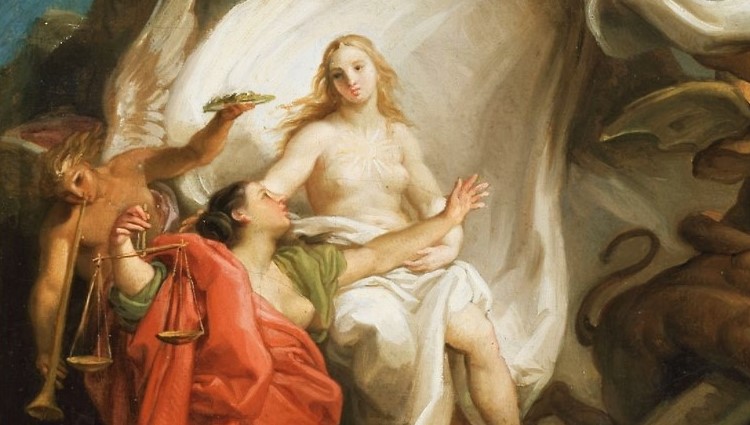
To shun wickedness, to care for our souls, and to love one another without looking for rewards, if followed by all, would turn injustice, now a constant companion of human life, into a stranger. In his 2005 masterpiece, Match Point, Woody Allen explores moral failing in a universe governed by chance, or what the protagonist [...]
The American College: The Place for Liberal Learning?

By |2023-05-21T11:30:42-05:00January 9th, 2017|Categories: Classical Education, E.B., Education, Eva Brann, Featured, Liberal Learning, Senior Contributors, St. John's College|

We want to give our students a classroom in which inciting books are talked about not as mere literature nor as historical documents, but boldly as they meant themselves to be taken: as the Word of God, or the insight of the intellect, or the wisdom of the world. And yet we want these same [...]

The Permanent Part of the College

By |2023-05-21T11:30:43-05:00January 4th, 2017|Categories: E.B., Eva Brann, Featured, Liberal Arts, Liberal Learning, Senior Contributors, St. John's College|

When the ancient philosophers speak of the philosophical life, one thing is immediately clear: It is a life and not a profession of which they are speaking. For the life of philosophy seems to have one reason for being—the search for truth. By “the permanent part” of the College in the title of my address, [...]

Mo and Mao: How the East Might Revive the West’s Tradition

By |2023-05-21T11:30:44-05:00December 27th, 2016|Categories: Books, E.B., Eastern Thought, Eva Brann, Featured, Senior Contributors, St. John's College|

Our tradition may be in dire need of resuscitation and recollection, and it seems quite possible that the Chinese may help us in our necessity. Sour Sweet by Timothy Mo (288 pages, Sphere Books, 1982; Aventura Paperback, 1985) Shenfan William Hinton (785 pages, Random House, 1983; Vintage Paperback, 1984) The two books lumped together here have nothing in [...]

Children’s Literature: Through Phantasia to Philosophy

By |2023-05-21T11:30:45-05:00December 19th, 2016|Categories: Books, E.B., Eva Brann, Featured, Imagination, Literature, Myth, Philosophy, Senior Contributors, St. John's College|

Phantasia is the realm of the imagination, the realm into which nothingness first erupts, and the begin­ning of philosophy. I The Unending Story by Michael Ende is both literally and in several other ways the most wonderful book I’ve read in ages. I think it will be easily received into the canon­—hitherto almost exclusively English—of great [...]

The Federal Idea

By |2021-05-05T13:14:26-05:00November 27th, 2016|Categories: Alexis de Tocqueville, Democracy in America, Featured, Federalist Papers, St. John's College, Timeless Essays, Wilfred McClay|

If we can begin to understand the sense of federalism as an idea rather than a fixed set of immutable relations, and moreover as an idea that is designed to balance and reconcile the competing claims of competing goods, then our debates over the promise of federalism may take on a new vitality and plausibility… Today’s offering in [...]

The Unbounded Eros of “Tristan and Isolde”

By |2021-05-18T16:11:57-05:00November 25th, 2016|Categories: Culture, Featured, Love, Music, Peter Kalkavage, Philosophy, St. John's College, Virtue|

Richard Wagner’s Tristan and Isolde should prompt us to search for an antidote to the lovers’ death wish—to pursue a love that preserves rather than destroys, celebrates rather than abolishes individuality, and seeks life rather than death. “They who were two and divided now became one and united.” —Gottfried von Strassburg, Tristan and Isolde I come [...]

Schopenhauer’s Will and Wagner’s Eros

By |2021-05-18T16:39:16-05:00November 18th, 2016|Categories: Featured, Music, Peter Kalkavage, Philosophy, St. John's College|

There is nothing in the natural world, or in the inner and outer life of man, that does not find its counterpart in the all-embracing realm of tones. Music as symbol is the whole of all things. “They who were two and divided now became one and united.” —Gottfried von Strassburg, Tristan and Isolde I [...]

Individualism: The Root Error of Modernity

By |2021-05-18T16:46:18-05:00November 7th, 2016|Categories: Alexis de Tocqueville, American Republic, Family, Featured, George Stanciu, Modernity, Philosophy, St. John's College|

Alexis de Tocqueville, while traveling through the dense woods in Michigan, in 1831, came across a pioneer and his family, making the “first step toward civilization in the wilds.”[1] He noted in his travel diary that “from time to time along the road one comes to new clearings. As all these settlements are exactly like [...]

The Copernican Revolution: The Defining Event of Modernity

By |2020-08-03T14:43:23-05:00November 2nd, 2016|Categories: George Stanciu, Modernity, Science, St. John's College|

The Copernican Revolution elevated the scientist above the stars, planets, and Earth to a position of the highest being in the cosmos. The Myth Like most, if not all religions, science has a creation myth that proclaims a new cosmic situation. The Copernican myth tells how science began and, like all myths, is recited again [...]

The Power of Pregnant Speeches

By |2023-05-21T11:30:47-05:00October 28th, 2016|Categories: Abraham Lincoln, E.B., Eva Brann, Featured, History, Language, Rhetoric, Senior Contributors, St. John's College|

Here’s a cause close to my heart: public and semi-public speech. I mean occasions when we are addressed by our political leaders on grand occasions of concern to the whole republic, and times, like the present, when we choose to come together to hear what someone invited to do so says about a matter of [...]

Looking for God in Modernity

By |2021-05-19T10:21:21-05:00October 15th, 2016|Categories: Catholicism, Christianity, Existence of God, George Stanciu, Modernity, Philosophy, St. John's College|

To understand the concept of God in Modernity, I first turned to the high point of Christianity in both the East and West. According to patristic tradition, God can be known in two ways. Cataphatic, or rational, knowledge defines God by positive statements; apophatic knowledge is direct experience of God, although such knowledge cannot be [...]

On the Timelessness of the Tradition

By |2023-05-21T11:30:48-05:00October 10th, 2016|Categories: Conservatism, E.B., Eva Brann, Featured, Liberal Learning, Senior Contributors, St. John's College, Tradition|

The ancient rhetoricians, who knew their business, taught that the way to begin a speech, the more so a breakfast talk, was with what they called a captatio benevolentiae, a “capturing of goodwill.” I’ll try that on you—I’ll try to snaffle your benevolence by claiming that we are likely to have this in common: a [...]

The Musings of a Professor

By |2023-05-21T11:30:49-05:00September 29th, 2016|Categories: E.B., Eva Brann, Featured, Language, Liberal Learning, Senior Contributors, St. John's College|

For the first time in nearly a decade I again have the great pleasure of teaching a freshman language tutorial. I am myself a believer in the "spirit" of a tutorial, because I am convinced that what happens in class for well or ill is nothing beyond the accumulated effect of the goodness or deficiency [...]

Go to Top