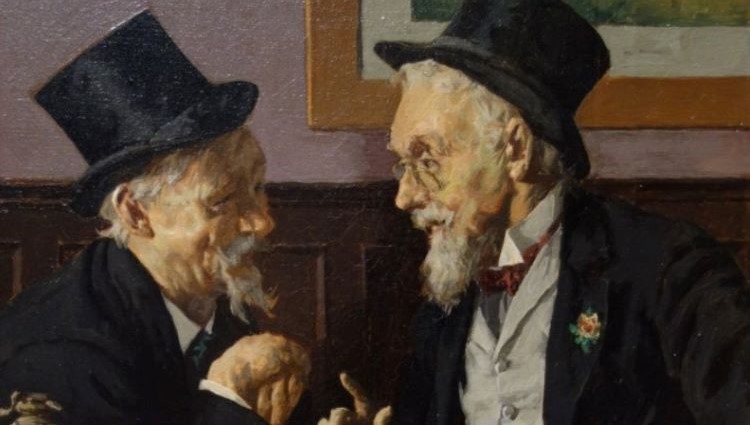
The Origins of Dialectic

By |2021-05-19T14:23:05-05:00April 22nd, 2015|Categories: Classics, Great Books, Philosophy, Plato, Quotation, Rhetoric, St. John's College|

“A debater treats the other speaker as someone who can only be right if he himself is wrong, whom he must defeat at all costs. In a conversation, though, we generally have the decency to accept the things another person says, at least temporarily and tentatively. If we disagree, and take the matter seriously, we [...]


Thucydides and Never-Ending War

By |2019-11-14T15:02:31-06:00April 15th, 2015|Categories: Audio/Video, Classics, Plato, Thucydides, W. Winston Elliott III, War|

Thucydides' account of the twenty-seven-year war between Athens and Sparta is filled with timeless questions about human conflict: When are aggression and vengeance justified? Can peace ever truly be secured by war? How does war affect the integrity of language and character? What is the role of chance in war? Is war ever truly inevitable? Additionally, the participants [...]

Whence Comes the Machiavellian: A Discussion of Maritain’s Paradigms

By |2021-05-06T20:04:15-05:00March 28th, 2015|Categories: Classics, Morality, Plato|Tags: |

Thus says the Lord: Do not learn the ways of the nations, and have no fear of the signs of the heavens, even though the nations fear them. For the carvings of the nations are nonentities, wood cut from the forest, fashioned by artisans with the adze, adorned with silver and gold. With nails and [...]

Plato’s Pious Prophecy of Modern Man in The Euthyphro

By |2019-09-12T13:52:54-05:00March 12th, 2015|Categories: Alexis de Tocqueville, C.S. Lewis, Christianity, Classics, G.K. Chesterton, Modernity, Plato, Richard Weaver|

Modernism is an ancient phenomenon. If prostitution is the world’s oldest profession, then modernism is the world’s oldest heresy. Modernism’s essential features were already understood long before the era of modernity. Plato reveals them in his dialogue The Euthyphro. The character of Euthyphro is a prototype of modern man. In the dialogue Euthyphro is prosecuting [...]

Mark Zuckerberg’s “A Year of Books” Without Any Classics

By |2021-05-20T16:05:04-05:00March 5th, 2015|Categories: Christopher B. Nelson, Classics, Culture, Featured, Liberal Learning, St. John's College|Tags: |

Mark Zuckerberg, CEO and founder of Facebook, made an announcement in January that he was launching a book club. He is calling 2015 “A Year of Books,” and he has invited Facebook users to join him in discussions and participate in author Q&As online. “We will read a new book every two weeks and discuss [...]

Leadership: Healing a Broken World?

By |2019-10-30T11:48:16-05:00March 1st, 2015|Categories: Classics, Leadership, Plato, Socrates|Tags: |

I wonder about the presuppositions when voices are raised concerning the fragmentation of society and problems of disconnectedness.[1] At the heart of these concerns is a philosophical anthropology, i.e., one’s beliefs about what it means to be human. What is it exactly that is fragmented or disconnected? It is probably incumbent on me to disclose [...]

The Enduring Nature of Scholasticism

By |2019-10-24T11:06:18-05:00February 10th, 2015|Categories: Aristotle, Books, Christendom, Christianity, Classics, Featured, Fr. James Schall, Science, St. Thomas Aquinas|

“Truth is the self-manifestation and state of evidence of real things. Consequently, truth is something secondary, following from something else. Truth does not exist for itself alone. Primary and precedent to it are existing things, the real. Knowledge of truth, therefore, aims ultimately not at ‘truth’ but, strictly speaking, at gaining sight of reality.” ∼ [...]

The Kindle and a Warning from Plato

By |2019-12-13T13:58:23-06:00February 8th, 2015|Categories: Books, Classics, Education, Featured, Plato, Technology|Tags: |

The written word has obviously been crucial to the preservation and development of Western civilization. Without the invention of the alphabet and the printing press, or the widespread use of writing, you would not have access to the minds of those who contributed to Western thought. Considering that you live in a culture sculpted and hewn [...]

Should America Invade the Hendiadys?

By |2015-01-01T08:21:11-06:00January 1st, 2015|Categories: Classics, Language, Stephen Masty|

In the unlikely event that any neo-cons read this, some will pore through the atlas with sound and fury; others will try and reroute the Pacific Fleet; while a few more will summon the 82nd Airborne to drop and rain down mass destruction. But they will be disappointed. The Hendiadys is not a group of [...]

Typical Tocquevillian Advice

By |2015-05-19T23:13:34-05:00December 28th, 2014|Categories: Alexis de Tocqueville, Aristotle, Classics, Education, Liberal Learning, Peter A. Lawler, Plato|

So I just finished reading the most recent contributions to Postmodern Conservative. The quality is high, and the depth and breadth of insight is real. And I wish I could say something to show I am anywhere near their pay grade when it comes to classical or contemporary events. I agree with Peter Spiliakos that [...]

Theodor Haecker, Man of the West

By |2015-05-19T23:15:03-05:00October 15th, 2014|Categories: Books, Bradley J. Birzer, Classics, Virgil|

In the late 1920s, a very young Tom Burns and an only slightly older Christopher Dawson founded one of the most interesting journals of the decade, Order. Though it lasted only four issues, it was the standard bearer of a serious, if somewhat youthful and angry, Christian Humanism. Order, it proclaimed, was the highest need, [...]

Go to Top