What, Then, Is Time?

By |2023-05-21T11:31:53-05:00April 14th, 2014|Categories: Aristotle, Classics, E.B., Eva Brann, Featured, Senior Contributors, St. Augustine, St. John's College, Time|Tags: |

When our dean asked me to lecture this September it was because I’ve just completed a book on time, and I’m happy to have the opportunity to talk about it. There seemed to be three possible kinds of profit that I figured might come to you and to me if I gave what one might [...]

Plato and The Man of Steel

By |2015-05-19T23:10:15-05:00February 12th, 2014|Categories: Christianity, Classics, Film, Peter A. Lawler, Plato|Tags: |

One reason to have a liberal education—one that’s usually neglected by all those experts these days who are saying that the value of an education is measured by the money you earn after graduation—is that it’s indispensable for understanding the political teachings of the better summer blockbuster movies, such as the very thoughtful new Superman [...]

Two Noble Ends of an Authentic Education

By |2019-09-24T11:15:54-05:00January 29th, 2014|Categories: Christianity, Classics, Education, Socrates, Steven Jonathan Rummelsburg, Western Tradition|Tags: |

The Oracle of Delphi foretold countless fortunes, futures, prophecies, and mysteries over many centuries and is the same ancient fount of wisdom who declared Socrates to be the wisest man in the world. A great sign above the entrance to the Temple at Delphi exhorts all who enter her sacred halls to “know thyself,” for without [...]

Hesiod’s “Works and Days”

By |2019-10-16T15:48:45-05:00January 19th, 2014|Categories: Books, Classics, Greek Epic Poetry, Labor/Work, Poetry, Steven Jonathan Rummelsburg|Tags: |

The centuries ebb and flow on a cosmic tide between faithfulness and depravity as men commit their lives to a seemingly infinite range of virtuous and vicious acts. Though man tears himself away from the face of God in pursuit of idols, God never abandons His creation. The glorious age of the Ancient Greek pagans has [...]

Progress and Progressives: Moving Beyond Antique Optimism

By |2015-05-19T23:10:16-05:00January 13th, 2014|Categories: Classics, Plato, Progressivism|Tags: |

To the classical philosophers, history was cyclical. J.B. Bury observed that thought in ancient Greece was dominated by the idea of cycles, and that time was itself the enemy of man to the degree it eroded the value of the corporeal world. Marcus Aurelius wrote that the rational human mind “stretches forth into the infinitude [...]

Nihilism or Idolatry: All Things Shining

By |2016-08-03T10:36:59-05:00December 26th, 2013|Categories: Books, Christendom, Christianity, Classics, Homer, Modernity, Religion|Tags: , |

All Things Shining: Reading the Western Classics to Find Meaning in a Secular Age by Hubert Dreyfus and Sean Dorrance Kelly The authors of this latest attempt to give life “meaning” and to “uncover the wonder” of the world—concealed, as it has been, by modern technological culture—begin their argument with an episode. In 2007, a young [...]

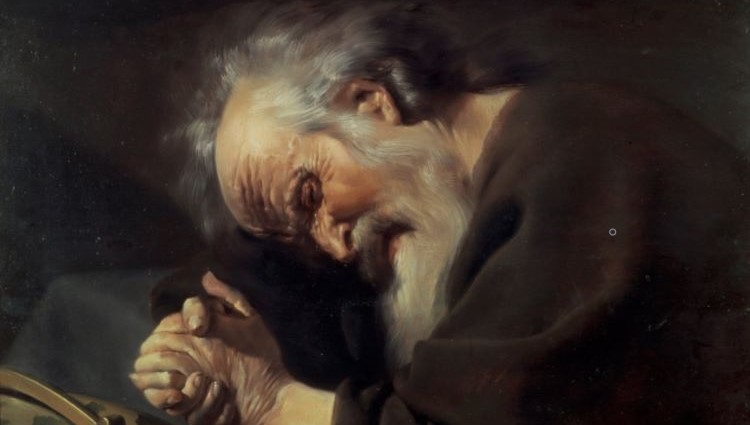
On the Logos of Heraclitus

By |2023-05-21T11:31:55-05:00November 2nd, 2013|Categories: Audio/Video, Classics, E.B., Eva Brann, Heraclitus, Liberal Learning, Philosophy, Senior Contributors, St. John's College|

What is the world like, and how can we understand it? Heraclitus thinks that the answer to both questions is found in “the logos,” which is a Greek word with multiple meanings: it can be an explanation, a word or linguistic meaning, science, rationality (the Latin word is “ratio”), the principle of exchange between things…So [...]

Insights on the Government Shutdown from Thucydides

By |2015-05-19T23:18:57-05:00October 16th, 2013|Categories: Books, Classics, Robert M. Woods, Thucydides|Tags: |

And if we should know what government is, we should observe, in Thucydides' laconic account of the revolution at Corcyra, what happens when it fails.– Stringfellow Barr Most keen observers would say that our government has been in failure mode for a number of decades, and this is not easily refuted on empirical grounds. Readers of [...]

Living Well On Earth and Entering Heaven: The Nineteen Types of Judgment

By |2019-03-11T07:48:20-05:00September 9th, 2013|Categories: Christendom, Classics, Liberal Learning, Plato, Reason, Socrates|

Peter Kreeft There are at least 19 different kinds of judgment that we should distinguish. I’m sorry I could not find a 20th, to match the number of digits on our fingers and toes. But 19 does match the digits of Frodo Baggins, one of my heroes. (I’m sure you remember Frodo of [...]

Talking, Reading, Writing, Listening

By |2023-05-21T11:31:57-05:00August 15th, 2013|Categories: Classics, E.B., Eva Brann, Featured, Great Books, Senior Contributors, Socrates, St. John's College|

I imagine that on Parents’ Weekend there might be some parents attending this once weekly occasion when the college assembles to hear a lecture. By its very name, a lecture is read—but read out loud, delivered in the writer’s voice. Thus, the sequence goes: I thought, I wrote, I read, I speak. Although this is the principal way of [...]

On Leisure & Culture: Why Human Things Exist & Why They Are “Unimportant”

By |2017-07-31T23:48:28-05:00July 25th, 2013|Categories: Aristotle, Christianity, Classics, Culture, Fr. James Schall, Plato|Tags: |

Let me begin by citing two passages that graphically underscore the themes that I wish to consider here—the things of leisure and culture, of what is and its surprising origins. The first lines are from Gregory of Nazianzen, the great Eastern theologian: What benefactor has enabled you to look out upon the beauty of the [...]

Story Telling & Judgment: Cultivating the Imagination

By |2019-06-13T11:30:00-05:00July 20th, 2013|Categories: Christopher B. Nelson, Classics, Liberal Learning, Socrates, St. John's College, Virtue|

I am pleased to join you in your conference focusing on the development of judgment in our young people today. I have been giving some special thought lately to the question of how one might develop a capacity for sound judgment and a desire to build good character through the exercise of the imagination—that is [...]

Cleverly Postmodern Homer: A Review of the Troy Movie

By |2015-05-19T23:12:16-05:00July 13th, 2013|Categories: Classics, Film, Homer, Iliad|

Briseis is revealed as Achilles’ Achilles’ heel in Wolfgang Petersen’s Troy (2004), a cleverly postmodern retelling of the plot of Homer’s Iliad. Homer himself enclosed the Calydonian boar hunt in his Iliad, a myth within the myth, as both a nod to what was previously big box office for bards, and a guide to old [...]

Homer and Political Philosophy

By |2019-05-17T23:06:22-05:00June 21st, 2013|Categories: Books, Classics, Homer, Iliad, Odyssey|Tags: , |

The Odyssey of Political Theory: The Politics of Departure and Return, by Patrick J. Deneen Patrick Deneen, an assistant professor of political science at Princeton University, sets out in this book to assess the contemporary relevance of the Homeric legacy, especially the Odyssey. He wishes to avoid both mere pious praise of Homer as the [...]

Go to Top