Should Conservatism Seek to Destroy the State?

By |2021-05-27T13:17:04-05:00October 16th, 2017|Categories: Beauty, Conservatism, History, Politics, Revolution, Russell Kirk, Truth|

For their own sake, as well as the sake of the civilization which they love, conservatives can and should deny the state’s legitimacy, on the grounds that it is destructive of the true, the good, and the beautiful. Two philosophies rarely seem as opposed as conservatism and anarchism. The Continental, Throne-and-Altar variant of conservatism obviously [...]

At the Center of the Storm: John Sullivan of New Hampshire

By |2020-06-15T14:17:19-05:00September 25th, 2017|Categories: American Founding, M. E. Bradford, Military, Revolution, The Imaginative Conservative|

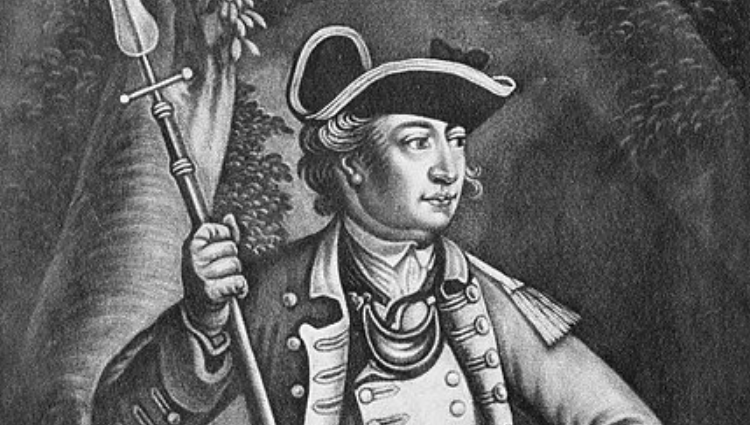
Controversy surrounds the story of John Sullivan’s life. Yet he is among the representative Americans of his time—gen­erous to a fault, jealous of his personal honor, optimistic, gregarious, ambitious, and “larger than life.” John Sullivan (1740-1795), lawyer, entrepreneur, soldier, and political leader of New Hampshire during and after the American Revolution. Both a commercial and [...]

The French Revolution: Did Edmund Burke Lose His Mind?

By |2022-07-13T18:29:49-05:00May 24th, 2017|Categories: Bradley J. Birzer, Edmund Burke, Edmund Burke series by Bradley Birzer, History, Liberty, Revolution|

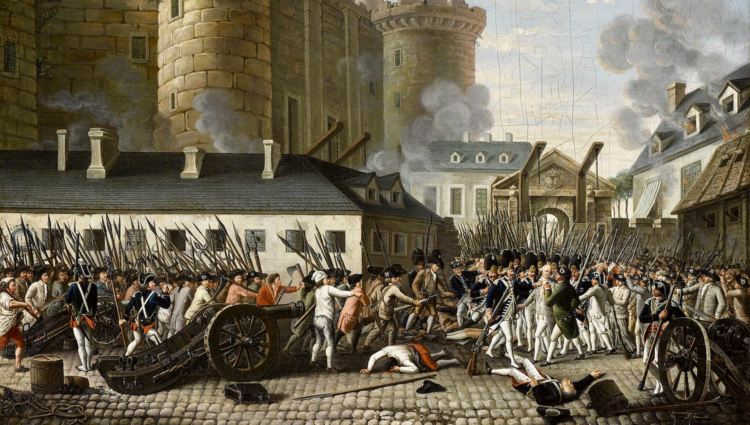
Thomas Paine and others charged that Edmund Burke unhesitatingly defended the French monarchy, monarchy in general, corruption in the Church, and oppressive governments, as long as they provided stability. But is this true? When challenging the “coffee-house” radicals who were so gleefully leading the French into generations of ruin through their mad abstractions, Edmund Burke [...]

Prudence vs. Fanaticism: On the American & French Revolutions

By |2021-05-25T16:38:24-05:00March 3rd, 2017|Categories: American Founding, RAK, Revolution, Russell Kirk|

The American and French Revolutions provide a contrast between principle and ideology; between prudence and fanaticism; between prescriptive rights and extravagant ambitions; between historical wisdom and utopianism; between free government and democratic despotism. A little book forgotten for a century and a half, Friedrich Gentz’s Origin and Principles of the American Revolution, compared with the Origin and [...]

The Siren Song of Anarchy in Western Art and Literature

By |2017-03-21T13:37:16-05:00January 19th, 2017|Categories: Art, Christian Humanism, Culture, Featured, History, Revolution|

The image of reason cut adrift and order overthrown are universal symbols of enormous and compelling power. Each of us sees in the dethronement of discipline and order an immediate personal advantage… Eugene Delacroix, “Death of Sardanapalus” Henry Adams describes his famous autobiography with a charming picture of the ancestral household at Quincy. [...]

Locating the Tory Tradition in American History

By |2019-10-30T13:35:35-05:00January 4th, 2017|Categories: American Founding, Christianity, Declaration of Independence, Featured, History, Revolution|

We ought to locate the basis of American conservatism in our colonial past, at a time when the English Tory variant of the old order of Europe had a real presence in our civilization, and we ought to remember that the old Tory order survived in the American historical tradition despite the Revolution of '76, [...]

Edmund Burke, Ideologues, & Subdivisions

By |2019-07-11T10:17:22-05:00September 27th, 2016|Categories: Adam Smith, Bradley J. Birzer, Conservatism, Edmund Burke, Edmund Burke series by Bradley Birzer, History, Revolution, Western Tradition|

When Edmund Burke surveyed the names of those leading the French Revolution in its first half year of existence in 1789, he despaired. Several were certainly good men, he noted, and many were quite accomplished. Yet, not a single man possessing any necessary experience in the world appeared on the list. “The best,” he lamented, [...]

The 1783 Treaty of Paris

By |2021-01-14T11:18:43-06:00September 3rd, 2016|Categories: American Founding, History, Revolution, War|

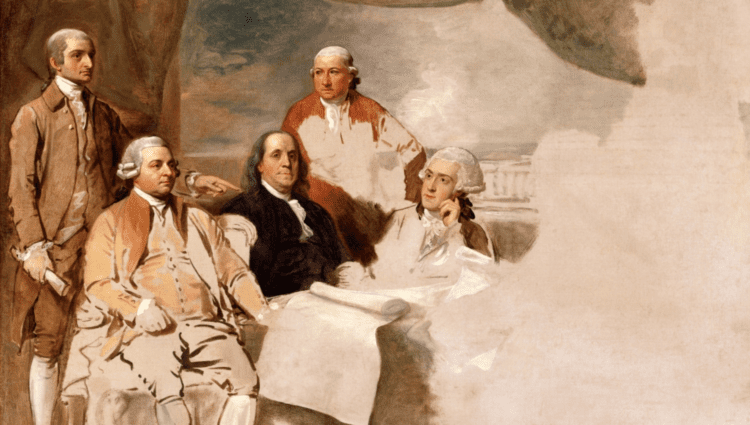
The Treaty of Paris, which ended the American Revolutionary War, was signed in Paris on September 3, 1783. By the treaty, Britain recognized the independence of the United States, and boundaries between the two countries in the New World were determined. Other issues addressed included navigation and fishing rights, outstanding debts, property rights, prisoners of [...]

A Revolution Not Made But Prevented

By |2020-07-08T16:20:05-05:00July 3rd, 2016|Categories: American Founding, Declaration of Independence, Edmund Burke, Featured, RAK, Revolution, Russell Kirk, The Imaginative Conservative, Timeless Essays|

Was the American War of Independence a revolution? It was certainly not the sort of political and social overturn that “revolution” has come to signify. Was the American War of Independence a revolution? In the view of Edmund Burke and of the Whigs generally, it was not the sort of political and social overturn that [...]

Edmund Burke & the American Revolution: The Whole Story

By |2024-05-04T15:17:02-05:00April 10th, 2016|Categories: American Founding, Bruce Frohnen, Cluny, Edmund Burke, Featured, Republicanism, Revolution|

You would not know it from the discussion on campus or in our high schools, but the best analysis of the American War for Independence was provided while it was still unfolding. The character of the Americans, the designs of the British Parliament, and the policies that brought these two into conflict were brilliantly analyzed [...]

The Reformation: The Mother of All Revolutions?

By |2019-01-04T11:40:15-06:00January 16th, 2016|Categories: Catholicism, Christendom, Christianity, Dwight Longenecker, History, Protestant Reformation, Religion, Revolution|

A Catholic friend of mine is fond of referring to the Protestant Reformation as “the Deformation.” Well, perhaps. Certainly the Reformation in England was a deformation. Henry VIII’s stripping of the altars was not only a monumental act of iconoclastic vandalism, but the cultural revolution brought about by his break with Rome—which included the dissolution of [...]

David Brooks and the Brahmin Stockholm Syndrome

By |2015-11-29T09:50:43-06:00October 26th, 2015|Categories: Bruce Frohnen, Featured, Government, Politics, Revolution, Ronald Reagan|

David Brooks, the in-house Republican at the New York Times, recently wrote an angry column aimed at conservatives (whom he dubbed “right-wing radicals,” among other unfriendly epithets). Elsewhere it has been pointed out, in essence, that someone like Mr. Brooks who pronounced Barack Obama suited for high office on account of the amazingly sharp crease in [...]

Revolution vs. Revelation: France & the Faith

By |2019-10-16T13:59:31-05:00October 1st, 2015|Categories: Christendom, Europe, Faith, History, Joseph Pearce, Revolution, StAR|

Like all nations, France is an enigma. Admired by Hilaire Belloc for being the eldest daughter of the Church, she is also the harlot who sacrificed her own sons and daughters on the anti-Christian altars of secularist revolution. She has produced great sinners and even greater saints. Legend traces the roots of Christianity in France [...]

Go to Top