Unheeded Wisdom in the Economic Wasteland

By |2024-10-02T13:39:43-05:00October 2nd, 2024|Categories: Catholicism, Economic History, Economics, Joseph Pearce, Senior Contributors, Unsung Heroes of Christendom, Wilhelm Roepke|

Wilhelm Röpke developed what was called “humane economics,” which placed the dignity of the human person at the core of economic thought, theory, and practice. Wilhelm Röpke In August 1938, as the world teetered on the brink of a second World War, only twenty years after the ending of the previous global conflagration, a [...]

The “Anonymous Society” vs. “The Great Workbench”

By |2024-09-29T18:26:16-05:00September 29th, 2024|Categories: Adam Smith, Capitalism, Catholicism, Distributism, Economic History, Economics, Free Markets, Free Trade, New Polity|

The “anonymous societies”—the corporations—can never deliver what they promise; they can never bring us limited government, free markets, or private property. But most especially, they cannot overcome the division between capital and labor; that can come only by sharing in ownership, and by identifying property with responsibility. The directors of such [joint stock] companies, however, [...]

Jesus, Take the Wheel

By |2024-09-22T17:12:51-05:00September 22nd, 2024|Categories: Books, Catholicism, Christianity, Labor/Work, New Polity|

As I read Matthew Crawford's "Why We Drive," I was struck by the book, not so much as an ode to awesome driving— which it is—but as a long observation of two modes of being in the world, two political stances that I have increasingly come to identify as Liberalism and Catholicism. Why We Drive: [...]

Marxism: A Primer

By |2024-09-17T16:33:42-05:00September 17th, 2024|Categories: Bradley J. Birzer, Civilization, Communism, Ideology, Karl Marx, Timeless Essays|

Unlike reality—which is infinitely and ultimately unknowable—Marxism as ideology pretends to understand the world, but, in reality, it offers only the merest shadow of true complexities. Though responsible—directly and indirectly—for the murder of nearly 150 million innocent children, women, and men in the previous century, Marxism is making a comeback in Western civilization. Not only [...]

Do Americans Really Value Hard Work?

By |2024-09-01T15:43:30-05:00September 1st, 2024|Categories: Character, Economics, Labor/Work, Mark Malvasi, Modernity, Timeless Essays|

The tiresome cant about the work ethic notwithstanding, Americans do not celebrate, or even recognize, the dignity of labor. Although they profess to disdain both the idle rich and the idle poor, they do not at the same time esteem those who must work for a living, even as most count themselves among that number. [...]

The Intellectual Revolution That Made the Modern World

By |2024-08-30T10:34:37-05:00August 30th, 2024|Categories: Adam Smith, Books, Economics, History, Morality, Philosophy, Timeless Essays|

The Enlightenment may well be the end of an old story rather than the beginning of a new one. The philosophy of insatiable appetites changed the Christian-Aristotelian moral order into the modern world, but now that the change is just about complete, what purpose does its catalyst serve? Power, Pleasure, and Profit: Insatiable Appetites From [...]

Reflections on Hilaire Belloc’s “Essay on the Restoration of Property”

By |2024-07-27T17:42:56-05:00July 26th, 2024|Categories: Distributism, Economics, Hilaire Belloc, John Creech, Political Economy, Timeless Essays|

While Hilaire Belloc often describes the type of economy he is advocating as “distributist,” he also refers to it as “proprietary,” due to the idea that a truly free economy requires the widest distribution of private property as possible. The recent esays on distributism and the many comments in response raised a number of interesting [...]

The Unsung Convert Who Converted Millions to Catholic Teaching

By |2024-07-07T13:55:41-05:00July 7th, 2024|Categories: Books, Catholicism, Economics, Joseph Pearce, Senior Contributors, Unsung Heroes of Christendom|

E.F. Schumacher succeeded in popularizing Catholic social teaching in a way that far exceeded the limited success of Hilaire Belloc and G.K. Chesterton to do the same thing fifty years earlier. It is not often that the publication of a single book can change the perception of millions of people around the world. Small Is Beautiful by [...]

Leisure, Work, and the Writer’s Life

By |2024-06-13T08:12:31-05:00June 11th, 2024|Categories: Blaise Pascal, Labor/Work, Leisure, Michael De Sapio, Senior Contributors|

Writing can simultaneously take a lot out of you—you feel pleasantly exhausted after firing off a big piece of work—and make you feel wondrously light and buoyant. How is this? I think it is because writing is simultaneously work and leisure, a mental strain and a contemplative joy. We are used to dividing our waking [...]

Bonapartism and the Populist Empire

By |2024-05-16T18:43:13-05:00May 16th, 2024|Categories: Economics, Europe, History, Populism, Revolution, Timeless Essays|

Under Louis Napoleon III, the Second French Empire was more successful than the first, and more successful than any political administration in France up to that point. An Empire focused on domestic order and growth had finally brought the liberty and prosperity that Republics and Monarchies had failed to achieve. How could such a successful [...]

Sed Contra: An Essay on the Modern Culture

By |2024-08-08T09:46:37-05:00May 1st, 2024|Categories: Catholicism, Christianity, Economics, Sainthood, St. Dominic, St. Joseph|

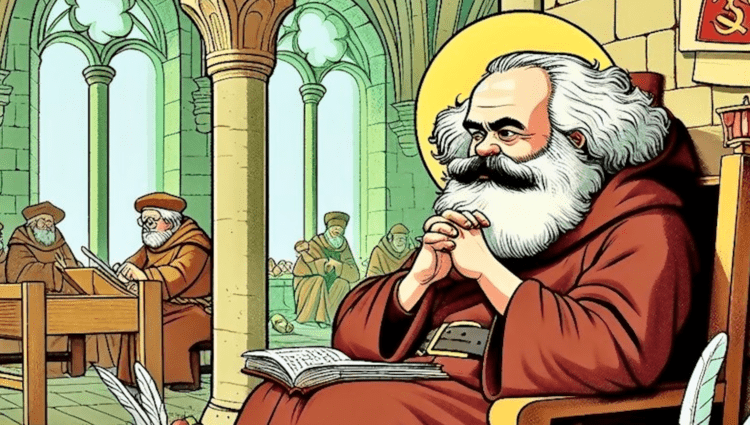
For Karl Marx, man is by nature productive, his value is in economic output. Any theory that reduces a person’s value to a producer or a consumer, misses the mark. In contrast, the Church begins with man’s inherent human dignity. It is not work that makes man valuable, instead “the primordial value of labor stems [...]

Go to Top