Flannery O’Connor: Mystery & Metaphor

By |2019-07-23T15:04:03-05:00March 25th, 2013|Categories: Books, Christianity, Featured, Flannery O'Connor, Gregory Wolfe, Literature, South|Tags: , , |

Flannery O’Connor Flannery O’Connor and the Language of Apocalypse, by Edward Kessler. Princeton: Princeton University Press, 1986. The Correspondence of Flannery O’Connor and the Brainard Cheneys, edited by C. Ralph Stephens. Jackson: University Press of Mississippi, 1986. A recent review in the New York Times employed the phrase, the Flannery O’Connor industry,” in [...]

Charles Murray’s In Pursuit: Of Happiness & Good Government

By |2014-12-30T14:19:16-06:00March 25th, 2013|Categories: Books, Bruce Frohnen, Charles Murray, TIC Featured Book|

In Pursuit: Of Happiness and Good Government by Charles Murray Featured Book: The crux of Murray’s argument is that in order to be happy, individuals must be members of communities. Through an unerring use of examples drawn from social science, Charles Murray shows how we know, or should know, that people have a need for close personal [...]

The Irrationalism of Nationalism

By |2014-03-07T10:58:42-06:00March 24th, 2013|Categories: Daniel McInerny, Foreign Affairs, Politics|Tags: , , |

Barack Obama and Abdullah II of Jordan The juxtaposition of two posts on The Imaginative Conservative this week has me thinking about U.S. foreign policy in our increasingly fractured world, and, more deeply, the moral stance of Christian humanism within the same encroaching chaos. Let’s begin with Pat Buchanan’s thought-provoking article, “America’s Role [...]

Wilhelm Roepke and the Liberal Ideal

By |2020-10-09T14:45:01-05:00March 24th, 2013|Categories: Economics, Liberal, Political Economy, Ralph Ancil, Wilhelm Roepke|

Wilhelm Roepke’s work is an exposition of the essence of Western thought that can be summed up in the word “liberal” properly understood. Much of Wilhelm Roepke’s work can be understood as an exposition of the essence of Western, Occidental thought, a contribution to civilization that can be summed up in the word “liberal” properly [...]

The Glory of Mankind: Alcohol and the Early Republic

By |2020-05-31T15:42:10-05:00March 23rd, 2013|Categories: American Republic, Constitutional Convention, Stephen M. Klugewicz|

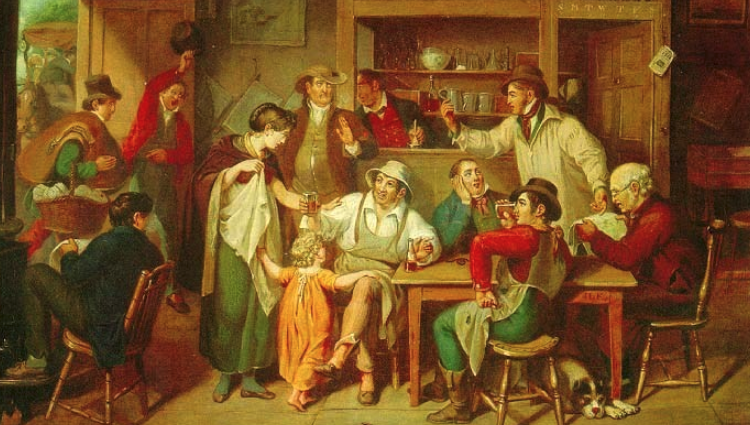
We like to think of the leaders of the American Revolution and the Framers of the Constitution as a sober lot. But 18th-century Americans liked to drink, and alcohol played an important role in the momentous political events of the age. What care I how time advances? I am drinking ale today. ― Edgar Allan [...]

Teaching in an Age of Ideology: John H. Hallowell

By |2019-11-08T16:01:28-06:00March 23rd, 2013|Categories: Education, Ideology, Liberal Learning|Tags: , |

In my last essay I wrote about Gerhart Niemeyer who sought to avoid indoctrinating his students in order for them to pursue the true, the beautiful, and the good. In this post I want to do the same thing but look at one of Niemeyer’s students, John H. Hallowell, as a teacher. Spending almost forty [...]

A Friend Closer Than a Brother

By |2014-01-30T17:23:44-06:00March 22nd, 2013|Categories: Culture|Tags: , |

A man of many companions may come to ruin, but there is a friend who sticks closer than a brother. –Proverbs 18:24 It is being reported that select schools in the UK are now forbidding students to have best friends in favor of group play. The primary reason cited for the policy is the potential pain [...]

The Demise of Congressional Deliberation: Willmoore Kendall

By |2022-03-07T16:08:01-06:00March 22nd, 2013|Categories: Congress, Federalist Papers, Politics, Presidency, Willmoore Kendall|Tags: , |

The one teaching of Willmoore Kendall's toward which all his early thought tended and from which radiated all his later thought was this: America's vindication of the capacity of men for self-government rests upon its devotion to the idea of a virtuous people, under God, determining national policy by the deliberations of a supreme legislature [...]

The Classics and the Traditional Liberal Arts Curriculum

By |2019-08-08T14:44:32-05:00March 21st, 2013|Categories: Christian Kopff, Classical Education, Classical Learning, Classics, Education, Featured, Liberal Learning|Tags: , |

Before I started writing this essay, I went to University of Colorado library and took out one of the best books in English on education, Albert Jay Nock’s Theory of Education in the United States (1932). It is significant for our topic that, while Nock‘s irritable tirade, Our Enemy, the State, is easily available in [...]

Aleksandr Solzhenitsyn: The Courage to be Christian

By |2020-12-10T15:27:09-06:00March 21st, 2013|Categories: Aleksandr Solzhenitsyn, Christianity, Featured, Joseph Pearce|

In these dark days in which the power of secular fundamentalism appears to be on the rise and in which religious freedom seems to be imperiled, it is easy for Christians to become despondent. The clouds of radical relativism seem to obscure the light of objective truth and it can be difficult to discern any [...]

Begin Here: Civility or Equality?

By |2014-01-16T12:59:47-06:00March 20th, 2013|Categories: Civil Society, Culture, Equality|Tags: |

“The thing that is in danger is the whole structure of society, and it is necessary to persuade thinking men and women of the vital and intimate connection between the structure of society and the theological doctrines of Christianity.”–Dorothy L. Sayers, “Creed or Chaos?” “But what is a practical joke in a world of nonsense, [...]

Faith and the Employer

By |2014-12-30T14:20:48-06:00March 20th, 2013|Categories: Bruce Frohnen, Christianity, Culture|

The diocese of Lansing, where I currently attend mass, is a pretty good one, as such things go in the contemporary United States. Our parish has a very good priest and I am confident we will not soon be joining in on the practice I have seen in the archdiocese of Detroit of worshipping in the [...]

And Now For Something Completely Different

By |2016-08-03T10:37:13-05:00March 19th, 2013|Categories: Christendom, Culture, Faith, Religion, Stephen Masty|Tags: |

The headline was a catch-phrase for Monty Python, a madcap 1970s British comedy troupe that might well have written the BBC’s news coverage of Pope Francis, but the hilarity was unintentional. (Americans who are spared from watching BBC news broadcasts may now offer up prayers of thanksgiving). The comedy started with a tweet from a [...]

Go to Top