Josef Pieper on Academia & the Abuse of Language

By |2024-05-03T10:42:00-05:00July 31st, 2017|Categories: Civil Society, Conservatism, Culture, Josef Pieper, Language, Liberal Arts, Liberal Learning, Modernity, Plato, St. John Henry Newman|

Education in the liberal arts is an ancient tradition that has slowly been eroded through our increasing attachment to approaching the world scientifically and pragmatically. The language of man reveals something significant about his nature and his relationship with the world. Language is so close to man’s nature that if it suffers a drastic change, [...]

Socrates Rises With Christ

By |2023-11-29T19:02:17-06:00July 29th, 2017|Categories: Christian Humanism, Christianity, Fr. James Schall, Justice, Plato, Reason|

The completion of Plato lies in the resurrection, in the reality that sees not just the immortality of the soul but the acting person as the source of all reason. Is there any way to bring political philosophy and revelation, Athens and Jerusalem, into a coherent, non-contradictory relation to each other without undermining the integrity [...]

Making and Revealing

By |2019-10-10T11:51:43-05:00July 28th, 2017|Categories: Catholicism, Christianity, Flannery O'Connor, Glenn Arbery, Hope, Literature, Plato, Poetry, Senior Contributors, Sophocles, Wyoming Catholic College|

Making art is a mode of revealing the world in new ways… For the past two weeks, I’ve been writing about the opportunity to make a new Catholic culture, not from scratch and not from attempts to appropriate whatever happens to be popular at the moment, but from the immense resources available in the tradition [...]

On the Mystery of Teachers I Never Met

By |2021-04-28T14:37:02-05:00July 21st, 2017|Categories: Aristotle, Christian Humanism, Education, Fr. James Schall, Great Books, Hilaire Belloc, Literature, Philosophy, Plato, St. Augustine, Tradition, Truth|

The mystery is how one person whom I never met, through recountings down the ages of how many others whom I also have never met, could shed light on each other, eventually to enlighten me. In The Apology, Socrates brought up the question of whether he was paid for being a teacher, like the Sophists, who were paid [...]

Jacob Klein: A Great Scholar, An Even Greater Man

By |2023-05-21T11:30:32-05:00July 15th, 2017|Categories: E.B., Eva Brann, Jacob Klein, Meno, Senior Contributors, St. John's College|

Jacob Klein was, first and last, every inch a teacher, a teacher who stymied discipleship in the very effort to induce learning. He did, indeed, have some teachings to convey—a few, though those were powerful and of large consequence. Editor’s Note: This essay was read as a tribute to philosopher and long-time tutor of St. [...]

In Pursuit of Truth and Beauty: The Fullness of Cultural Renewal

By |2021-05-27T16:20:39-05:00June 7th, 2017|Categories: Beauty, Culture, Philosophy, Plato, Rhetoric, Russell Kirk|

Cultural decadence is all around us, and there is a siren call to submission. But such submission is not worthy of a free people, and we must respond with wonder and beauty, truth and goodness, philosophy and rhetoric. For those of us convinced that ours is a moment of profound decadence, it quite naturally occurs [...]

On Debate and Existence

By |2019-04-04T11:22:41-05:00May 18th, 2017|Categories: Eric Voegelin, Ideology, Philosophy, Plato, Politics, St. Augustine, St. Thomas Aquinas|Tags: |

The speculations of classic and scholastic metaphysics are edifices of reason erected on the experiential basis of existence in truth. We cannot withdraw into these edifices and let the world go by, for in that case we would be remiss in our duty of “debate”… In our capacity as political scientists, historians, or philosophers we [...]

Depth Versus Complexity

By |2023-05-21T11:30:33-05:00April 24th, 2017|Categories: Aristotle, E.B., Eva Brann, Great Books, Philosophy, Plato, Senior Contributors, St. John's College|

Entertaining questions requires wisdom, a considering, reflecting frame of a mind still resonating with past experience but now focused by desirous expectation. Otherwise put: Questions are a mode of blessed ignorance, a thorough apprehension of our own cognitive limitations which clears our minds of mere opinions and, while it prevents us from reaching for personal [...]

The Tyrant’s Unexamined Soul

By |2023-04-14T11:22:17-05:00April 8th, 2017|Categories: Featured, Fr. James Schall, Plato, Socrates, Tyranny|

Tyrants—intelligent, charming men as they usually are—rush into politics without first examining their souls. Politics without wisdom is not politics. A recurring theme in Plato’s dialogues, including his Seventh Letter, describes the education of a young man who wants to achieve the highest things, which he considers to be achieved primarily through his ruling the [...]

Tyranny in American Political Discourse

By |2021-04-14T06:52:31-05:00April 2nd, 2017|Categories: Alexis de Tocqueville, American Republic, Aristotle, Democracy in America, Featured, Plato, Russell Kirk, Timeless Essays|

There is a strong case to be made that the United States is creeping ever closer to tyranny. For if the rule of law is undermined, political rule will then be, by definition, tyrannical. The word “tyranny” has a long history in American political discourse. Since at least the American Revolution, Americans have used the [...]

Plato’s “Symposium”: Beguiling Eros

By |2023-05-21T11:30:34-05:00March 30th, 2017|Categories: E.B., Eva Brann, Featured, Great Books, Love, Peter Kalkavage, Plato, Senior Contributors, St. John's College|

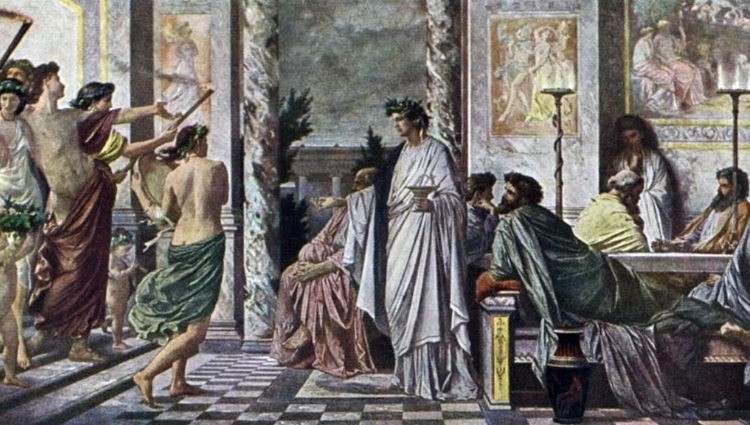
The vivid love-speeches of the Symposium come to us, reach us, through several layers of incomplete remembrance, and as though from a mythic past. Symposium (or Drinking Party) by Plato, translated and edited by Eva Brann, Peter Kalkavage, and Eric Salem (Hackett, 2017) Why hast thou nothing in thy face? Thou idol of the human [...]

The “Utopia” of Thomas More: A Contemporary Battleground

By |2023-07-06T00:21:41-05:00March 9th, 2017|Categories: Catholicism, Cicero, Literature, Philosophy, Plato, St. Augustine, St. Thomas More|

By thinking through the limits and possibilities of political life, as presented in “Utopia,” the careful reader imitates Cicero and Thomas More by preparing for politics through the careful study of great literature. “The struggle is not merely over an iso­lated work of genius but over a whole culture”—so says Stephen Greenblatt about Thomas More’s [...]

On Profound Ignorance

By |2023-05-21T11:30:37-05:00February 13th, 2017|Categories: Books, E.B., Eva Brann, Featured, Philosophy, Plato, Senior Contributors, Socrates, St. John's College|

Is “the knowing of what one knows and what one does not know that one does not know” ever possible? And what is the benefit of that knowledge? Profound Ignorance: Plato’s Charmides and the Saving of Wisdom by David Lawrence Levine (Lexington Books, 2016) Plato’s Charmides is not one of the more famous dialogues or [...]

Go to Top