The Un-Burkean Economic Policy of Edmund Burke

By |2019-06-17T10:55:49-05:00June 16th, 2019|Categories: Adam Smith, Economics, Edmund Burke, Ralph Ancil, Wilhelm Roepke|

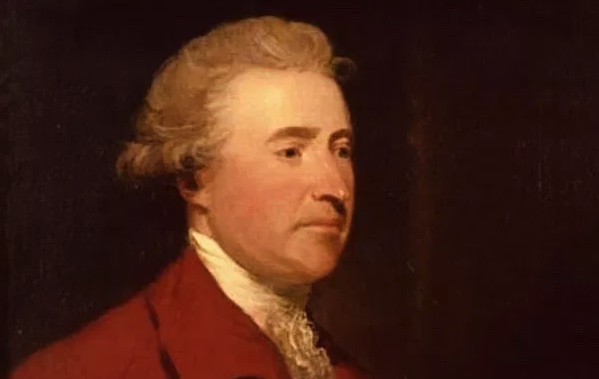
Edmund Burke allowed his fear of the French Revolution to cloud his judgment of a fitting response to the needs of agricultural workers. He was blind to the dangers of monopoly and concentration of economic power, to the possible ways of intervening that conform to the character of a market economy. “The mistakes which have [...]
Measuring the Influence of Russell Kirk & Other Conservative Authors

By |2021-08-01T17:26:59-05:00May 12th, 2019|Categories: Christopher Dawson, Conservatism, Culture, Eric Voegelin, Irving Babbitt, Robert Nisbet, Russell Kirk|

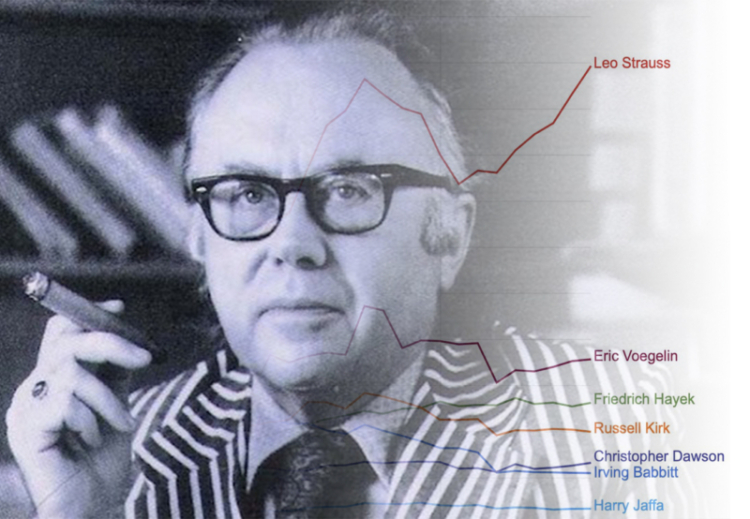
By using Google’s Ngram Viewer, we find that Russell Kirk’s reputation hit its highpoint in 1964, and then began a painful decline that remained unabated until his death in 1994. What does Ngram tell us about other conservative authors, like Robert Nisbet, Leo Strauss, Eric Voegelin, and Christopher Dawson? While I would never consider myself [...]

A Letter to the Seniors

By |2019-05-07T21:33:50-05:00May 7th, 2019|Categories: Character, Culture, Glenn Arbery, Senior Contributors, T.S. Eliot, Tradition, Virtue, Wyoming Catholic College|

T.S. Eliot reaches into the unsaid, perhaps even into the ultimately unsayable, in a way that makes new possibilities present for those of his own time. Eliot comes out of the great tradition, the long conversation of the West, which is now your own earned inheritance as well. What will you do with it? Early [...]

Eliot and Irons

By |2019-12-10T11:51:26-06:00March 15th, 2019|Categories: Culture, Dwight Longenecker, Imagination, Literature, Poetry, T.S. Eliot|

Hearing T.S. Eliot's poems read brings us back to the haunting beauty of the words themselves, and hearing the words unlocks Eliot’s powerful imagery, just as he would have wanted. Jeremy Irons' classic rendition empowers this strange transaction, and through the words we are taken beyond the words to the realm of the Word. Those [...]

Christopher Dawson and Time

By |2021-10-11T12:36:02-05:00February 4th, 2019|Categories: Bradley J. Birzer, Christianity, Christopher Dawson, Christopher Dawson Series by Bradley Birzer, History, Senior Contributors, Time|

Christopher Dawson believed that history, far from being cyclical, was instead a particular manifestation of God’s will, and thus was “moving towards a great consummation, the revelation of the power and glory of Yahweh through his servant Israel”… As noted in previous essays in this series, Christopher Dawson (1889-1970), one of the greatest of the [...]

Christopher Dawson and the Nature of Progress

By |2019-02-04T22:38:27-06:00January 28th, 2019|Categories: Bradley J. Birzer, Christian Humanism, Christopher Dawson, Christopher Dawson Series by Bradley Birzer, Heaven, History, Progressivism, Senior Contributors|

An understanding of progress and its adherents was not just of academic curiosity to Christopher Dawson. It was central to understanding the good life and preventing those who misunderstood history from gaining control and imposing the will of man upon the creation of God… “What has happened will happen again, and what has been done [...]

Being Christopher Dawson’s Friend

By |2019-11-14T12:57:04-06:00January 16th, 2019|Categories: Bradley J. Birzer, Christian Humanism, Christopher Dawson, Christopher Dawson Series by Bradley Birzer, Senior Contributors|

Despite all Christopher Dawson’s quirks and social fears, friends flocked to him; together, they read poetry, discussed philosophy, farmed, and made crafts. Would there have been a European renaissance of Christian Humanism without this friendship centered around “Tiger Dawson”? Almost certainly not… Though he might very well have been the most important Christian Humanist intellectual of [...]

T.S. Eliot’s “The Fire Sermon”: Of Memory & Salvation

By |2019-08-08T11:17:24-05:00January 13th, 2019|Categories: Conservatism, Great Books, Modernity, Poetry, T.S. Eliot, Timeless Essays|

T.S. Eliot reminds us that the answers to our soul’s depravity are all around us, in our collective culture—the books we read, the places we inhabit, the music we listen to—but also that culture can only survive if we remember it and keep it alive... Today’s offering in our Timeless Essay series affords our readers [...]

T.S. Eliot’s Magical Journey

By |2022-01-06T12:31:18-06:00January 5th, 2019|Categories: Books, Character, Christianity, Dwight Longenecker, Literature, Poetry, Senior Contributors, T.S. Eliot|

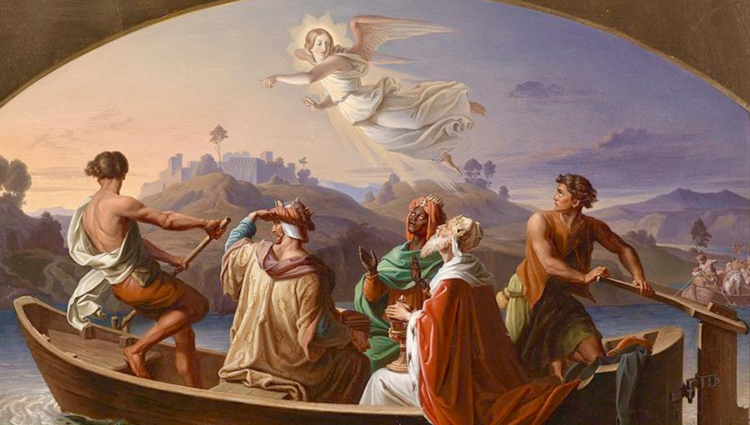
Through T.S. Eliot’s use of symbolism in “The Journey of the Magi” there is a call to a world beyond words—just as the mystics of historic Christianity beckoned to Eliot from the beginning of his journey. In the summer of 1927, just after his baptism into the (Anglo) Catholic faith, T.S. Eliot wrote “The Journey [...]

Edmund Burke on Revolutionary Armies and Taxes

By |2020-09-01T15:25:15-05:00December 13th, 2018|Categories: Bradley J. Birzer, Civil Society, Conservation, Edmund Burke, Edmund Burke series by Bradley Birzer, Revolution, Taxes|

No government has ever made itself permanently wealthy through the plunder of its people—which destroys not just the productive capacity of a country but also its moral foundations. Though a classic in its own right, and arguably the first book on conservatism in the modern world, Edmund Burke’s Reflections on the Revolution in France of 1790 is [...]

Edmund Burke and the Calculation of Man

By |2020-07-08T16:45:48-05:00December 7th, 2018|Categories: American Republic, Bradley J. Birzer, Civil Society, Community, Conservatism, Edmund Burke, Edmund Burke series by Bradley Birzer, Politics|

As Edmund Burke began to wind down his very long letter—that which would become 1790’s Reflections on the Revolution in France—he returned to the question of first principles and right reason, especially in regard to the nature of the human person. At his best and most natural, Burke argued, men understood themselves as spirited and [...]

Leo Strauss vs. Edmund Burke

By |2019-07-30T15:56:42-05:00December 3rd, 2018|Categories: Books, Edmund Burke, History, Leo Strauss, Nature, Philosophy, Political Philosophy, Reason, Truth|

What ought to take primacy when carrying out research and interpreting seminal books: the text itself, or the context? A known critic of historicism and contextualism, Leo Strauss published his seminal essay, ‘What is Political Philosophy?’ in 1957 in the Journal of Politics and introduced a problem with the field: Modern academic obsessions over positivism [...]

Understanding Voegelin’s Critique of Locke

By |2019-11-21T19:44:32-06:00November 30th, 2018|Categories: American Republic, Books, Democracy, Eric Voegelin, John Locke, Philosophy, Political Philosophy|

No matter how conservative intellectuals try, they just do not seem able to escape John Locke. Jonah Goldberg’s well-received Suicide of the West proudly called America’s Declaration of Independence “echoes of” the great English Enlightenment philosopher John Locke, saying U.S. history was “more Locke than anything Locke imagined.”  He inspired “a government but not a state”: a government with power [...]

Firing the Imagination: The Legacy of Russell Kirk

By |2022-04-28T16:32:55-05:00October 19th, 2018|Categories: Conservatism, Prospects for Conservatives, Russell Kirk, The Imaginative Conservative, W. Winston Elliott III|

Russell Kirk offers us a rich legacy in words and deeds. If we heed them we may yet play our part in preserving our Republic’s ordered liberty. The thought of Dr. Russell Kirk has inspired many people and many projects, including the journal that you are now reading. Founded by Dr. Bradley Birzer and myself [...]

Go to Top